

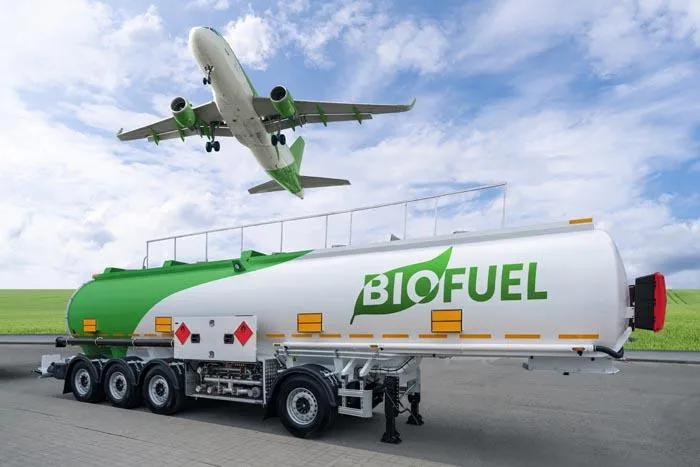
South Africa has long identified the need to diversify the sugar industry beyond traditional markets. The Sugarcane Value Chain Master Plan explicitly positions biofuels, including SAF derived from sugarcane ethanol, as a central pillar of long-term sustainability.
Image: Supplied
By Dr. Thomas Funke
South Africa’s aviation sector is experiencing another cost crisis as a result of the fact that the country does not control the fundamentals of its own jet fuel supply.
This reflects a domestic gap - the failure to convert existing agricultural capacity into strategic energy supply. Sugarcane, long recognised as a viable feedstock for biofuels, offers a direct pathway into sustainable aviation fuel (SAF) production. Had that pathway been developed with urgency, a portion of today’s aviation fuel demand could already have been met locally, softening the impact of the current volatility in global oil supply.
Instead, years of delayed implementation have left that potential largely unrealised. The country remains dependent on imported, dollar-priced fuel at precisely the point when global markets are tightening and costs rising.
In recent weeks, airlines have raised concerns about both the price and reliability of Jet A-1 supply, with prices surging from around R8.50 per litre in February to above R30 per litre by April. This reflects tightening regional supply and broader global volatility linked to the war in the Middle East.
While Airports Company South Africa (Acsa) has indicated that current stocks remain sufficient, airlines are seeking clarity on reserves and allocation, signalling growing uncertainty and exposure to external shocks.
South Africa has long identified the need to diversify the sugar industry beyond traditional markets. The Sugarcane Value Chain Master Plan explicitly positions biofuels, including SAF derived from sugarcane ethanol, as a central pillar of long-term sustainability.
The scale is important as industry research indicates that surplus sugarcane could support the production of approximately 700 million litres of ethanol annually, which could in turn yield around 400 million litres of sustainable aviation fuel. This would not replace total jet fuel demand, but it would establish a meaningful domestic supply base, introduce competition into the fuel mix, and create a degree of resilience that does not currently exist.
More importantly, it would change the country’s strategic posture.
At present, South Africa imports a significant share of its refined fuel requirements, while domestic refining capacity has declined and logistics constraints persist. Jet fuel pricing remains anchored in global benchmarks like markets and crude oil, with exchange rate movements transmitting volatility almost directly into local costs. When the rand weakens or global supply tightens, the impact is immediate.
Sustainable aviation fuel offers a practical way to rebalance that exposure. Sustainable aviation fuel can be blended with conventional jet fuel and used within existing aircraft and infrastructure, delivering lifecycle emissions reductions of up to 80% while supporting domestic production.
Globally, sustainable aviation fuel is moving from pilot phase to scale. The International Air Transport Association estimates it will account for approximately 65% of the emissions reductions required for aviation to reach net zero by 2050, implying production volumes of more than 400 billion litres per year by mid-century.
Countries that move early are positioning themselves not only for energy security, but for participation in a rapidly expanding industrial market. While Sasol’s move to position Natref Refinery as a producer of certified sustainable aviation fuel and renewable diesel, with early volumes already coming to market and longer-term ambitions to scale output significantly, is a welcome development, it follows years of constrained refining capacity and delayed policy execution and does little to mitigate South Africa’s immediate exposure to imported jet fuel volatility.
Biofuels strategies have existed for more than a decade, and the Sugarcane Value Chain Master Plan has reaffirmed them. Yet regulatory frameworks remain incomplete, investment signals inconsistent and project development slow, hence South Africa being unprepared for the current fuel crisis.
Aviation is one of the few sectors where there is no viable near-term alternative to liquid fuels.
This is where sugarcane-derived SAF becomes more than an environmental ambition but also an economic and strategic necessity.
For the sugar industry, the implications are equally significant. The sector supports more than one million livelihoods, including around 27,000 small-scale growers, yet it remains under sustained pressure from low-cost imports, the threat of the Health Promotion levy (sugar tax) and climate change. Diversification is the answer to long-term viability.
Sugarcane feedstock biofuels provide a commercially grounded pathway to that diversification, linking agriculture, energy and industrial development in a way that strengthens all three.
The current jet fuel pressure should therefore be read as a policy signal to the South African government to prioritise and invest in the diversification of the sugar industry.
South Africa cannot control global oil prices, exchange rate movements or geopolitical disruptions. But it can reduce its exposure to them by converting domestic agricultural capacity into strategic energy supply and positioning itself within a global sustainable aviation fuels market so that it does not miss out in the future.

Dr. Thomas Funke is the CEO of SA Canegrowers.
Image: Supplied
* Dr. Thomas Funke is the CEO of SA Canegrowers.
** The views expressed do not necessarily reflect the views of IOL or Independent Media.
BUSINESS REPORT