

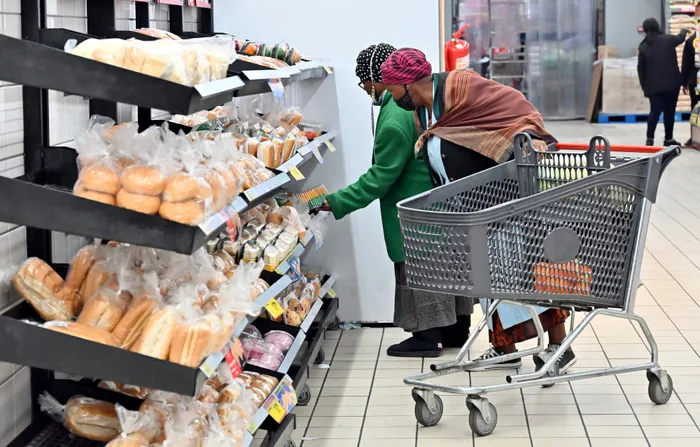
Rising fuel prices have begun to push food costs higher in South Africa, raising concerns over food security and national stability as households struggle to absorb these financial shocks.
Image: Ayanda Ndamane/ Independent Newspapers.
The latest data from the Pietermaritzburg Economic Justice and Dignity Group (PMBEJD) on the household food basket has shown the early effects of rising fuel prices on consumers.
The April 2026 Household Affordability Index revealed that despite a general easing in food price inflation over the past several months, the latest figures reveal a significant month-on-month increase.
The April Household Food Basket rose by R123.56 (2.3%), bringing the total cost to R5,452.09.
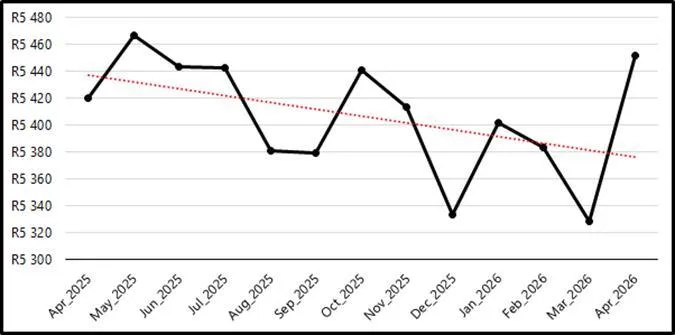
PMBEJD’s April Household Food Basket increased by R123,56 (2,3%) month-on-month to R5 452,09.
Image: Supplied.
Mervyn Abrahams, Programme Coordinator at PMBEJD said that historically, the increase from March to April typically ranges from 1.1% to 1.7%, suggesting that the new rise is indicative of an early response to the escalating fuel prices linked to geopolitical tensions, particularly the ongoing conflict involving the USA, Israel, and Iran.
The South African economy is highly sensitive to fuel and energy price fluctuations.
"With around 70-80% of fuels imported, and diesel accounting for a significant portion of this, the pressure is mounting on consumers. Currently, only two of South Africa's once six crude oil refineries are operational, creating a precarious reliance on external markets. This scenario raises questions about stability, particularly as diesel prices at the pump are not regulated, leading to unpredictability for consumers and businesses alike." Abrahams said.
According to Neil Roets, CEO of Debt Rescue, South Africans have valiantly attempted to weather the storm of escalating costs over the past five years. However, “their wells have all but run dry,” he said.
Roodt said, “South Africa could be heading for a sharp rise in inflation as fuel prices climb, with diesel prices set to go up even higher in May."
The Affordability Index further revealed that South African households only buy food as needed, typically referred to as "just-in-time" purchasing.
"With high unemployment rates and insufficient social security measures, most families are unable to absorb such price increases, potentially leading to a severe food security crisis. This situation echoes the unrest witnessed in July 2021, implying a looming threat not only to food security but also to national stability," Abrahams added.
As per the latest Household Affordability Index, there was an overall increase in costs for most items.
Notably, 30 of the foods surveyed in April experienced price rises, with yellow-fleshed maize meal, frozen chicken portions, and rice seeing significant spikes. In stark contrast, only a few items noted any price decrease, underscoring the widespread nature of this inflationary trend.
Analysis showed that for many low-income households, there continues to be a disconnect between current expenditure and nutritional needs.
Foods in the basket which increased in price in April 2026 by 5% or more, include:
Foods in the basket which increased in price in April 2026 by 2% or more, include:
Foods in the basket which decreased in price in April 2026, by 5% or more was just oranges (-8%).
Foods in the basket which decreased in price in April 2026, by 2% or more, include:
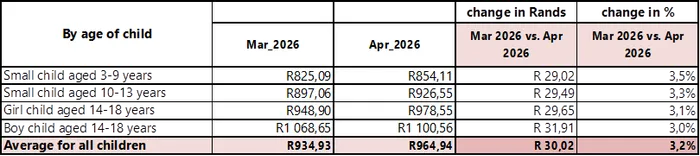
Average cost of feeding children of different ages a basic nutritional monthly diet (April 2026).
Image: Supplied.
April's findings reveal that the average cost per person for adequate nutrition exceeds available monthly incomes for families reliant on minimum wage jobs, pushing many into deeper financial strain.
Particularly disconcerting is the Child Support Grant, which has only increased by R20 to R580 per month.
"This hike falls drastically short compared to the R964.94 needed to adequately feed a child on a nutritional diet. As such, parents and caregivers are left grappling with the insurmountable gap while trying to meet their primary obligation of providing food for their children," Abrahams stated.
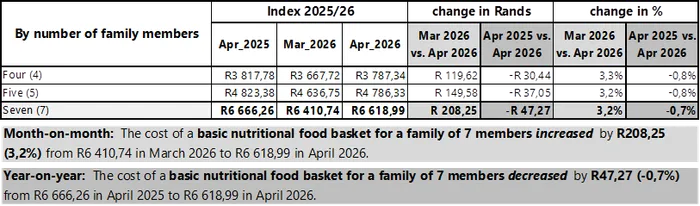
April 2026: The Basic Nutritional Food Index: household sizes.
Image: Supplied.
As the nation navigates these treacherous economic waters, experts call for a continued watch on price behaviours and encouragement of government intervention, such as extending temporary relief on fuel levies to mitigate costs for families.
The complexities underlying food pricing must be addressed to avert a burgeoning crisis that could threaten not just individual households but national security as well.
Follow Business Report on Facebook, X and on LinkedIn for the latest Business and tech news.