

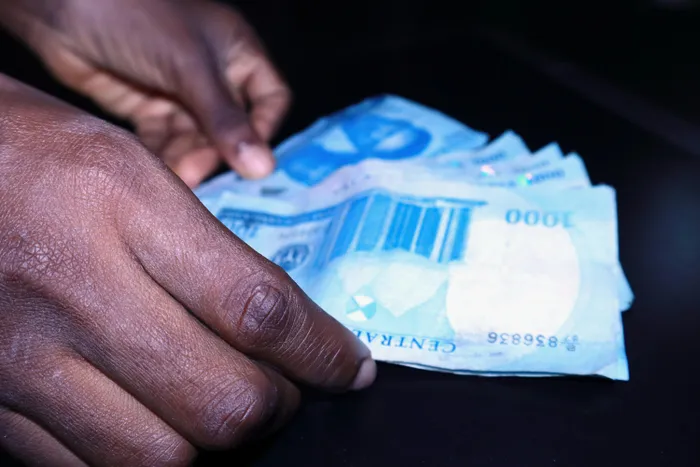
The naira lost significant ground against the dollar through much of 2023, creating real-time headaches for remittance platforms — and for the Nigerian families depending on money sent from abroad.
Image: Sunday Abegunde on Unsplash
There's a critique doing the rounds in African tech circles that I find myself both sympathetic to and mildly exasperated by: that there's no original innovation happening on the continent… especially in fintech.
Our appetite for the novel and the whizzy has a way of crowding out curiosity about the craft that actually holds things together.
I’d hazard that most of the work Oluwatosin Adelaja has done across his career wouldn't make headlines.
He's a software developer, UK-based, originally from Nigeria, with nearly a decade spent building things people depend on.
Think international remittance platforms, B2B payment systems, and workforce tools for the UK’s National Health Service (NHS).
What follows is a first-person account of a specific and decidedly unglamorous problem he lived inside as lead frontend engineer on a Nigeria-facing remittance platform in 2023.
I hope it goes some way towards rectifying our tendency to overlook this kind of work.
Oluwatosin Adelaja’s insights, in his words:
The Slack message came in at 11:47 PM Lagos time: "Why did my mom receive less than I sent?"
I was three months into building the sender app for a US-UK-Canada to Nigeria remittance platform processing hundreds of thousands of dollars monthly across 5,000+ active users. As the lead frontend engineer, I was the bridge between what users expected and what the underlying financial infrastructure could actually deliver.
The user had sent $500. Started the transaction when our app showed ₦750 per dollar. Expected his mom to get ₦375,000. She got ₦367,500.
He was furious. We were 'scamming' him. But here's what actually happened in those 15 minutes between when he hit "Send" and when his mom checked her account: the naira dropped from ₦750 to ₦735 per dollar.
It was August 2023. The Nigerian currency was in free fall. Every builder serving African markets faces the same gap between what users expect (instant, perfect, free), and what infrastructure can actually deliver. How you handle that gap determines whether you build trust or breed suspicion.
A remittance transaction isn't instant. Even the "instant" ones.
User opens app. Sees exchange rate. Confirms. Enters 2FA. Waits for bank authorisation. Money moves to the payment processor. The processor batches it. Nigerian bank receives it. Processes it. The recipient gets notification.
On a good day: 15 minutes. On a Friday evening when Nigerian banks are slow: 45 minutes. And in those 15 to 45 minutes in 2023, the naira could move 2%. Sometimes 5%. Once, in June, it moved 8% in an hour.
Which rate do you show the user? The rate when they started? When we received their money? When the Nigerian bank processed it?
Every remittance company solves this the same way: we add a buffer. If the real rate is ₦750, we show ₦735. If the rate drops to ₦730 by completion, we keep the difference. If it goes up to ₦755, we eat the loss.
Our competitors showed ₦750. Advertised "zero fees." It looked cheaper. When the rate moved, they'd say "the rate changed" and give users whatever the final rate was. Sometimes better, often worse. Users hated this more.
I watched it play out in support tickets. Users comparing our rate to Google. Google showed ₦750. We showed ₦735. They thought we were stealing ₦15 per dollar. What Google showed was the midpoint rate that no one actually gets — not even the banks.
We couldn't eliminate the 15-minute problem, but we could be honest about it. I designed a rate-locking system with a 10-minute guarantee window.
Lock in ₦735 for 10 minutes. Complete within that window, you're guaranteed that rate. Miss it, you get whatever the current rate is. I built a progressive notification system around it: gentle nudge at 7 minutes, urgent warning at 9, "Rate expires in 30 seconds" at 9:30.
Completion rates within the lock window went from 62% to 89%. Support tickets about "rate changes" dropped by 73%. User retention improved by 34%. Our competitors eventually adopted similar approaches, but in 2023 we were among the first platforms serving Nigeria to give users rate certainty with a visible countdown.
Users already know infrastructure is unreliable. They live with it daily. What they don't know is whether your app will be honest about it. The countdown timer was as much a UX pattern as it was a trust signal.
Mercifully, the naira is more stable now. Many of the systems I built (rate-locking windows, predictive routing, partial success handling for bulk payments) have become fairly standard across Nigerian fintechs. While the specifics applied to the Naija context in 2023, the underlying logic applies more broadly.
If you're building payments in Kenya during mobile money outages, or logistics in Egypt when fuel prices shift hourly, or agritech in Ghana where coverage is patchy, there are similar questions to answer. I’d ask, where is the gap between what you're promising and what your infrastructure can deliver? Are you hiding it or surfacing it?
Fintech app users across the continent have seen enough broken promises to know what’s what. They know mobile telcos go down.
They know banks go “offline” to do maintenance. They know forex rates fluctuate (sometimes wildly). What frustrates them isn't that these things happen, it's when the app pretends otherwise, then leaves them to figure out Plan B on their own.
The fintechs that stick around are usually the folks that decided to be straight with their customers from the start (or at least soon enough into their ‘partnership’ journeys with users).
Andile Masuku is co-founder and executive producer at African Tech Roundup. He serves as executive editor of Future in the Humanities (FITH), powered by the SA–UK Chair in the Digital Humanities at Wits University. Connect and engage with Andile on X (@MasukuAndile) and via LinkedIn.
Oluwatosin Adelaja is a software developer and frontend engineer based in the UK, with nearly a decade of experience building fintech and healthcare systems across Nigeria and the United Kingdom.

Andile Masuku is co-founder and executive producer at African Tech Roundup. He serves as executive editor of Future in the Humanities (FITH), powered by the SA–UK Chair in the Digital Humanities at Wits University. Connect and engage with Andile on X (@MasukuAndile) and via LinkedIn.
Image: Supplied.

Oluwatosin Adelaja is a software developer and frontend engineer based in the UK, with nearly a decade of experience building fintech and healthcare systems across Nigeria and the United Kingdom.
Image: Supplied.
Follow Business Report on Facebook, X and on LinkedIn for the latest Business and tech news.