

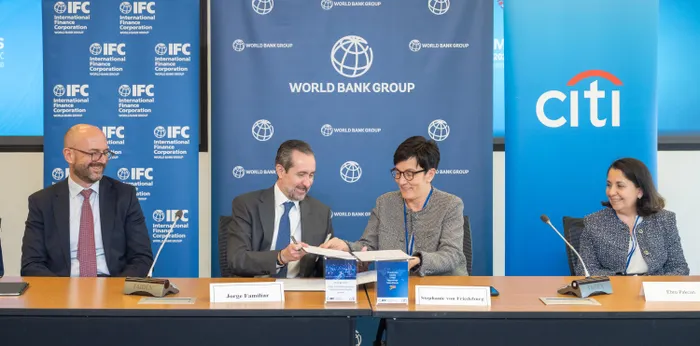
Announced in Washington, D.C. on Tuesday, the agreement forms part of the broader efforts by the World Bank Group to deepen financial systems in emerging markets by reducing reliance on foreign currency funding.
Image: Supplied
The International Finance Corporation (IFC) and Citigroup have signed a R1.6 billion borrowing facility aimed at expanding access to local currency financing in South Africa, marking a significant step toward strengthening the country’s capital markets and supporting private sector growth.
Announced in Washington, D.C. on Tuesday on the sidelines of the IMF/World Bank Annual Meetings, the agreement forms part of the broader efforts by the World Bank Group to deepen financial systems in emerging markets by reducing reliance on foreign currency funding.
As global economic uncertainty persists, initiatives like the IFC-Citi facility highlight the growing importance of partnerships that blend development objectives with private sector expertise — a model that could shape the future of finance in emerging markets.
The facility will enable IFC—a member of the World Bank Group—to increase its rand-denominated lending, helping businesses and financial institutions mitigate the risks associated with currency volatility.
The initiative has already played a catalytic role in supporting IFC’s anchor investment in a groundbreaking performance-based bond issued by FirstRand Bank.
The Cape Water bond is notable for being the first outcome-based bond issued by a commercial bank globally, signaling innovation in how development finance can be structured to achieve measurable social and environmental outcomes.
Jorge Familiar, vice president and treasurer of the World Bank Group, said the facility demonstrates the power of partnerships between development institutions and the private sector. He emphasized that local currency financing and capital market development remain central to the institution’s strategy in emerging economies.
“This facility is another example of what our partnerships with the private sector can deliver — from outcome bonds to local currency solutions — in support of long-term finance for development,” Familiar said.
The agreement also builds on an earlier transaction between IFC and Citi involving the Kenyan shilling, underscoring a scalable model that could be replicated across other emerging markets.
According to Stephanie von Friedeburg, global head of Citi’s public sector group, the South African rand facility represents an important addition to the toolkit available to development finance institutions.
“Following our Kenyan shilling transaction, this first South African rand facility reflects a model that can be replicated throughout emerging markets,” she said.
Currency volatility has long been a major constraint on private sector investment in developing economies, where borrowing in foreign currencies can expose businesses to exchange rate shocks.
By expanding local currency financing options, institutions like IFC aim to create more stable funding environments that encourage long-term investment.
The World Bank Group has made significant strides in this area over the past decade, with IFC committing more than $33 billion in local currency financing across 71 currencies.
These efforts are designed to deepen domestic capital markets, making them more liquid and accessible to a broader range of participants.
In South Africa, where capital markets are relatively advanced compared to many peers, the new facility is expected to unlock further innovation while reinforcing resilience against global financial fluctuations.
It also aligns with broader development goals, including infrastructure financing and climate-related investments, which increasingly rely on sustainable and locally denominated funding mechanisms.
BUSINESS REPORT