

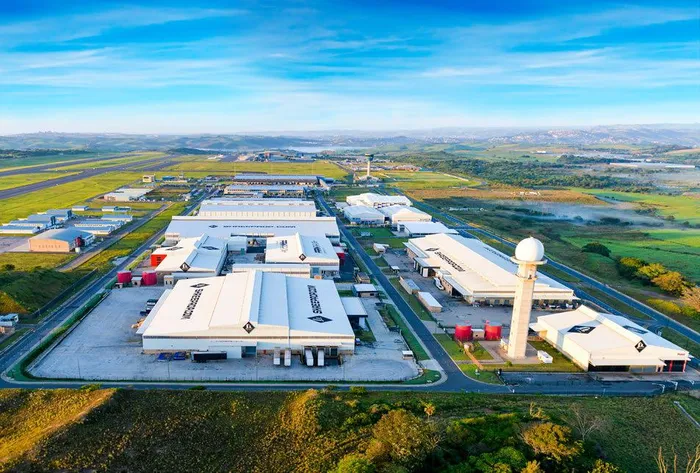
The TradeZones are designed to support manufacturing, assembly, warehousing and value-added processing.
Image: Supplied
The expansion of the Dube TradePort Special Economic Zone (SEZ) on KwaZulu-Natal’s north coast has opened up significant new opportunities for Indian investment, as New Delhi looks to deepen its footprint in one of South Africa’s most strategically positioned economic hubs.
As the country’s only SEZ integrating an international airport — King Shaka International Airport — with dedicated cargo facilities, Dube TradePort offers a compelling value proposition. Its logistics-driven model is ideally suited to manufacturing and export-oriented industries, supported by incentives such as a reduced corporate tax rate of 15%, building allowances, customs-controlled areas, and fully serviced industrial land.
The decision by Trade, Industry and Competition Minister, Parks Tau, to expand the SEZ’s boundaries follows sustained investor demand and consistently high occupancy levels. Since its designation in June 2017, Dube TradePort SEZ has emerged as one of South Africa’s most successful SEZ models, leveraging its airport-linked advantage to attract both local and international investors.
The approved expansion will add approximately 752 hectares to the SEZ footprint. This includes 56.4 hectares earmarked for Dube TradeZone 3, 690.3 hectares for TradeZones 4 and 5, and 5.4 hectares for Dube City. The additional capacity is expected to significantly boost industrial land availability for export-oriented manufacturing, while also enabling integrated commercial development.
The TradeZones are designed to support manufacturing, assembly, warehousing and value-added processing. In parallel, Dube City provides serviced commercial space for retail, business process outsourcing (BPO), research and development, and ICT operations — creating a hybrid industrial-services ecosystem that enhances the precinct’s competitiveness.
The SEZ has already established itself as a hub for advanced manufacturing, agro-processing, pharmaceuticals, ICT, logistics and business services. Indian firms have played a notable role in this growth. Mahindra South Africa, for example, operates a semi-knocked down (SKD) vehicle assembly plant within the precinct, reinforcing Dube TradePort’s position as a base for automotive assembly and regional distribution.
Similarly, Cipla Medpro - part of India’s Cipla Limited - has established pharmaceutical manufacturing operations within the SEZ, underscoring its attractiveness to healthcare and life sciences investors. These anchor investments not only bring capital into the region but also contribute to local industrial development through skills transfer and job creation.
While Indian businesses are keen to expand their presence, there are emerging concerns about the potential implications of the China-Africa Economic Partnership Agreement (CAEPA), signed in February. The agreement, which grants duty-free access for South African exports to China, could reshape regional and global trade flows, potentially affecting India’s relative positioning in sectors such as minerals, agro-products and intermediate goods.
Despite these concerns, the expansion of Dube TradePort SEZ remains strategically significant for India. Its airport-linked infrastructure is particularly well suited to high-value, time-sensitive exports — including pharmaceuticals, automotive components, electronics and perishables — aligning closely with India’s broader Africa export diversification strategy.
With its world-class cargo facilities, investor-friendly incentives and forward-looking leasehold models, Dube TradePort continues to strengthen its appeal as a gateway for international trade. For India, it represents not only a platform for expanded commercial engagement, but also an opportunity to deepen economic ties with South Africa in an increasingly competitive global trade environment.
* Fawzia Moodley is a freelance writer.
** The views expressed do not necessarily reflect the views of IOL or Independent Media.
BUSINESS REPORT