

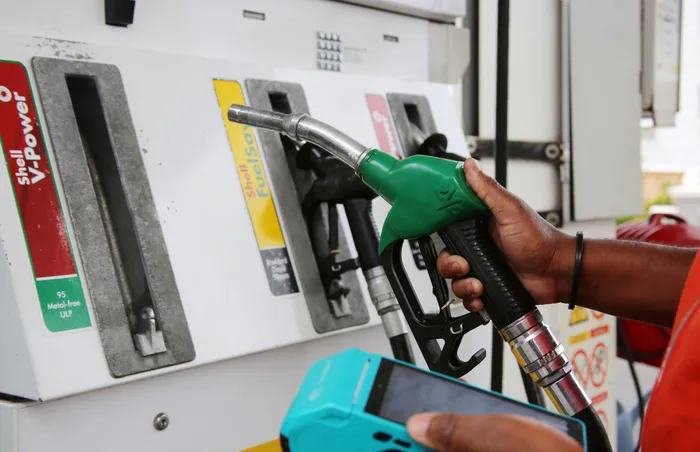
Last week’s fuel price hike of over R3 per litre for petrol and R7 for diesel directly impacts South African businesses, threatening supply chains and production lines. With further increases anticipated, early intervention is crucial to mitigate financial distress across key sectors.
Image: Tumi Pakkies / Independent Newspapers
For businesses, last week’s fuel price increase of over R3 per litre for petrol and R7 per litre for diesel, is a direct hit to operating costs, impacting supply chains, production lines and distribution networks.
In sectors such as agriculture, manufacturing, mining and logistics, where fuel is a core input rather than a discretionary expense, this is a hit which is difficult to absorb.
With more petrol price increases on the horizon, fuel costs can become a trigger for financial distress across key sectors, so early intervention is important to protect the business and preserve value.
South African businesses are well accustomed to operating under sustained pressure.
Loadshedding, elevated interest rates, civil unrest, constrained demand and margin compression have become embedded features of the commercial environment.
The ongoing crisis in the Middle East has sharply brought into focus the volatility of markets and where the increased price of oil is set to drive inflation to unprecedented levels worldwide.
A sharp increase in fuel price is not just an additional cost, it can act as an inflection point pushing a business from being under pressure, into financial distress.
Fuel is a uniquely systemic input. It underpins logistics, distribution, production and service delivery across most sectors of the economy. When fuel prices increase, businesses experience an immediate escalation in operating costs, often without the ability to respond in real time. Unlike many other cost drivers, fuel cannot be deferred or meaningfully reduced without operational consequence.
In our current financial environment, this is pivotal. Projected increases come at a time when many businesses are already operating with limited liquidity buffers. Fuel, in this context, does not create distress in isolation, it exposes underlying fragilities and accelerates them.
The impact is most acutely felt in working capital.
Even where fuel is procured through fleet cards, bulk supply arrangements or credit facilities, the cost is incurred immediately and settles over short cycles, typically within seven to thirty days.
The result is that while payment may not be instantaneous, the pressure on cash flow is both rapid and concentrated. At the same time, revenue (particularly in sectors with extended debtor terms) lags. This creates a familiar but critical dynamic: costs increase now, while recovery follows later, if at all.
It is at this point that the inflection occurs.
In practice, the early indicators are rarely dramatic, but they are consistent and ever creeping. Businesses begin to stretch creditor payment cycles, rely more heavily on overdrafts and short-term facilities, and experience mounting pressure on stock and inventory funding.
Liquidity tightens, often despite turnover remaining stable or only marginally reduced. These developments may not yet constitute formal insolvency, but they are frequently the precursors to it.
Certain sectors are particularly exposed.
Transport and logistics businesses experience a direct and immediate escalation in operating costs. Retail and manufacturing absorb the increase through supply chain and distribution channels, often without the ability to pass costs through in real time. Construction and mining operations face higher input costs across plant, fuel and contractor pricing.
Agriculture warrants particular attention.
Diesel is a critical input for planting, harvesting and irrigation, meaning that rising fuel costs effect on-farm operations and the broader agricultural value chain, including storage, transport and ultimately, food pricing.
In a sector already exposed to climate variability and input cost volatility, fuel increases can quickly shift marginal operations into distress.
From a restructuring and insolvency perspective, fuel is seldom identified as the primary cause of failure.
Formal proceedings typically refer to an inability to pay debts as they become due, breaches of funding arrangements or sustained creditor pressure. In reality, fuel price shocks often act as the catalyst, the event that removes the remaining margin for error in an already constrained business.
Importantly, this is not a question of long-term profitability. Businesses rarely fail because they are unviable over time; they fail because they run out of cash in the short term. This is a critical distinction
The practical implication is that businesses should not wait for distress to crystallise.
Those operating in fuel-sensitive sectors should be actively stress-testing cash flow assumptions, reassessing pricing and pass-through mechanisms, and engaging with funders and key creditors early on. In challenging trading conditions, businesses should act early by exploring options such as negotiating a compromise of debt, a reconfiguration of unwieldy overhead costs, negotiations with landlords for better terms.
When all of this has an impact on the ability to trade on a solvent basis, the timely intervention of a business rescue process, may preserve significantly more value than reactive intervention.
The difference between resilience and distress is often not strategy, but timing.
In the current environment, fuel price increases are accelerating that timeline.
Businesses experiencing pressure should engage early to assess liquidity and restructuring options. Once cash flow pressure switches into default, the range of available solutions narrows significantly.
*Dr Eric Levenstein is Director and Head of Insolvency & Business Rescue at Werksmans Attorneys and Amy Mackechnie is a Senior Associate at Werksmans Attorneys.

Dr Eric Levenstein.
Image: Supplied.

Amy Mackechnie is a Senior Associate at Werksmans Attorneys.
Image: Supplied.
Follow Business Report on Facebook, X and on LinkedIn for the latest Business and tech news.