

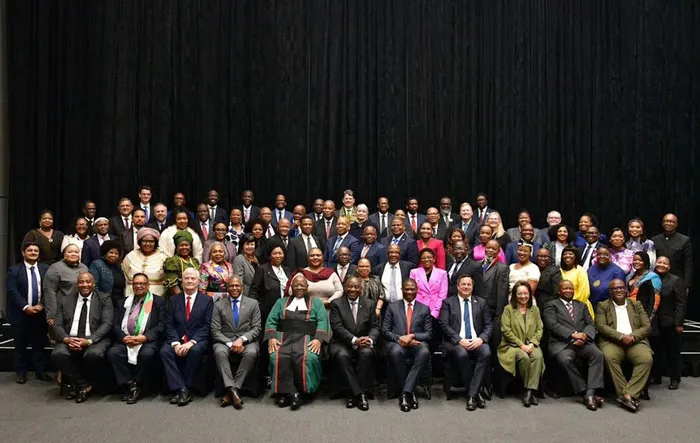
Members of the Eexecutive under the Government of National Unity (GNU). The BER report noted that under the Hadeda, the GNU holds, but coalition complexity and state incapacity limit its ability to deliver reforms.
Image: GCIS
A new report by the Bureau for Economic (BER) released this week has indicated a consensus that the fastest way to raise the economic growth rate is to accelerate the pace of economic reforms by the Government of National Unity (GNU).
The report by Prof Johan Fourie and Claire Bisseker said that this is one of the core messages from the Pick-A-Bird scenarios developed by the BER.
“The BER has modelled three scenarios – the Hadeda, where SA continues to muddle through; the Marabou Stork, where SA descends into a failed state; and the Fish Eagle where growth soars to 3% and 2.4m jobs are created by 2030.”
The report added that under the Hadeda, the GNU holds, but coalition complexity and state incapacity limit its ability to deliver reforms.
“Under the Fish Eagle, SA uses the current political window to deliver rapidly on its reform agenda. But under Marabou, the trigger for SA’s descent is a political realignment resulting in a more populist GNU that fails to back the existing reform agenda.”
A paper commissioned by the BER titled The Political Economy of Growth Coalitions indicated that it was not enough for the GNU to just hold together.
“It must generate sufficient policy coherence to reduce uncertainty, thereby catalysing a sustained private fixed investment upswing that leads to higher growth and employment,” it argued.
The paper examined the experiences of Chile (1986), Poland (1992), India (2002), Germany (2005) and Argentina (2003) to determine what political conditions enable sustained economic growth.
The three chief lessons from the paper were mainly that the deep crises open reform windows by lowering the political cost of policy reform.
“However, only credible political settlements that reduce policy uncertainty can translate these windows into sustained private investment and growth. Successful reformers start with high-visibility, broadly beneficial reforms (like building infrastructure),” it argued.
“They defer the most divisive changes (like labour market reform) until a growth dividend materialises, but do not defer the hard choices indefinitely. Reforms survive only when institutional anchoring makes reversal costly and the coalition maintains operational coherence around a focal programme.”
The BER report said that SA’s crisis is slow burning.
“This makes reform harder. It means the GNU must construct urgency by being honest about the cost of inaction; build credibility by achieving visible delivery milestones (like stabilising Joburg’s water crisis); protect existing institutions; and build coalition coherence around a shared policy programme and reform scorecard.”
The report added that we should be constantly asking: Are high-impact reforms being achieved? Is there a shared reform programme with clear deliverables, or are coalition members pursuing parallel agendas or being drawn into politically divisive battles?
The report said that the central message of the BER’s scenarios is that SA has only a short window to accelerate the pace of reform and make the GNU work better.
“What’s missing in SA right now is a credible, shared GNU policy agenda aligned to the national budget and tied to a detailed GNU scorecard (as opposed to just an Operation Vulindlela scorecard). The coalition is holding, for now, but the risks are growing, and SA shares far too many features with Path-B countries for comfort.”
BUSINESS REPORT