

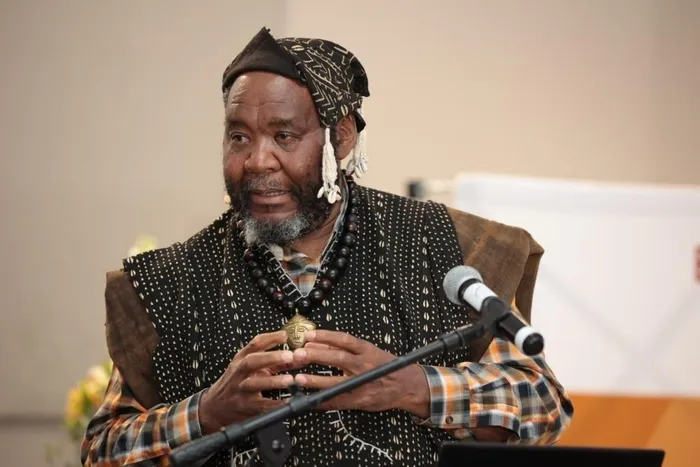
Dr Pali Lehohla is a Professor of Practice at the University of Johannesburg, a Research Associate at Oxford University, and a distinguished Alumni of the University of Ghana. He is the former Statistician-General of South Africa.
Image: Supplied
The Lehohla Ledger, a statistical journey in search of truth to inform continental development starts with young Thabang, a resident of Diepkloof, Soweto on Rustenburg Street.
He is thirteen years of age in 2026 and has set his eyes on how Agenda 2063 will favour his continent.
He uses the 1976 moment at fifty in 2026 as his spring board and has since never looked back.
The Lehohla Ledger answered that a nation cannot be led by "Administrative Dust" or the "Lesser Ledger" of unverified averages.
The story of the 2,752 instruments is the chronicle of a twenty-year forensic war against the Vulture Vortex of misinformation.
It is the radiology of a Republic, forged in the weekly discipline of 3,200 opinion pieces and columns, where the Numerical Conscience was finally codified into a weapon for the Successor Sage.
Thabang from Rustenburg Street in Diepkloof is a beneficiary of the integrative power of this torch and has to guide it to the United Nations Security Council where he ensures that by 2063 Africa has two seats in the Security Council.
The Genesis: The 3,200 Columns (2002–2022)
The instruments did not arrive as a single revelation. They were hammered out in the "Foundry" of a weekly deadline.
Between 2002 to date, I have been writing two columns per week across the Business Report, Sunday Times, and other platforms. As the Statistician-General and later the Founder of PIE I began to see the "Material Terminus" of the state.
Each column was an audit of a failing mesh.
Whether discussing the 1996, 2001, 2011, or 2022 Censuses, the Community Surveys or the quarterly Labour Force Surveys, my writing identified a recurring "Spatio-Temporal Collision." The 2,752 instruments are the distilled essence of those 3,200 interventions—a massive library of Valid Metadata condensed into a functional toolkit for Asset Rebirth.
The instruments are not mere spreadsheets; they are the Radiological Sensors of the state are in action as a Ledger. In their new electronic action and integrated action focus they conceal a yet to be written eight volume treatise of leather bound collected works.
In their active interventionist laser sharp diagnosis, they are categorized into Eight Volumes, each addressing a specific layer of the "Bucket."
The analysis deepened into other avenues and naturally the ledger expanded to electronically integrate the 2,752 instruments. The integration represented the Digital Convergence—the moment the metadata became "Live" and could be used for the 120-Minute Golden Window of service remediation.
The Ledger Said: "2,745 was the observation; 2,752 is the intervention." This provided the agility, intentional computational logic of intergenerational value, instantaneous ability and blockchain competence to within lightening speed deliver results with an auditable trail.
The story of these instruments culminates in the hands of Thabang. Armed with the 2,752 tools, the young Sage in Diepkloof no longer waits for a "Lesser Ledger" report to tell him his street is failing.
He uses Instrument 442 (Flow Analytics) to detect a leak before it becomes a sinkhole. He uses Instrument 1920 (Digital Certification) to prove his worth to the Nairobi Silicon Savannah. He uses Instrument 2700 (Sovereignty Shield) to ensure the energy from the Congo River powers his own "Foundry" in the West Rand.
The 2,752 instruments are the "Technical Hammer" of the African Century. They prove that poverty is not a mystery—it is a lack of Numerical Conscience.
They prove that the 161,000 households of indigents in Tshwane are not a burden, but the primary asset of the Successor Continent.
The story of the 2,752 is the story of Numerical Truth overcoming administrative silence. It is the legacy of the Lehohla Ledger, archived for the Sages who will finally build the Code 99 world.
Dr Pali Lehohla is a Professor of Practice at the University of Johannesburg, a Research Associate at Oxford University, and a distinguished Alumni of the University of Ghana. He is the former Statistician-General of South Africa.
Follow Business Report on Facebook, X and on LinkedIn for the latest Business and tech news.