

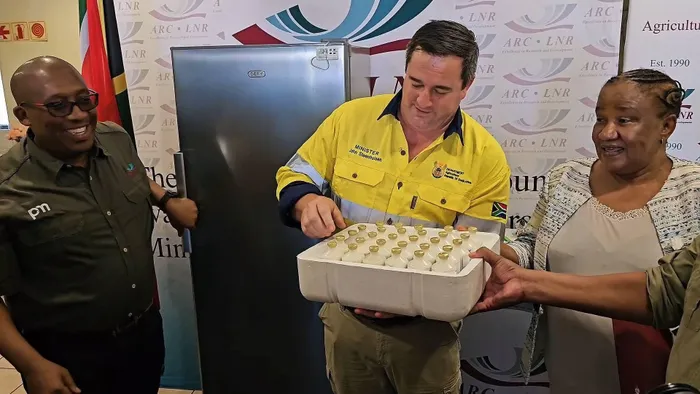
The Presidential Envoy on Agriculture and Land Reform met the Agricultural Research Council (ARC) CEO following last week's announcement of the release of 20,000 doses of locally produced Foot and Mouth Disease (FMD) vaccines by ARC.
Image: Supplied Department of Agriculture
South Africa’s efforts to combat Foot-and-Mouth Disease (FMD) have received a significant boost following the release of 20,000 doses of locally produced vaccines by the Agricultural Research Council (ARC), reinforcing the country’s biosecurity and agricultural resilience.
The milestone comes amid renewed collaboration between government, research institutions, and the private sector, with a strong emphasis on innovation as a driver of long-term agricultural growth.
Wandile Sihlobo, the Presidential Envoy on Agriculture and Land Reform, recently met with Dr Litha Magingxa, CEO of the ARC, to discuss the role of research in strengthening the sector.
Sihlobo emphasised that scientific research remains central to the performance and sustainability of agriculture, and that the ARC is key to advancing agricultural research and innovation in South Africa.
“The South African agricultural sector has thrived over the years thanks to scientific advancements by the ARC and the private sector. We have agreed with the CEO that these relations with the industry need to be harnessed and deepened where possible,” he said.
“We must ensure that the ARC is well supported so that it can effectively collaborate with the private sector, academia, and the agricultural community to continuously improve its service to the sector and respond effectively to new issues in biosecurity and climate change, among others.”
Sihlobo said together with the Department of Agriculture, they will continue to support the ARC’s efforts and ensure it responds effectively to the present-day challenges in the agricultural sector.
“Science or scientific advancements involve long-term investments that need to be seen in the context of what they are, not in the instant-based eyes wanting returns immediately or tomorrow," he said.
"I intend to meet with several institutions over the next two weeks or so to harvest their wealth of knowledge to guide my work as the Presidential Envoy.”
Last week, the ARC confirmed the release of 20,000 doses of locally produced FMD vaccine to support ongoing vaccination efforts and strengthen animal health across the country.
Magingxa said that by expanding their manufacturing capacity, the ARC provides farmers and veterinary services with timely access to the vaccines needed to safeguard animal health and food security across the country.
John Steenhuisen, the Minister of Agriculture, said that the restoration of production capacity at the ARC is well under way, with an additional investment in expanding the existing capacity over the medium term already afoot.
“Over time, this will progressively reduce reliance on imports and ensure sustainability of vaccine supply in line with the national disease management strategy,” he said.
“Vaccine availability is a crucial part of this strategy and we will do everything to make sure that there is enough vaccine to reach our target of 80% vaccination by year-end.”
During the release of the first 12,900 doses in February, the ARC set a target to produce 20,000 vaccine doses by the end of March as part of efforts to scale up local manufacturing capacity to meet national demand.
The department said the ARC will continue producing additional batches of approximately 20,000 doses of SAT 1, 2, or 3 weekly to support animal health and veterinary services.
"It should be noted that while the current programme is to continue producing 20,000 doses of the SAT 2 monovalent on a weekly basis, production will be adapted in line with prevailing circulating strains. In that regard, both vaccine composition and production timelines will be adjusted accordingly,” it said.
“Since the initial release of the 12,900 doses of ARC vaccine on 6 February 2026 and the importation of one million Biogénesis Bagó vaccines in Argentina and 1.5 million from Dollvet in Turkey, over 1.7 million animals have been vaccinated up to 26 March 2026. During the month of April, an additional 3.5 million vaccine doses (1.5 million from Biogénesis Bagó and two million from Dollvet) will boost the vaccination efforts.”
BUSINESS REPORT