

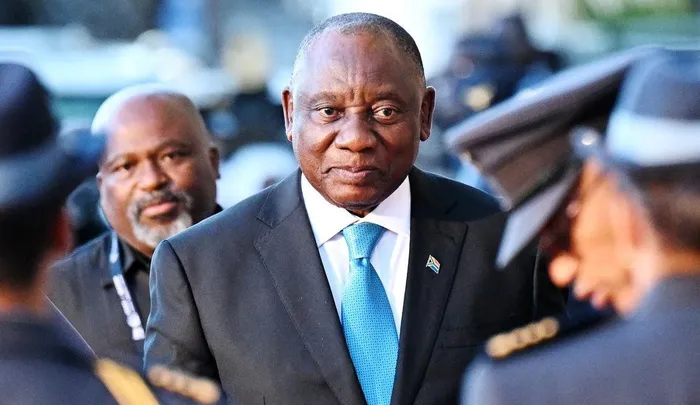
President Cyril Ramaphosa hosted the 7th annual Investment Summit, where nearly R900 billion in investment commitments were secured. As South Africa grapples with stagnant economic growth and high unemployment, this summit represents a crucial step towards revitalising the economy and fostering job creation.
Image: Phando Jikelo / Parliament of SA
President Cyril Ramaphosa hosted the 7th annual Investment Summit this past week bringing together government, business, labour and other key role players to ramp up efforts to mobilise badly needed investments to stimulate economic growth.
The Congress of South African Trade Unions (Cosatu) is encouraged by the nearly R900 billion in investment commitments secured by government at the Investment Conference.
This is a marked increase over previous pledges.
Whilst some naturally question the importance of such engagements, when we have an economy that has been stuck at 1% growth for more than a decade, unemployment at stubbornly high levels of 41.1% and entrenched poverty and inequality; then the answer is not that we need such events, but that we need to do more to ramp up investments for the economy and job creation and most importantly to ensure that commitments translate into action.
The Investment Summit took place at a time when South Africa’s reputation has been systematically attacked with a flood of fake news and wild conspiracy theories on social media and even in the halls of “diplomacy”.
These pledges by domestic and foreign business leaders and investment funds are a bold and welcome vote of confidence by investors in South Africa’s future and its strategic economic role in the African continent and the world.
Cosatu appreciates efforts by government, in particular the Presidency and the Department of Trade, Industry and Competition (DTIC) to tackle the investment strike that has been an albatross around South Africa’s neck for years.
This is a call to action that the Federation has been agitating for over many years.
No sober person, and especially government and captains of industry, should be satisfied with or accept such weak economic growth nor such high unemployment.
The global trade turmoil has provided one useful impetus, for government and business to not only diversify South Africa’s trade and investment partners, important given the inevitable global turbulence, but also to seek new trade opportunities for South African exports and thus boosting local jobs.
The greater our trade and investment diversification is, the better insulated we will be for the inevitable geo-political, trade, climate change, natural disasters and other turmoil.
This requires not only applause but more importantly a close trade and investment promotion partnership between government, business and labour.
Whilst there is much that government, business and labour will disagree with given our different constituencies and challenges, there are fundamentals that we must agree upon.
These must include enabling a growing and inclusive economy, creating decent work and rising incomes, building a well-resourced and capacitated developmental state.
This necessitates that Treasury provide DTIC with the resources it requires and that DTIC deploy these strategically, e.g. every South African diplomatic mission should have skilled attaches well prepared to promote trade, investment, tourism and transport.
The absence of skilled trade attaches across our diplomatic missions is deeply concerning. It robs South Africa of potential trade and investment opportunities that would help create badly needed jobs.
We, however, remain deeply concerned that the Investment Summits’ positive strides are not enough to generate the growth and the jobs we desperately need. South Africa’s already tepid 2026 1.4% growth projection will very soon face severe strain with the devastating fuel price increases, notwithstanding government’s temporary R3 a litre cushion.
Whilst it is important to lobby investors to spend their money in South Africa. We must appreciate that key to stimulating inclusive economic growth and reaching the 5% target necessary to see our dangerously high unemployment rate of 41.1% fall, is to tackle the very real deterrents to investment.
Government needs to prioritise and ramp up its investment campaign as the economy braces for severe global economic turmoil due to the war in the Middle East and the subsequent massive hikes in oil and petrol prices.
It is urgent that government working with business and labour accelerate collective efforts to mobilise investments to cushion and stimulate the economy; in particular to boosting strategic and jobs intensive manufacturing, mining and agricultural sectors.
These are key to saving and creating decent jobs. These should be linked to strategies to boost local procurement and value chains and strengthen their linkages to export opportunities.
DTIC’s efforts to expand and diversify trade opportunities, in particular with key global economic hubs and Africa, must be intensified and provided with the necessary support. This should include support in the form of procurement, marketing and networking by other South African companies already established across the continent and the world.
Particular attention must be paid to the African continent and to use trade agreements, be it with the United States, Europe or Asia to boost Africa’s economic and infrastructure integration.
Pension and investment funds must be engaged to increase their investments in domestic industrial sectors and critical economic infrastructure as well as jobs rich and emerging economic sectors.
Whilst critical progress has been made under President Cyril Ramaphosa’s African National Congress led administrations to dismantle the state capture and corruption networks, much more needs to be done to overcome our unacceptably high levels of crime and corruption. Key to winning this existential war is to ensure that the South African Police Service, National Prosecuting Authority, the Judiciary and other law enforcement organs have the necessary leadership, personnel, skills and resources.
It is equally urgent to expedite efforts to rebuild and return to full capacity Eskom, Transnet, Metro Rail and other important state-owned enterprises.
Eskom in particular requires support to lower the increasingly unaffordable price of electricity. Similar attention needs to be paid towards capacitating frontline public and municipal services as the economy cannot grow, nor attract investment, without these.
Investments in our ports, rail and roads must be linked to efforts to expand our export capacity and not simply to fast track the processing of imports into our economy.
Cosatu for its part, will continue to work closely with government and business to accelerate these efforts at Nedlac, in the sectoral master plans and in bargaining councils.
Zingiswa Losi is the president of Cosatu.
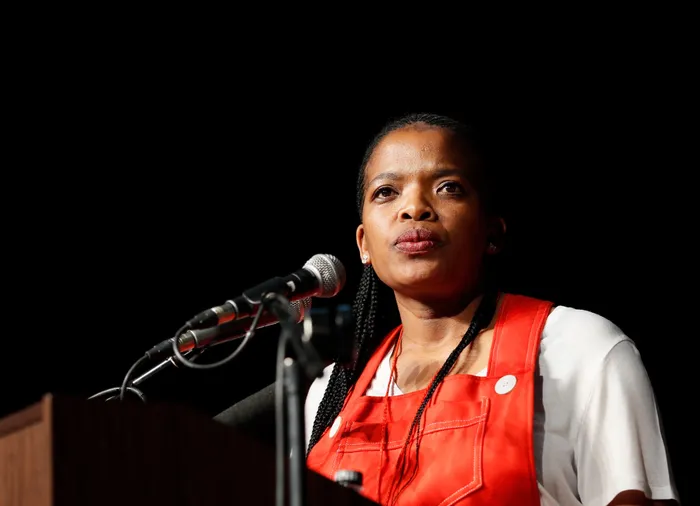
Zingiswa Losi is the president of Cosatu.
Image: Independent Newspapers
Follow Business Report on Facebook, X and on LinkedIn for the latest Business and tech news.