

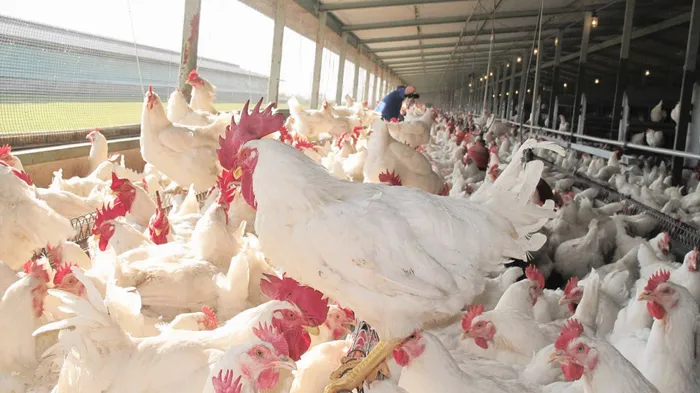
The spread of avian influenza (bird flu) in America and Europe has raised more calls for increased local vaccination by the South African Poultry Association.
Image: Supplied
The rapid spread of avian influenza across the United States and Europe has intensified calls for widespread poultry vaccination in South Africa, as industry leaders warn that current containment strategies are failing to curb the disease.
According to Poultry World, global experts argue that traditional control methods, particularly the large-scale culling of infected birds, are no longer sufficient to manage the ongoing outbreaks.
Professor Sjaak de Wit of Utrecht University of Veterinary Medicine last week likened the situation to a war, stressing that vaccination must be central to long-term disease control.
He said vaccination should no longer be viewed as a last resort, but as a critical and sustainable tool, urging regulators and policymakers worldwide to adopt this approach.
“Vaccination is not a last resort — it’s a critical component of sustainable avian influenza control. The challenge now is to ensure that this message reaches veterinary regulators and policymakers worldwide,” De Wit said.
Dr Leslie Sims, an independent veterinary consultant and international expert, said she was concerned that millions of chickens and turkeys were still destroyed each year despite the availability of effective vaccines.
“Stamping out alone is not sustainable economically, socially, or ethically. We are relying on an 18th-century method of disease control when 21st-century tools are at our disposal,” she said.
Avian influenza expert, David Swayne, noted that emergency vaccination campaigns in France and six Latin American countries had already demonstrated success in reducing outbreaks, and several other nations are now developing national vaccination plans and vaccine banks.
Izaak Breitenbach, the CEO of the South African Poultry Association (SAPA), said the current avian flu outbreak is problematic specifically in Europe and the US, where the culling policy does not eradicate the disease.
“The problem for South Africa is that we have learnt that when there is Highly Pathogenic Avian Influenza (HPAI) in Europe, it is just a matter of time before wild bird migration brings the virus to South Africa. We are thus concerned about this winter,” he said.
Breitenbach added that the situation in South Africa differs from that in the US and Europe, as the domestic industry does not receive compensation for infected or culled birds.
“Companies big and small thus have to carry their own costs. In a lot of cases in 2023, companies lost all the birds they owned and did not have the means to restock the farm. The 2023 outbreak was particularly bad, where the industry lost in excess of 30% of all the long-living birds they owned," he said.
“In Gauteng, 90% of all birds perished, with financial and environmental consequences that we could not afford. The 2023 outbreak cost the industry in excess of R10 billion in stock losses alone. It is thus important to vaccinate to curb the stock losses and reduce the load of the virus in the environment in the case of an outbreak.”
He added that there have been in excess of 4,000 cases reported in Europe, up from what was expected in the past.
“We have learnt that a lot of wild birds migrate to South Africa from Europe and in the past brought the disease with them. We had six primary infections during 2023; therefore, the situation in Europe is of concern.”
Smalltalkdaily Research analyst Anthony Clark said that there is significant avian influenza throughout all of the European Union and in about 35 to 36 states in the US.
“There's also been outbreaks in Argentina and in certain other countries in Asia. So Avian Influenza remains a very destructive pandemic in many of the leading global producers of chicken, principally,” he said.
Clark added that parts of Europe, particularly France and the United Kingdom, have announced vaccinations of grandparent breeder stocks.
“Astral Foods in this country has started to vaccinate part of their breeder flock. The trouble is, the cost of vaccination is quite expensive, at around R1.50 per shot, and it needs to be done fairly frequently during the life cycle of a breeder flock. And that cost ultimately will have to be borne by the consumer.”
Clark said that although the east of Africa government has dragged its heels on allowing vaccination of poultry, it has been mandated by the State vet though it's just a very slow process.
"At any one point in time, there are up to 200 million chickens running around this country in any one week as part of the underlying production and then slaughter chain," he said.
"So even though the breeder and grandparent stock is a percentage of that, it's at a significant cost that will have to be borne by the producers if they intend to widely vaccinate poultry.”
BUSINESS REPORT