

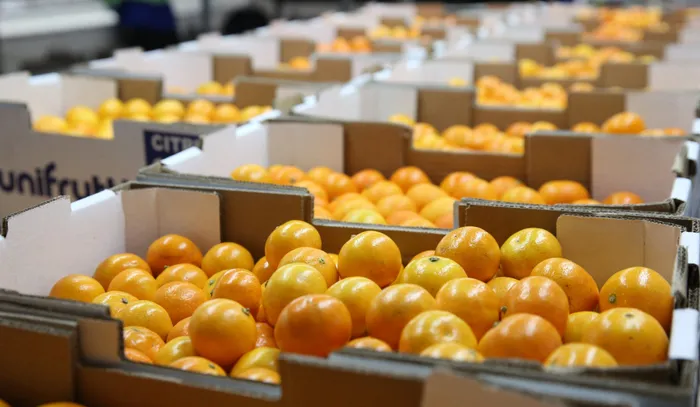
Agricultural Business Chamber of South Africa (Agbiz) has raised concern that as the citrus export season draws closer, new export markets need to be looked at due to the ongoing Middle East conflict.
Image: Zanele Zulu/ Independent Newspapers.
The Agricultural Business Chamber of South Africa (Agbiz) has warned that South Africa’s agricultural sector must urgently identify alternative export markets as the ongoing Middle East conflict threatens to disrupt trade flows ahead of the citrus export season.
Wandile Sihlobo, chief economist at Agbiz, said last week that uncertainty continues to cloud the outlook four weeks into the conflict. He noted that the duration of the war, the extent of infrastructure damage, and the timeline for recovery in affected countries remain unclear.
Sihlobo stressed that exporters must work closely with key government departments, including the Department of Agriculture, Department of Trade, Industry and Competition, and Department of International Relations and Cooperation, to assess risks and prioritise new markets capable of absorbing excess produce.
“For exporting businesses, this is a risk we have to take seriously and start planning for alternative export markets where conditions permit.”
Sihlobo said that South Africa is approaching its citrus export season.
“The challenge for the current year includes not only ample domestic supplies but also a recovery in Brazilian output, which will intensify competition against South African products in various export markets.”
Sihlobo added that the same is true of other fruits and berries, whose export seasons are fast approaching.
“The Middle East is not the biggest market for South Africa. The region accounted for about 8% of South Africa’s agricultural exports of $15.1 billion (R254 billion) in 2025, according to data from Trade Map,” he said.
“The challenge of accessing the Middle East, at a time when South American fruit produce is also recovering, suggests there may be increased competition, even in other markets where South Africa would ordinarily have increased its volumes during years of shortages in South America.”
Sihlobo said that the industry must lead the effort to outline the markets where many relationships already exist or are most likely to be established swiftly, and thereafter communicate this information to the relevant policy departments, which can then use the insight to plan and initiate conversations at the government level.
“The various economic analysts in South African Missions around the world can also do their part by assessing whether, in the regions they serve, there is a possibility of advancing South Africa’s agricultural exports in the near term to avert the challenges posed by the Middle East conflict,” he said.
“Serving the South African business in times of such need is a key part of the country’s economic diplomacy. Assistance to businesses in these critical times is a key part of demonstrating that South Africa has an effective economic diplomacy policy and can utilise it to serve businesses, ultimately helping maintain jobs in South Africa.”
Sihlobo said that the Middle East conflict once again exposes the need for South Africa to increase its focus on export diversification.
“This entails opening as many new export markets as possible to broaden growth opportunities for domestic businesses and reduce the risks associated with overexposure to a small number of markets.”
He said South Africa’s long-standing ambition to expand agricultural production through underutilised government-owned land would also lead to a major increase in production.
Therefore, Sihlobo said, the discussion about the domestic expansion of agricultural production in these new lands cannot be economically sustainable without ensuring the country has new export markets to absorb the produce and, ultimately, keep farming businesses profitable.
“Ultimately, the risks we are seeing in the Middle East regarding South Africa’s agricultural exports are not a call to disregard this region. It remains a key part of our long-term growth strategy as an export market. What we are facing now is an immediate challenge.”
BUSINESS REPORT