

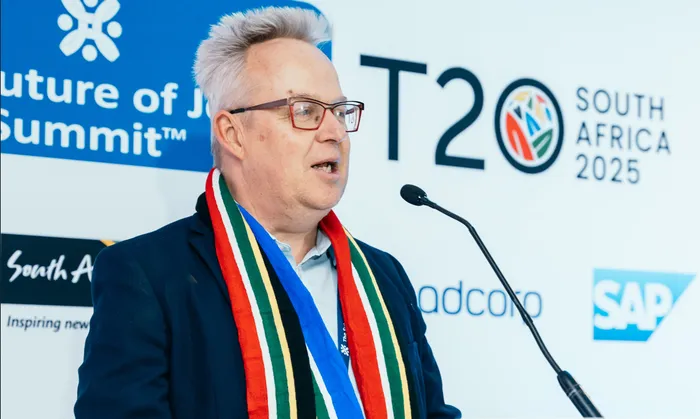
Dr Nik Eberl is the founder and executive chair: The Future of Jobs Summit™ (Official T20 Side Event). He is also the author of Nation of Champions: How South Africa won the World Cup of Destination Branding).
Image: Supplied
The world is reconfiguring and South Africa is more relevant than it has been in years.
That may sound counterintuitive at a time when global headlines are dominated by conflict in the Middle East, supply chain disruptions, and rising economic uncertainty.
But history teaches us a consistent lesson: when instability rises, capital, talent, and trade do not disappear, they relocate.
The question is not whether opportunity exists in moments like this. The question is whether countries are prepared to recognise and act on it.
Earlier this week, 1,200 delegates from over 50 countries gathered in Sandton for the South Africa Investment Conference. Their presence sent a powerful signal: global capital is paying attention again.
President Cyril Ramaphosa captured this shift directly, noting that in a world of fragmentation and supply chain disruption, South Africa presents itself as a “resilient, credible and reform-oriented investment destination with strong fundamentals.”
The conference itself reinforced that message. Record investment pledges were secured, and a new ambition was set: to mobilise R3 trillion in fresh investment over the next five years.
But beyond the numbers, something more important is happening.
For the first time in modern history, four strategic doors have opened simultaneously for South Africa:
South Africa sits in a uniquely advantageous position. It shares a time zone alignment with major global markets, offers deep and liquid financial systems, and operates one of the most traded emerging market currencies in the world.
Johannesburg and Cape Town have the infrastructure, the expertise, and the institutional depth to absorb financial services looking for a stable alternative. But markets do not move on potential alone. They move on signals, incentives, and execution.
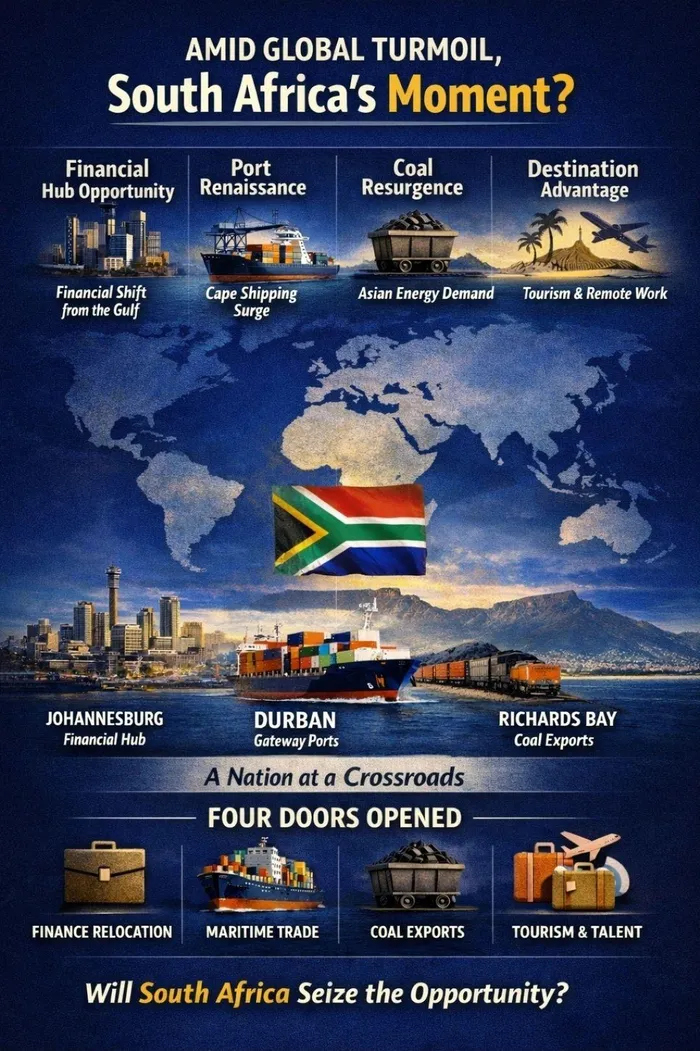
Amidst global upheaval, South Africa emerges as a beacon of opportunity, attracting investment and talent as it positions itself for economic growth.
Image: Supplied.
That is now changing. Durban’s vessel turnaround time has improved dramatically — from weeks to days — under renewed operational focus.
This is not a marginal improvement; it is a structural shift. When global trade flows meet improved domestic performance, opportunity accelerates. We are no longer asking for traffic to come our way. It already is.
South Africa, through Richards Bay, is already seeing the impact. Export volumes are rising just as rail and port capacity begin to recover.
While the long-term energy transition remains critical, the short-term reality is clear: global demand has shifted in our favour. The countries that benefit from such shifts are those that respond pragmatically and strategically.
South Africa offers what the world suddenly needs: distance from conflict zones, a favourable climate across seasons, and a globally competitive hospitality sector.
From Cape Town to the Kruger, the country is uniquely positioned to attract both leisure and business travellers — as well as the growing class of digital nomads and mobile professionals.
Taken individually, each of these opportunities is significant. Taken together, they represent a rare moment of convergence.
This is where leadership becomes decisive.
None of this diminishes the human cost of global conflict, nor does it shield South Africans from rising fuel prices or economic pressures. But recognising opportunity in a shifting world is not opportunism — it is responsibility.
Nations do not rise because the world is stable. They rise because they respond intelligently when it is not.
South Africa now faces a defining choice. We can continue to view global disruption as something that happens to us — something we endure. Or we can recognise it for what it is: a strategic opening.
Because moments like this do not last indefinitely. Capital settles. Trade routes stabilise. Talent finds new homes. The window is open now. The only question is whether South Africa will move fast enough — and boldly enough — to step through it.
Dr Nik Eberl is the founder and executive chair: The Future of Jobs Summit™ (Official T20 Side Event). He is also the author of Nation of Champions: How South Africa won the World Cup of Destination Branding)
Follow Business Report on Facebook, X and on LinkedIn for the latest Business and tech news.