

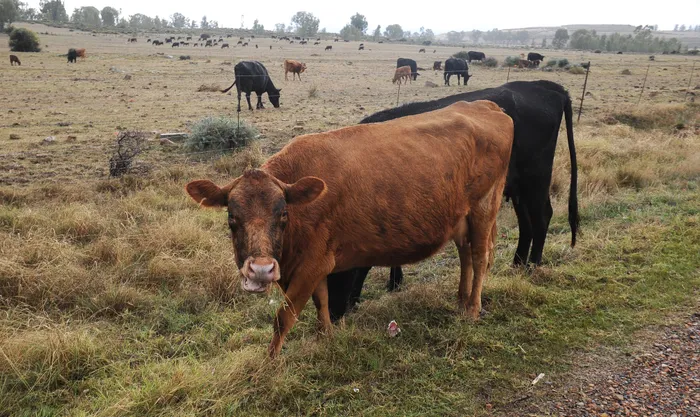
The Red Meat Producers Organisation (RPO) have voiced their concern about impending court action by private Veterinary organisations, as it can lead to delays in Foot and Mouth Diseases vaccinations.
Image: Courtney Africa / independent Newspapers
The Red Meat Producers Organisation (RPO) has raised concerns that legal action by veterinary bodies could delay the rollout of vaccinations against Foot and Mouth Disease (FMD), potentially undermining efforts to stabilise South Africa’s livestock industry.
Central to the dispute is the perceived role of the Red Meat Industry Services RMIS in the vaccination process.
Dr Frikkie Mare, CEO of RPO, on Monday said the organisation had noted objections and court action initiated by the Ruminant Veterinary Association (RuVasa) and the South African Veterinary Association (Sava)’s objection and legal action against the draft scheme relating to the preventive vaccination of livestock against FMD.
“The organisations’ formal objection to the draft Section 10 scheme states that the scheme will, among other things, grant too many powers to RMIS,” Mare said.
“The most important observation is that the legal action by Sava and RuVasa could lead to further delays in a vaccination campaign that will assist in getting the industry back on its feet.”
Mare added that the livestock industry in South Africa cannot afford further delays in the vaccination process, especially due to incorrectly presented or interpreted information.
“Not only is this a waste of valuable time, but it also creates unnecessary confusion at a time when coordinated action is of the utmost importance.”
Mare said that FMD is a State-controlled disease and ultimately the State has the final say on the services to be rolled out.
“RMIS works for the industry, which has an existing system that is proposed as a facilitation measure. RMIS cannot take control out of anyone’s hands. It is now, more than ever, important that producers focus on the task at hand and not be derailed by side battles and semantics.”
Mare added that there are a few important facts that producers should take note of to clear up any confusion, uncertainty, and misinterpretations.
“Firstly, the draft document on which the parties and their legal representatives are basing their arguments is an outdated version of the proposed Section 10 scheme,” he said.
“The document has undergone several amendments since the first draft, and the version on which their comments are based is an old version that does not contain the updates and amendments made some time ago by different parties – the Ministerial Task Team on FMD, the Industry Coordinating Council, and the National Department of Agriculture.”
Mare said that the RPO is unsure which other parties had a hand in the document, and it is also unclear why this old version of the document was used as the basis of the legal action.
“We do appreciate Sava and RuVasa’s concerns and objections, as some of the issues they raise were the same issues identified by the aforementioned parties, who then proposed and made certain changes. The fact is that the document on which the complainants’ comments are based is not the correct or last version of the proposed scheme.”
Mare added that it seems that the role of RMIS’ role in the process has been misinterpreted and in this regard it is necessary to take note of a few facts.
“It must first be noted that RMIS is in no way a decision-maker for or on behalf of the industry; it is a service provider that may only act at the behest of the red meat industry and a designated board. No veterinarians are required to participate in the RMIS traceability platform in order to perform their work,” he said.
“The proposal contained in the draft scheme entails that veterinarians registered with Sava log on to the RMIS system to place their vaccine orders there, ensuring a smooth process, which will generate a GLN number after which the system can identify the areas in which vaccinations were administered.”
Mare said that RMIS cannot approve the certificates related to the process.
“An appointed committee must perform this function. The RMIS platform is merely proposed as a channel through which a certificate application can be submitted, after which the committee must grant approval so that RMIS can issue it. The proposal is based on the fact that the RMIS platform already has a function that can facilitate such a process.”
“RMIS is, however, available to perform the necessary facilitation between industry and government to roll out the process as soon as possible. RMIS’s ultimate objective is to implement the red meat cluster’s 2030 red meat industry strategy by achieving specific objectives, including strategies to manage animal disease risks and comply with international traceability requirements.”
BUSINESS REPORT