

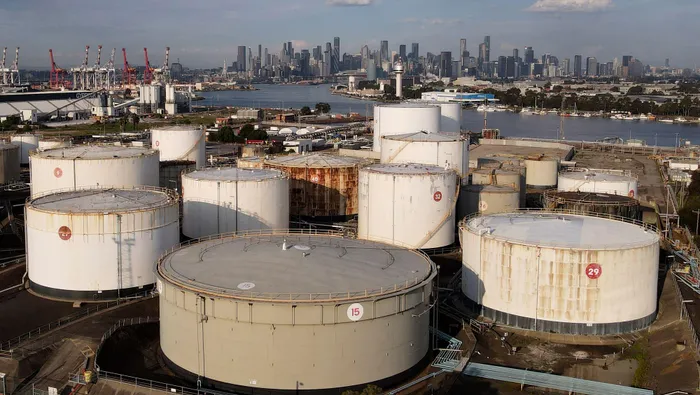
The Hormuz crisis reveals how systemic risk infiltrates economies, not as a spectacle but through rising costs. This article explores the implications for the global South and the urgent need for energy resilience.
Image: William West / AFP
The first signal is rarely geopolitical.
It is practical. It shows up in a freight invoice, in a transport fare, in a procurement team suddenly repricing assumptions it made only weeks earlier.
That is how systemic risk enters ordinary economic life in import-dependent states: not first as spectacle, but as cost.
The Strait of Hormuz crisis has followed that pattern with precision.
Its significance lies not in a simplistic story of absolute closure, but in the emergence of a more fragile operating environment in which energy still moves, though under sharper political discretion, tighter routing constraints and greater price volatility.
That distinction matters.
Iran has publicly said the Strait remains open to all except “enemy-linked” vessels,while recent reporting shows that some ships have in fact been allowed through after diplomatic engagement,including Malaysian vessels and a group of 10 tankers that Washington described as a goodwill gesture.
At the same time, UNCTAD reported that daily ship transits through the Strait had come close to a halt in early March,underscoring that continued passage for some vessels should not be mistaken for a return to normal maritimeconditions.
South Africa’s position should therefore be stated carefully.
The strongest current public indication is not thatSouth African-bound cargo has been blocked, but rather that supply has remained stable in the near term.
According to the South African government, imports were still arriving as planned, with current arrangements covering requirements through mid-April 2026.
That is a useful assurance, but it is a near-term administrativeposition, not proof that the underlying system is secure.
The more serious point is that a country can still receivefuel while remaining exposed to a chokepoint whose disruption raises insurance, freight and pricing risks acrossthe economy.
That broader vulnerability now sits against a weakening macroeconomic backdrop.
In January, the IMF projected global growth of 3.3% for 2026, arguing that technology investment, fiscal and monetary support,accommodative financial conditions and private-sector adaptability were offsetting trade headwinds.
By late March, however, the OECD had revised 2026 global growth down to 2.9% and lifted its G20 inflation forecast to 4.0%, warning that the Middle East energy shock was erasing the expected improvement in global conditions.
The issue is not only the price of oil itself.
It is the way an energy shock travels through logistics, food systems and inflation expectations far beyond the Gulf.
UNCTAD’s framing is especially important because it is measured rather than theatrical.
The agency notes that the Strait carries around one quarter of global seaborne oil trade, as well as significant volumes of liquefied natural gas and fertilisers.
Reuters, citing Barclays, separately reported that around one-fifth of global oil and LNG shipments had been blocked by the disruption and that a prolonged closure could remove 13 million to 14 million barrels per day from supply.
These figures describe related but distinct dimensions of exposure.
Taken together, they point to the same conclusion: even partial or selective disruption at Hormuz is enough to transmit economic stress rapidly into vulnerable economies.
This is why the current African debate needs more discipline than slogans.
The instinctive response, visible inpublic commentary across the continent, is to argue that Africa can simply supply itself.
The sentiment capturesa legitimate frustration with dependence on distant energy routes, but it compresses a systems problem into aresource argument.
Africa does have major hydrocarbon producers, growing refining ambitions and large untapped electricity potential.
What it does not yet have, at sufficient scale, is a fully coordinated continentalenergy system capable of absorbing a shock of this kind without severe friction.
Nigeria’s Dangote refinery is the clearest example of both the opportunity and the limit.
Reuters reports that the 650,000-barrel-per-day refinery reached full capacity in February and that Nigeria’s clean-product exports roseto around 214,000 barrels per day in March, with shipments to African markets increasing to about 90,000 barrels per day from 38,000 barrels previously.
That is strategically significant.
It shows that regional refiningcapacity can begin to cushion external shocks.
But it also shows how early the process still is.
One successful refining asset, however transformative, does not yet amount to continental energy resilience.
The same logic applies to electricity.
The Democratic Republic of Congo’s Inga complex has long representedthe scale of Africa’s unrealised energy promise.
World Bank documents describe Inga Falls as having a currentpotential capacity of about 44 GW, while also noting that the most recent feasibility work for Inga 3 envisagedaround 4.8 GW.
Yet the same source is explicit that persistent governance issues have hampered therealisation of this potential.
That is the deeper pattern running through the continent’s energy debate: the constraint is often not geology, nor even engineering, but execution, institutional credibility, financing structureand cross-border coordination.
That institutional weakness now intersects with a larger global transition. Eurasia Group’s No. 2 risk for 2026,“Overpowered”, argues that China is betting on electrons while the United States is betting on molecules.
Behind the phrase is a hard strategic insight: countries that build strength in grids, storage, batteries and integrated electricity systems are positioning themselves for the next layer of energy power, while others remaintied to older hydrocarbon vulnerabilities.
For many Global South economies, the danger is not simply dependence on imported oil.
It is being caught in a dual trap, still exposed to fossil-fuel shocks whileunderprepared for the governance and capital demands of the electric transition.
South Africa sits squarely inside that tension.
Its current fuel flows may remain intact in the near term, but its economy is still exposed to the inflationary and logistical effects of a disrupted chokepoint.
The real policy challenge is therefore not whether officials can secure the next shipment.
It is whether the country and theregion around it, can use moments like this to build durable redundancy: more storage, more refining optionality where viable, stronger transmission links, firmer regional power arrangements and more credible execution of large-scale infrastructure.
A state does not become resilient merely because supplies continue for another few weeks. It becomes resilient when it has choices.
That is the more serious reading of the Hormuz crisis. The Global South is not being forced into realignment because every tanker has stopped moving.
It is being forced into realignment because the old model of strategicdependence has become more visibly expensive, more politically contingent and harder to defend.
The Strait remains open to some traffic.
South Africa’s short-term supply remains covered.
But neither fact cancels the larger lesson.
In a fractured order, vulnerability is no longer defined only by whether energy flows. It is defined by who controls the conditions under which it does.
If African governments take the wrong lesson from this episode, they will chase emergency contracts and callit strategy.
If they take the right one, they will treat the current shock as evidence that sovereignty in energy isless about rhetoric than about system design.
The countries that emerge stronger will not be those that merely survive the next disruption. They will be those who use this one to reduce the cost of being surprised again.
Nomvula Zeldah Mabuza is a Risk Governance and Compliance Specialist with extensive experience in strategic risk and industrial operations. She holds a Diploma in Business Management (Accounting) from Brunel University, UK, and is an MBA candidate at Henley Business School, South Africa.
*** The views expressed here do not necessarily represent those of Independent Media or IOL.

Nomvula Zeldah Mabuza is a Risk Governance and Compliance Specialist.
Image: Supplied
Follow Business Report on Facebook, X and on LinkedIn for the latest Business and tech news.