

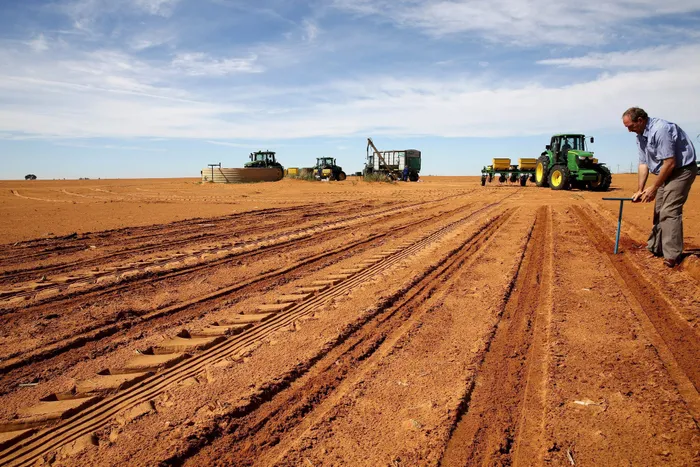
Wandile Sihlobo, Presidential Envoy on Agriculture and Land Reform, The Presidency and Chief Economist, at Agricultural Business Chamber of South Africa (Agbiz), said that South Africa’s agriculture sector is facing a time of uncertainty.
Image: Siphiwe Sibeko Reuters
South Africa’s agricultural sector is entering a period of heightened uncertainty, with rising fuel and fertiliser costs—driven by ongoing tensions in the Middle East—emerging as key risks to food price stability in 2026.
Wandile Sihlobo, chief economist at the Agricultural Business Chamber of SA (Agbiz), on Thursday said South Africa’s agriculture sector is facing a time of uncertainty due to Middle East tensions, rising oil and fertiliser prices.
“We started the year with optimism that this would be a recovery period, with better vaccination against foot-and-mouth disease, favourable rainfall to support crop production, and, ultimately, positive outcomes for agriculture, pointing to a moderating consumer food price inflation path,” he said.
Sihlobo added that what has sparked the uncertainty is not domestic factors but the higher fuel and fertiliser prices driven by the ongoing conflict in the Middle East.
“In this environment, where people generally expect higher prices for various commodities, there may also be room for market power abuse or for premature price adjustments," Sihlobo said.
"This is something one would discourage, as farmers and consumers are already under financial strain. Farmers are under immense cost pressures of higher input costs and lower commodity prices. Consumers are also under a tough economic strain.”
Sihlobo said the conflict in the Middle East is a factor in the global fertiliser market, and the market was already experiencing a surge in prices and the region's growing importance as a source of fertiliser ingredients.
He added that the next major fertiliser usage period in South Africa and Southern Africa's agriculture at large is from October 2026, when we plant summer crops.
“This means that if logistics in the Middle East ease before June, upside price pressures in the fertiliser market should soften, and farmers wouldn't start the 2026-27 production season with a major cost burden.”
Sihlobo said that some people are concerned about how the fertiliser price surge will affect consumer food prices.
“On this, we must always remember that farmers can't pass fertiliser costs directly to consumers. Farmers are price takers. In extreme cases, farmers can mainly influence prices by adjusting the area planted," he said.
"We don't see this as a near-term possibility. And the new crop is only planted in October 2026. The reality is that farmers will be under immense strain if fertiliser prices remain elevated for some time.
"Fertiliser accounts for 35% of grain farmers' input costs and a substantial share of other crop farmers' input costs. This is still early, and we don't know how long the disruptions or the Middle East war will last, or how long the disruptions to fertiliser will last.”
Sihlobo added that the farming sector is also currently concerned about fuel prices and supply availability in some areas.
“Generally, fuel supplies remain healthy in the country, but there may be unusual demand ahead of April price adjustments. It is for this reason, amongst other things, that one may see reports of supply disruptions," Sihlobo said.
"Ideally, a normal buying pace would help immensely. Fuel accounts for a notable share across various agricultural value chains, and harvesting and planting are the periods of highest use.”
Sihlobo said that South Africa's consumer food price inflation could moderate in 2026 due to ample supplies of grains, oilseeds, fruits, and vegetables.
“This is a view I expressed at the start of this year, and I haven't shifted from it. But I am increasingly worried that higher fuel prices due to the war in the Middle East may alter this optimistic food inflation path if the war continues.”
Sihlobo added that he expects South Africa's consumer food price inflation to slow in 2026, but fuel prices remain a major upside risk as they account for a substantial share of food product distribution costs.
“About 80% of South African grain, and a substantial share of other products, are transported by road. Therefore, higher fuel prices can be partly passed through to the final prices consumers pay for their products in this scenario.”
Sanele Nkosi, head of agriculture at BDO South Africa, said that rising input costs and logistical delays could reduce yields, raise food prices, and squeeze margins across the sector.
“South Africa’s reliance on imported fuel and fertiliser amplifies the impact of global instability, while stricter trade finance conditions add further strain," Nkosi said.
"South Africa’s agricultural sector is uniquely exposed to global shocks. Farmers rely heavily on imported inputs such as fertilisers, fuel, and machinery, while selling into globally priced markets.”
BUSINESS REPORT