

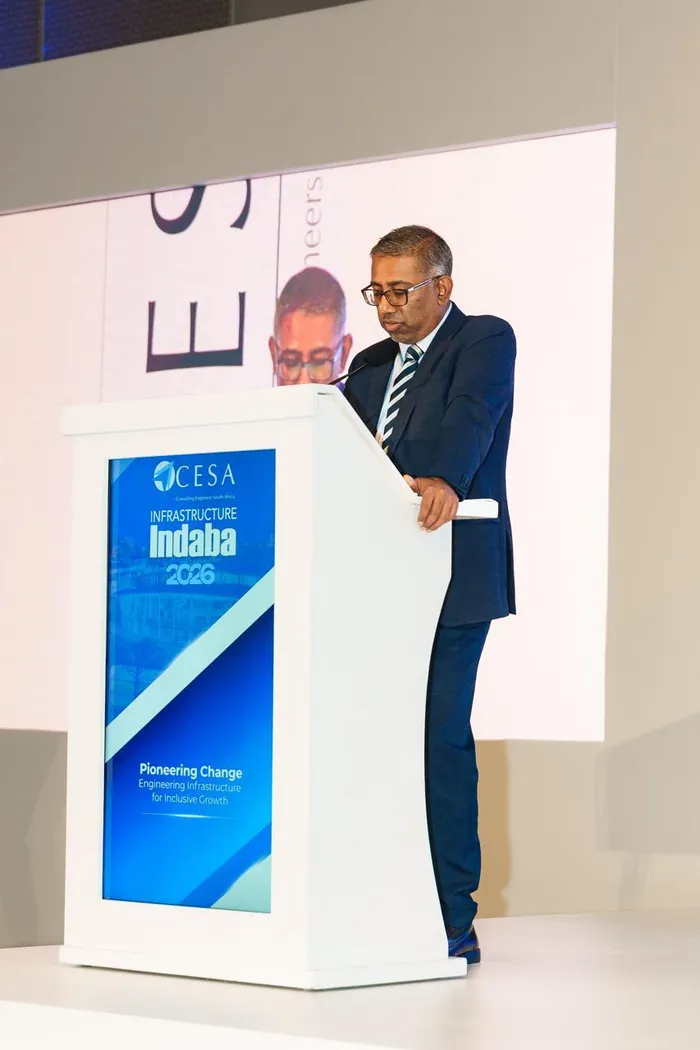
Subesh Pillay, acting director-general at the Department of Electricity & Energy, said despite significant infrastructure spend allocation over the medium-term, there was underspending and fruitless spending of these budgets, most profoundly in municipalities.
Image: Supplied
Infrastructure is fast emerging as a principal battleground for global economic competitiveness, industrial strength and national resilience, according to Subesh Pillay, acting director-general of the Department of Electricity and Energy.
Delivering a keynote address at the Consulting Engineers South Africa Infrastructure Indaba in Durban on Wednesday, Pillay said governments across the world are increasingly recognising a long-standing truth: modern economies are fundamentally built on the reliability and scale of infrastructure systems.
“Electricity networks, logistics corridors, water systems, and digital infrastructure form the physical backbone upon which economic activity depends.”
This growing awareness is now being matched by unprecedented levels of investment. Citing estimates from the Global Infrastructure Hub, Pillay noted that the world will require roughly $94 trillion in infrastructure investment by 2040 to sustain growth and meet development needs.
Within the energy sector alone, spending has surged. Data from the International Energy Agency shows that global energy investment has exceeded $3trln annually in recent years, driven by profound structural shifts in the global economy.
Pillay identified three key forces behind this surge. The first is the rapid electrification of economic activity, with electricity increasingly replacing other energy sources across transport, industry and buildings.
The second is the digitalisation of economies, which is significantly boosting electricity demand through data centres, advanced manufacturing and digital infrastructure. A third, underlying factor is the transition to cleaner energy systems, which is reshaping how and where infrastructure is deployed.
“It means that infrastructure delivery is no longer simply a domestic planning exercise. It takes place within a highly competitive global environment in which capital, technology, and manufacturing capacity are increasingly contested.”
He explained that infrastructure systems sit at the intersection of multiple forces, including state capability, regulatory frameworks, capital markets and industrial policy. Engineers, financiers, regulators and governments must all work in coordination to deliver complex, large-scale projects.
Adding to this complexity are shifting geopolitical dynamics. Pillay noted that global supply chains for energy infrastructure are becoming more strategic, with major economies competing for control over critical minerals essential for renewable technologies, batteries and power electronics. At the same time, industrial policy interventions in key markets are reshaping global manufacturing capacity.
Disruptions to trade routes and shipping corridors have further compounded these challenges, introducing new uncertainties at a time when demand for energy infrastructure equipment is accelerating. According to the IEA, the expansion of electricity networks needed to support electrification and renewable energy is placing unprecedented strain on global manufacturing capacity for grid components.
Against this backdrop, South Africa faces its own domestic constraints. Pillay pointed to uneven project preparation capacity within the State, fragmented institutional coordination among implementing agencies and regulators, and complex, time-consuming public procurement processes as key obstacles slowing infrastructure delivery.
South Africa’s electricity sector is also undergoing a major structural transition. The system is shifting away from a vertically integrated model dominated by a single utility toward a more diversified framework involving multiple generation technologies and market participants.
This transition is underpinned by an ambitious investment pipeline. The forthcoming Integrated Resource Plan 2025 projects an electricity system with around 105 gigawatts of installed capacity by 2040. Achieving this will require generation investment estimated at between R2trln and R3trln.
At current economic levels—roughly R7trln in gross domestic product—this represents close to one-third of the size of the economy. Spread over the planning horizon, it equates to annual investment of approximately 1.5% to 2.5% of GDP in generation alone.
Pillay stressed that engineers will play a pivotal role in delivering this transformation. Their responsibilities extend beyond technical design to include project preparation, feasibility assessments, procurement structuring, construction oversight and long-term asset optimisation.
“The quality of engineering capability within a country has a direct influence on the effectiveness of its infrastructure delivery system,” he said.
Pillay concluded that engineers occupy a central position within the infrastructure system.
“Their work extends well beyond the technical design of infrastructure assets. Engineers are involved in project preparation, technical feasibility assessment, procurement structuring, construction supervision, and long-term asset optimisation,” he said.
“The quality of engineering capability within a country, therefore, has a direct influence on the effectiveness of its infrastructure delivery system.”
BUSINESS REPORT