

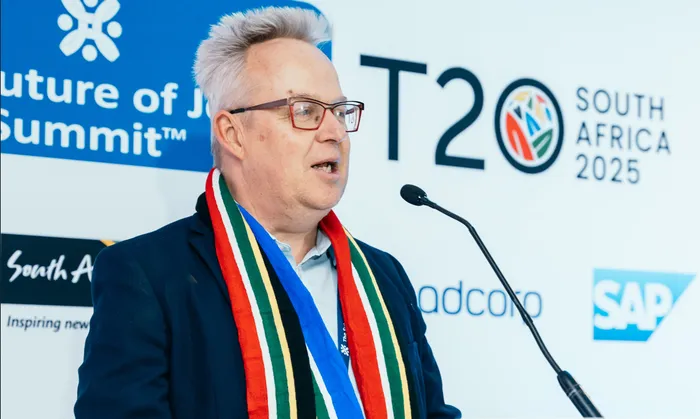
Dr Nik Eberl is the Founder & Executive Chair: The Future of Jobs Summit™ (Official T20 Side Event).
Image: Supplied
In the 20th century, economic power was largely determined by access to natural resources, industrial capacity and capital. In the 21st century, however, the defining currency of national competitiveness is talent. The countries that attract, develop and retain the best minds will lead the global economy.
We are entering what economists increasingly describe as the Talent Economy—a system where human capability, innovation and knowledge drive productivity, investment and growth. In this new economy, the flow of talent matters as much as the flow of goods, capital or technology. In fact, research has shown that the mobility of highly skilled people is now as critical to economic growth as the movement of financial capital or trade itself.
In a world shaped by artificial intelligence, advanced manufacturing, biotechnology and digital platforms, economic advantage is increasingly determined by who has the most capable people—and where they choose to live and work.
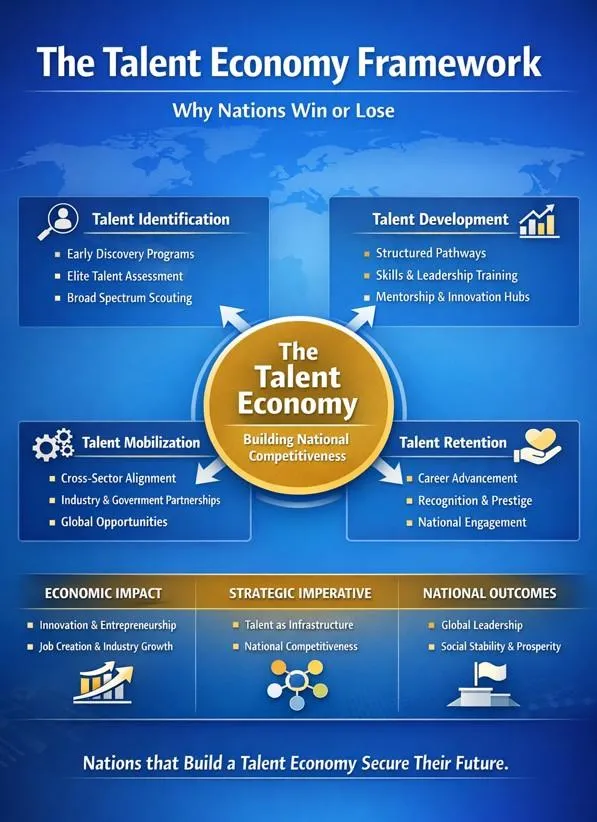
Talent Economy.
Image: Supplied
The Global Race for Talent
The race for talent is intensifying. Highly skilled workers are becoming the world’s most sought-after asset, and governments are competing fiercely to attract them.
Recent research shows that roughly 2.4 million highly skilled professionals relocate internationally each year, choosing ecosystems where their skills can flourish. These professionals are not simply employees; they are catalysts for innovation, entrepreneurship and new industries.
Talent mobility also drives knowledge transfer. When highly skilled professionals move between countries, they bring new ideas, networks and expertise that accelerate innovation and business growth.
This is why the world’s most dynamic economies—places like Singapore, Germany, and the Nordic countries—invest heavily in talent ecosystems. They combine strong education systems, immigration policies that attract global expertise, and innovation environments where entrepreneurs can thrive.
Clusters such as Silicon Valley, Cape Town, and Berlin demonstrate a powerful economic truth: talent attracts more talent. When highly skilled people congregate in one ecosystem, innovation accelerates, startups multiply, and entire industries are born.
Talent Determines Economic Success
The logic is simple: talent drives innovation, and innovation drives growth. Highly skilled individuals are disproportionately responsible for new patents, startups and scientific breakthroughs. When economies succeed in identifying and nurturing exceptional talent early, they dramatically increase their capacity for innovation and productivity.
Yet the global distribution of talent opportunity remains deeply uneven. Around 90% of the world’s young people live in developing economies, but the majority of major scientific breakthroughs still originate in advanced economies. The difference is not intelligence or ambition—it is the presence of systems that identify, develop and empower talent. This is the real competitive frontier of the 21st century.
South Africa’s Untapped Advantage
South Africa is often described through the lens of unemployment and economic stagnation. Yet the country possesses one of the most powerful, underutilised assets in the global Talent Economy: a large and youthful population.
If properly developed, this demographic advantage could become a major economic engine. But talent does not automatically translate into productivity. It requires a system that discovers potential early, nurtures skills, and connects people to opportunities. Too often, South Africa loses its brightest minds through emigration or fails to fully develop the capabilities of those who remain. Winning in the Talent Economy therefore requires a deliberate national strategy.
How South Africa Can Win the Talent Economy
1 Identify Talent Early
South Africa must dramatically improve its ability to discover and develop exceptional ability in science, engineering, mathematics, entrepreneurship and leadership. Talent identification programs, specialised academies and scholarship pathways should become national priorities.
Countries that invest early in high-potential youth consistently outperform those that do not.
2 Build World-Class Talent Hubs
Talent clusters matter. Cities such as Cape Town, Johannesburg and Durban could evolve into global hubs for industries like fintech, renewable energy, mining technology, digital services and advanced manufacturing. When universities, investors, startups and corporates cluster together, they create ecosystems that attract global talent.
3 Reverse the Brain Drain
South Africa has produced extraordinary global talent—from technology entrepreneurs to scientists and executives. Many of them now live abroad.
A targeted “brain circulation” strategy could encourage these individuals to invest, mentor and collaborate with local innovators. Talent should flow globally—but the networks should remain connected to South Africa.
4 Align Education with the Future Economy
The Talent Economy rewards skills in AI, data science, engineering, design, entrepreneurship and advanced technical trades.
Education systems must adapt accordingly. Universities and vocational institutions must become engines of innovation rather than merely credentialing systems.
5 Position South Africa as Africa’s Talent Gateway
With the right policies, South Africa could become the world’s leading destination for skilled professionals, researchers and entrepreneurs. By attracting local and global talent, the country could position itself as the innovation hub of the Global Economy.
The Strategic Choice
The global competition for talent will intensify in the coming decades. Countries that create attractive ecosystems for ambitious, creative and skilled people will flourish. Those that fail to do so will fall behind. South Africa stands at a crossroads.
The nation can continue to see talent as an individual success story—or it can recognise talent as a strategic national asset. Because in the Talent Economy, the most valuable natural resource is no longer gold, oil or minerals. It is human potential.
Dr Nik Eberl is the founder and executive chair: The Future of Jobs Summit™ (Official T20 Side Event). He is also the author of Nation of Champions: How South Africa won the World Cup of Destination Branding.
*** The views expressed here do not necessarily represent those of Independent Media or IOL.
BUSINESS REPORT