

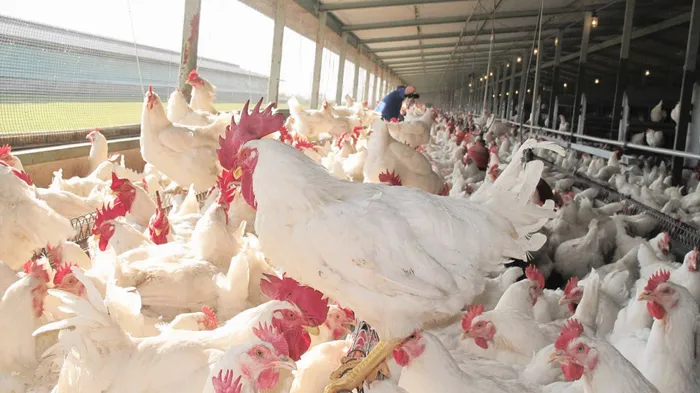
A roundtable discussion hosted by the South African Poultry Association (SAPA) on Thursday revealed that more needs to be done to boost the sector’s economic competitivenes.
Image: Supplied
A roundtable discussion hosted by the South African Poultry Association (SAPA) on Thursday revealed that more needs to be done to boost the sector’s economic competitiveness.
The news followed the release of the Bureau for Food and Agricultural Policy (BFAP) 2025 Competitiveness Benchmark Report last month, which indicated that South Africa is now the second most competitive poultry producer globally, using less feed to produce a kilogram of chicken than most of its international counterparts.
The discussion included Izaak Breitenbach, the CEO of SAPA, and Dr Tracy Davids, director of commodity markets and foresight at the BFAP.
Davids said that the first report that they did was around 2015. “When you consider competitiveness, there are various approaches that one can take. In this instance, we focused basically on a cost benchmark. We look from a technical perspective and from an economic perspective, but it all relates to cost of production. So we don't try to look at prices, marketing strategies, or actual performance in terms of imports and exports. We basically try to see if we use this common methodology to measure the cost of production, who can deliver a kilogram of chicken at the lowest cost across these various countries.”
Davids added that that's influenced by how efficient you are technically and how expensive your input costs are and how those relate to each other. “In the last iteration, this is the first one where we actually dropped below the US. Brazil is still the benchmark. They are the biggest exporter in the world. And if you are going to play the export markets, they're the ones that you're going to have to compete with. If you say you want to be the most competitive producer, that is the one that you look to as a reference.”
Breitenbach said that if South Africa reduces imports from Brazil and the US, “we can increase the total employment of people in the poultry sector from 56,000 people to 70,000 people. That is the net job loss we have because of imports. There is positive news for the industry since 2019; we have added over 2,600 jobs in South Africa because of the growth of the industry. We need to keep this industry going as it's a crucial contributor to not just the agricultural economy but also the economy of South Africa.”
Breitenbach added that South Africa would like to expand our poultry exports, but there are challenges.
“These countries that we would like to export to all have local production and they protect their local production, so they make it very difficult for countries like South Africa to export to those markets. What is preventing us is simply the normal red tape that one needs to go through to actually get to the point where we export for the first time. If we don’t expand imports, it won't be good for the industry. It is strategically imperative that we open up the export market for two reasons: the first reason is that we have a limited market growth in terms of consumption, and the second one would be that we need to earn additional revenue to be competitive in terms of caucus income.”
Davids said the poultry industry is a big integrated value chain. “It's not just about producing chicken; it's the chicken production chain itself, it's on-farm your primary producers and the logistics chain. There are a lot of knock-on impacts. If we can grow our poultry industry faster because we can export competitively, then we can also process more maize and produce more soybeans.”
Breitenbach concluded that two things that are crucial for the poultry industry are exports and vaccination.
“Exports are very important for us to earn good revenue from exports and also to open up new markets for us because our market is stagnant at the moment. The second thing is that we need to vaccinate birds against Highly Pathogenic Avian Influenza (HPAI). We have made the decision, according to Minister Steenhuisen in June last year, that we will be doing mass vaccination; because of technical issues, we haven't started that vaccination yet. So these are two strategic issues we need to address to further improve South Africa's competitiveness,” he said.
BUSINESS REPORT