

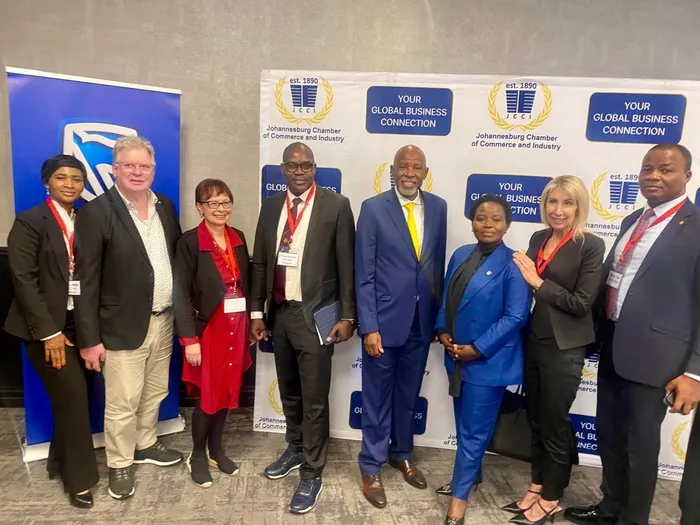
The South African Reserve Bank (SARB) Governor, Lesetja Kganyago, said on Tuesday that there has been improvement in the country’s macroeconomic landscape while warning against complacency
Image: Supplied
The South African Reserve Bank (SARB) Governor, Lesetja Kganyago, said this week that there has been improvement in the country’s macroeconomic landscape while warning against complacency. Kganyago was delivering a key policy address to members and stakeholders of the Johannesburg Chamber of Commerce (JCCI).
Kganyago detailed a "macro reset" driven by better coordination between fiscal and monetary policy while highlighting that inflation is trending toward a new target of 3%. Measured growth is not yet robust. There has been a material improvement relative to 2023 and 2024, with projections now exceeding 1%.
Kganyago added that the rand has strengthened, trading better than R16 to the dollar and appreciating against most other currencies.
“However, the global environment remains highly uncertain. You went to bed on Friday with one world, and you woke up the following day in a different world. Such is the nature of the environment that policymakers are managing economies under these circumstances,” he said.
Kganyago said that there is a direct link between lower inflation and lower interest rates. “The SARB policy rate has declined by 150 basis points since September 2024 to 6.5%. Crucially, the government's longer-term borrowing costs have fallen even more dramatically; the 2053 bond now sits at 8.44%, a drop of more than 400 basis points from its peak.”
Kganyago added that a less steep yield curve signals market confidence. “The yield curve steepness has actually reduced recently; it has declined to its long-run average. This matters because if the most creditworthy borrower pays 400 basis points more, I do not want to know what your costs are trying to borrow 30-year money. By the government reducing how much it borrows, it brings down the cost of borrowing for itself, and for all of us in the economy.”
Kganyago said that this success can be attributed to fiscal sustainability efforts, primary surpluses delivered by National Treasury, and structural reforms, including progress in stabilising the electricity grid and arresting logistical decay. “The fact that the entire yield curve is now below 9% shows that the market has renewed confidence in South Africa. Indeed, at a time when many other countries have high and rising debt levels, South Africa is starting to look less like a cautionary fiscal tale and more like an example to follow.”
Kganyago added that we should not lose focus. “There are three remaining monsters which are debt, inflation, and economic stagnation.”
Bernadette Zeiler, CEO of the Johannesburg Chamber of Commerce, welcomed the Governor’s assessment but echoed his call for continued action.
“The Governor’s address provides a compelling narrative of progress and a tangible reset of our macro economy. The JCCI members, as the engine room of this country's growth, are encouraged by the improved fiscal discipline and the demonstrable reduction in borrowing costs, which are critical for long-term investment,” she said.
Zeiler added that for sustained business confidence, South Africa needs to see this fiscal prudence translate into faster, on-the-ground economic growth. “The private sector stands ready to partner with the government to ensure we not only keep the upper hand but decisively vanquish the stagnation that has held our economy back.”
North West University Business School economist Professor Raymond Parsons said that SARB Governor Lesetja Kganyago’s overall economic message must be strongly endorsed.
“The economy is in a better position than it has been for some time, and SA must now capitalise on it. One immediate test of the progress made will be whether the Monetary Policy Committee (MPC) announces a further interest rate cut at its March 26 meeting.”
Parsons added that to sustain confidence, the challenge remains to ensure that the financial achievements to date are translated into faster growth and effective delivery.
“The common thread running through the three “monsters” identified by Governor Kganyago remains the overall need for much higher inclusive growth. Stronger growth is not an answer to all problems, but it now makes other policy aims - including lower national debt ratios - easier to attain, and softens conflict among them. Governor Kganyago is also right to warn about the new uncertainties emerging from the Middle East conflict and its possible consequences for business and the economy,” he said.
BUSINESS REPORT