

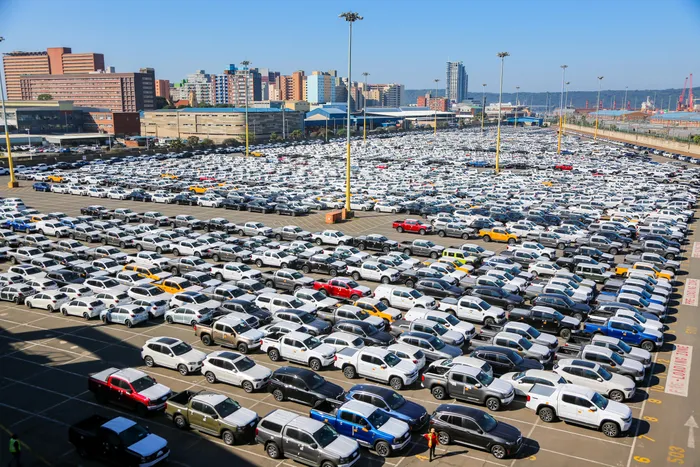
Transnet Port Terminals (TPT) announced on Monday that it handled a total of 792 574 fully built units (FBU) between 1 April 2025 and 15 February 2026
Image: Supplied by TPT
Transnet Port Terminals (TPT) announced on Monday that it handled a total of 792 574 fully built units (FBU) between April 1, 2025 and February 15, 2026. The news has received welcome reactions from experts.
TPT said that it handled a total of 792 574 fully built units (FBU) between April 1, 2025 and February 15, 2026.
“The number includes new imports, export and transshipment vehicles. In the past 10 months, the three car terminals located in Durban, Gqeberha, and East London have broken seven productivity records, driven by increased volumes of FBUs moving on and off car carriers. The introduction of new vehicle distributors such as Jameel Motors, along with the return of automotive importers including MG, JMC, TATA, and Geely to the South African market, has significantly supported the sector’s improved performance,” it said.
TPT added that locally based automotive original equipment manufacturers have also contributed to the positive trajectory, with exports meeting Euro emission standards and boosting international demand.
“New models such as the Ranger PHEV and BMW hybrid, introduced in late 2024, began ramping up production in 2025, further strengthening export volumes. Over and above the surge in import and export volumes, transshipment activity has shown notable improvement compared to the previous year,” it said.
TPT said that despite strong competition from port terminals along the Eastern coast of Africa, transshipment volumes continue to rise – contributing significantly to overall volume growth which further positions TPT’s automotive terminals as a preferred automotive hub.
General Manager of Commercial and Planning at TPT Michelle van Buren Schele said that they have had to reinvent themselves for growth as a business. “Our initiatives coincided with improved market conditions, lower inflation and interest rates which sparked the demand we have witnessed.”
TPT said that according to the country’s automotive business council, the National Association of Automobile Manufacturers of South Africa (naamsa), South Africa’s new vehicle market delivered a landmark performance in 2025, finally recovering above 2019 pre-pandemic levels and hitting highs not seen in a decade.
“South Africa’s new vehicle market delivered a landmark performance in 2025, finally recovering above 2019 pre-pandemic levels and hitting highs not seen in a decade. This upward swing, closely tied to broader economic improvements, was significantly buoyed by a cumulative 150bps in interest rate cuts since September 2024, record-low vehicle inflation, an influx of affordable model imports, and the liquidity injection from the two-pot retirement system withdrawals,” it said.
Dr Jacob van Rensburg, head of research and development at the Southern African Association of Freight Forwarders (SAAFF), said that exceeding annual handling targets indicates operational stability and improved terminal productivity (across the board and in auto).
“In the automotive context, throughput is the primary variable: higher fully built unit (FBU) volumes signal improved berth utilisation, yard management, labour coordination, and vessel turnaround performance. After several years of volatility in South Africa’s port system, meeting and surpassing targets reflects incremental recovery in execution capacity,” he said.
Van Rensburg added that in the automotive sector, this provides greater scheduling certainty and reduces logistics risk.
“Approximately 45–50% of FBUs are exports, 40–45% are imports, and 5–10% are transshipments. Export volumes support domestic production and OEM competitiveness, while rising imports – particularly from China – reflect structural shifts in sourcing patterns. A more diversified export base reduces concentration risk but exposes producers to geopolitical and demand volatility,” he said.
Van Rensburg concluded that further improvements are possible, but conditional. “Global risks (e.g., Middle East tensions affecting shipping costs, fuel, and schedules) remain material. Locally, AGOA renewal until end-2025 provides short-term support, yet policy uncertainty persists. Sustained gains will depend on equipment reliability, rail integration, berth optimisation, and stable trade policy alignment.”
Ulrich Joubert, an independent economist, said that this is really good news that they achieved their target already by before the end of the financial year at the end of March.
“One must remember that the car industry was under a lot of pressure during last year. The disruption that took place because of the imposition of tariffs by the United States on everything, and even more things than what we anticipated. And actually also targeting the car industry and car imports into the United States,” he said.
Joubert added that especially with the challenges at the Ports, this is really good news for the sector and TPT.
BUSINESS REPORT