

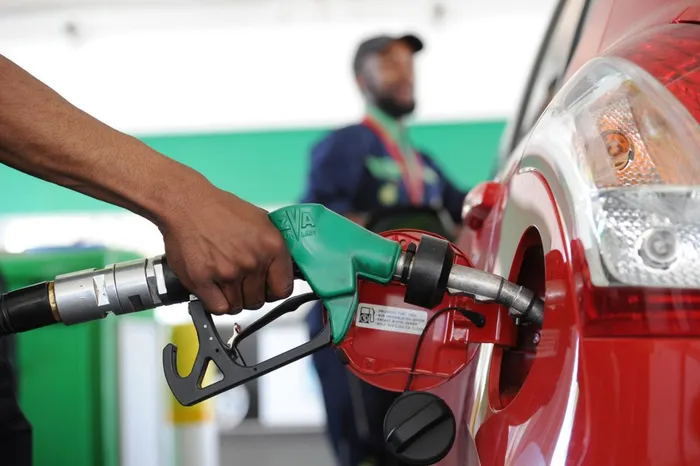
South African consumers face a challenging situation as fuel prices rise, with experts warning of significant economic implications and urging households to seek financial assistance.
Image: Karen Sandison / Independent Media
The latest fuel price increase could not have come at a worse time for South African consumers according to Neil Roets, CEO of Debt Rescue.
Roets explained that while a 20 cent increase in petrol and the sharper rise in diesel may appear modest on paper, the knock-on effect across the economy will be significant.
Minister of Mineral and Petroleum Resources, Gwede Mantashe on Monday said that based on current local and international factors, the fuel prices for March 2026 will be adjusted as follows: Petrol 93 (ULP & LRP): twenty cents per litre (20.00 c/l) increase. Petrol 95 (ULP & LRP): twenty cents per litre (20.00 c/l) increase. Diesel (0.05% sulphur): sixty-two cents per litre (62.00 c/l) increase. Diesel (0.005% sulphur): sixty-five cents per litre (65.00 c/l) increase.
Mantashe added that the average Brent Crude oil price increased from 64.08 US Dollars (R1033) to 69.08 (R1114) during the period under review.
“The main contributing factors are the higher shipping rates as well as the geopolitical uncertainty caused by the tension between the US and Iran, which could result in disruption of crude oil supply in the Strait of Hormuz,” he said.
“Fuel is embedded in the cost structure of nearly every essential good and service. When it rises, transport costs increase, food prices climb, and the overall cost of living accelerates. Consumers feel it almost immediately,” he said.
He noted that households are already contending with high interest rates, elevated food costs and persistent debt obligations.
With the repo rate remaining at 6.75%, many bondholders and vehicle finance customers are paying substantially more each month than they did just a few years ago.
“Disposable income has been steadily eroded. For many families, there is simply no buffer left to absorb additional increases,” Roets added.
The timing is particularly difficult with the Easter period approaching, when many families traditionally travel to visit relatives.
“For millions of South Africans, even short-distance travel is becoming financially unviable. What should be a time of connection and rest is instead overshadowed by budget anxiety,” he said.
Roets warned that sustained fuel increases, combined with global geopolitical pressures and domestic economic constraints, risk deepening the financial vulnerability of already over-indebted consumers.
He urged households who are struggling to seek assistance sooner rather than later, emphasising that early intervention can prevent long-term financial damage.
Adding to the pressures of the fuel price hike on consumers, the Iran conflict placed further uncertainty for consumers with the geo political tensions possibly having an effect on the South African Reserve Bank's (Sarb) stance on interest rates for the country.
While 2026 was widely predicted to see the start of an easing in the repurchase rate (repo rate) policy, the global tensions could well undo the path that was meant for the Sarb's Monetary Policy Committee this year.
As inflation was contained and economic growth showing a slight upward projection, expectations had built around further repo rate cuts this year to put the repo rate at 6.5%, and possibly another in early 2027.
Frank Blackmore, Lead Economist at KPMG South Africa said that Markets have already begun reacting as oil prices soared in recent days.
Blackmore pointed to immediate financial shifts that could have far reaching implications.
“The immediate consequence is that we have seen already an increase in the price of oil and gold as well as the depreciation of the Rand and the appreciation of the dollar,” he said.
Follow Business Report on Facebook, X and on LinkedIn for the latest Business and tech news.