

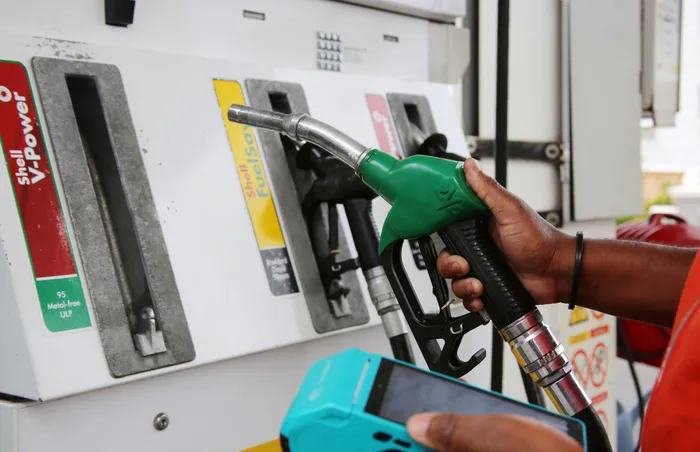
Concern has been raised by trade unions and other sectors following an increase in both grades of petrol and diesel for March announced by the Department of Mineral and Petroleum Resources on Monday.
Image: Tumi Pakkies / Independent Newspapers
Concern has been raised by trade unions and other sectors following an increase in both grades of petrol and diesel for March announced by the Department of Mineral and Petroleum Resources on Monday.
Minister of Mineral and Petroleum Resources, Gwede Mantashe on Monday said that based on current local and international factors, the fuel prices for March 2026 will be adjusted as follows: Petrol 93 (ULP & LRP): twenty cents per litre (20.00 c/l) increase. Petrol 95 (ULP & LRP): twenty cents per litre (20.00 c/l) increase. Diesel (0.05% sulphur): sixty-two cents per litre (62.00 c/l) increase. Diesel (0.005% sulphur): sixty-five cents per litre (65.00 c/l) increase.
Mantashe added that the average Brent Crude oil price increased from 64.08 US Dollars (R1033) to 69.08 (R1114) during the period under review.
“The main contributing factors are the higher shipping rates as well as the geopolitical uncertainty caused by the tension between the US and Iran, which could result in disruption of crude oil supply in the Strait of Hormuz,” he said.
Gavin Kelly, the CEO of the Road Freight Association (RFA), said that the increase in fuel prices in March 2026 is a direct result of upward pressure on the international price of oil due to both supply and logistics risks following the start of hostilities between Iran and the US and Israel.
“The RFA has noted with both dismay and concern that the price of diesel is increasing by between R0.60 and R0.65 per litre. Given that diesel is the primary source of fuel for most medium and heavy commercial transporters, this will place an immediate cost burden on daily operations,” he said.
Kelly added that transporters will be faced with – either immediately or later, depending on their operating models or agreements – factoring this increase (and any others that may arise) into their pricing when offering freight transportation services.
“This means that the gains which were achieved through the gradual reduction of the basic fuel price during 2025 will be erased and the consumer will, inevitably, begin to feel this change in increasing prices at the till,” he said.
Kelly said that unfortunately, fuel is one of the basic input costs in a transportation business that has a huge impact on rates for transport. “The general economy will also not be immune – with this pressure becoming an upward inflationary force – thus affecting both future decisions regarding the repo rate and the value of the Rand in the pocket of the man on the street.”
Abigail Moyo, spokesperson of the trade union UASA, said the union is deeply concerned about the recent geopolitical tensions and escalations between the United States and Iran in the Middle East, which led to attacks by the US and Israel over the weekend.
“This escalation drove oil prices from below $60 (R969) to over $80 (R1292) per barrel during the month. Although the Rand showed some resilience, it was insufficient to sustain positive fuel price recoveries,” she said.
Moyo said that UASA remains hopeful that the fuel price outlook will improve. If not, rising inflation may pose further challenges for consumers seeking financial relief.
Matthew Parks, Cosatu Parliamentary Coordinator, said that Cosatu is deeply worried about the pending fuel price hike and the potential, given the outbreak of war in the Middle East, for the international oil price and thus fuel prices to skyrocket.
“This will have a devastating impact upon workers, commuters and the economy. This is something that an economy projected to grow by only 1.6% and a staggering unemployment rate of 41.1% can ill afford. It will be critical that the government moves swiftly to cushion the working and the economy from the rising price of petrol. Measures should include possible petrol price relief if it rises further, repo rate cuts by the SARB and efforts to reduce the price of electricity,” he said.
Ester Ochse, Product Head of Integrated Advice at FNB, said that the consumer will feel the impact of the diesel and petrol price increases.
“Unfortunately, this is a result of the increase in global oil prices and under-recovery of diesel and petrol,” Ochse said.
BUSINESS REPORT