

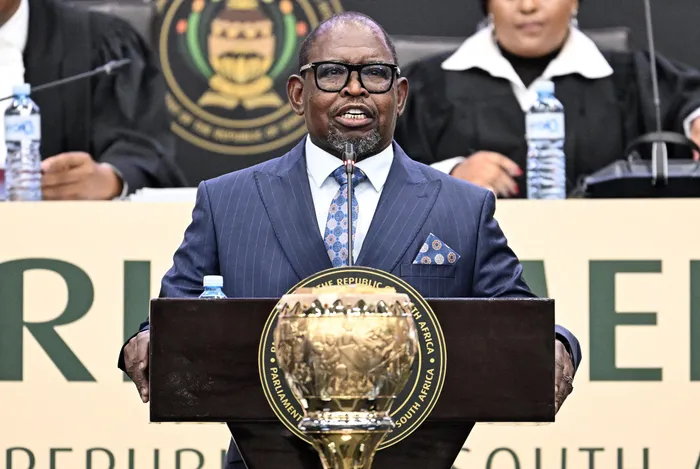
Economists have lauded Finance Minister Enoch Godongwana's 2026 National Budget speech on Wednesday as a consumer-friendly and good news budget.
Image: Supplied
Economists have lauded Finance Minister Enoch Godongwana's 2026 National Budget speech on Wednesday as a consumer-friendly and good news budget.
North West University Business School economist Prof Raymond Parsons said that the overall welcome impact of the Budget on the economy will be positive and confidence-building. “The markets will also price in what is a ‘good news’ Budget in favourable fiscal circumstances. Finance Minister Enoch Godongwana has displayed a credible pair of hands in playing the better economic cards he now holds in addressing the inevitable competing demands on South Africa’s still limited public finances."
Parsons added that while global factors still pose a risk, South Africa’s terms of trade have improved as a result of the commodity price boom. “The Budget strategy now offers a more stable macro-background, with the prospect of further interest rate cuts this year, and possible sovereign credit rating upgrades over the next couple of years. Business and consumer confidence should also gain from the Budget relief on ‘bracket creep’ and medical aid credits.”
Parsons said that the major advantage of building confidence in fiscal sustainability through the Budget’s commitment to higher inclusive growth is that it strengthens resilience but also makes other aims - such as job creation and a bigger tax base - easier to attain. “South Africa therefore now needs to shake off the chains of a low-growth economy. The present economic recovery is still modest and uneven. The economy is not yet on autopilot, and disappointed expectations can still easily become self-fulfilling. Much higher levels of fixed capital formation are now needed if the Budget’s modest near-term average growth projection of 1.8% is to surprise on the upside and eventually meet the GNU’s GDP growth target of 3.5% by 2030.”
Economists have lauded Finance Minister Enoch Godongwana's 2026 National Budget speech on Wednesday as a consumer-friendly and good news budget.
Image: Supplied
Unisa economist Dr Eliphas Ndou said that this is an improved budget outlay with an optimistic outlook that is needed to sustain the improvement in the various economic sentiment indicators. “Economic growth, although projected to rise in the medium term, is still below the optimal level that can significantly reduce high unemployment. The return of the inflation-adjusted income tax brackets is good news for constrained consumers, who will now have more disposable income, and this will go a long way in easing their financial burdens.”
Professor Waldo Krugell, an economist at North West University, said that growth projections for 2026–2028 are identical to the 2025 Medium-Term Budget Policy Statement (MTBPS). “Consolidated expenditure trajectory is broadly maintained — the Minister describes it as keeping the 'broad medium-term spending plans. Debt stabilises in 2025/26 and declines thereafter, as promised. The deficit narrows as planned, reaching 3.1% by 2028/29.”
Krugell added that revenue is lower over the medium term because the R20 billion tax increase was withdrawn. “The Minister frames this as affordable given in-year revenue overperformance, but it does narrow fiscal space. Debt-to-GDP peak is 1 percentage point higher (78.9% vs 77.9%), partly deliberate (pre-funding) and partly from weaker nominal GDP. We can be cautiously convinced that the Minister is sticking to his broad plans — the direction is right — but the pace of fiscal consolidation has modestly softened.”
Dawie Maree, head of information and marketing at FNB Agriculture, said that in general, it is a positive budget. “I think market realities, increased commodity prices and more confidence in the SA economy, assisted the Minister to deliver a more positive budget. The more than expected tax income paved the way for increased spending on the things that matter for growth. And this is where agriculture will benefit. Expenditure on infrastructure and logistics (ports, etc.) will always be to the sector’s benefit, although it is indirect.
Maree added that he is disappointed that no mention was even made about foot-and-mouth disease (FMD). “It was declared a national disaster two weeks ago in the SONA, but nothing in the budget speech. That being said, we can expect that it will be addressed in the Departmental budget speech.”
Jurgen Eckmann, Wealth Manager at Consult by Momentum, said that the National Budget 2026 picks up where the President left off with SONA, with the Finance Minister delivering a largely consumer-friendly budget.
“However, projections for GDP growth and fiscal health are not exciting, which shows us that while reform momentum is improving, the material impact on growth is still gradual," he said.
Eckmann added that consumers will be cheering about some relief provided in the form of a full inflation adjustment to personal income tax brackets (after two years of bracket creep), while the increase in the tax-free savings account limit and the higher retirement fund deduction cap meaningfully expand tax-efficient saving capacity. “For those able to use these tools, this is one of the more favourable savings environments in recent years.”
BUSINESS REPORT