

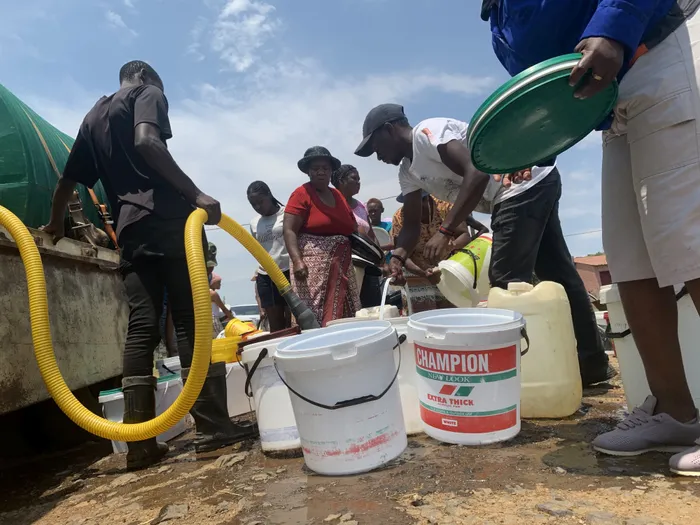
The intervention comes as South Africa grapples with a widespread water supply crisis, largely attributed to poor infrastructure maintenance, weak governance systems and ineffective credit control measures within municipalities.
Image: Bhekikhaya Mabaso / Independent Newspapers
Finance Minister Enoch Godongwana on Wednesday announced a decisive shift in the government’s approach to struggling municipalities, signalling a move from oversight to active structural intervention to address deepening governance, financial and service delivery failures at the local level.
The intervention comes as South Africa grapples with a widespread water supply crisis, largely attributed to poor infrastructure maintenance, weak governance systems and ineffective credit control measures within municipalities. With local government elections looming later this year, stabilising municipalities is also seen as critical to curbing rising service delivery protests.
While tabling the 2026 National Budget Review in Parliament on Wednesday, Godongwana said the National Treasury identified weak revenue collection, poor credit control, and a lack of financial discipline as the key factors in municipal financial instability.
According to the Budget Review documents, rising electricity and water input costs intensify financial pressures. However, the accumulation of arrears largely reflects failures to bill accurately, collect revenue consistently, and ring-fence and remit collections for bulk services.
Godongwana said local government is the sphere where communities experience the state most directly but many municipalities are in financial and operational distress and therefore unable to deliver services as they should.
"Audit outcomes highlight this unacceptable reality: 63% of municipalities are in financial distress, and the proportion of clean audits remains unacceptably low," Godongwana said.
Budget 2026
Image: Logo
"A central challenge with municipalities is that they not only differ in capacity, but also in their revenue-raising potential. This demands a more targeted approach to respond to the diverse pressures facing municipalities."
Godongwana said these systematic weaknesses have left 88 municipalities with unfunded budgets and limited capacity to maintain infrastructure and sustain services.
In a pre-Speech media briefing, Deputy Finance Minister David Masondo echoed Godongwana's sentiments, stating the 2026 Budget signals a fundamental shift in the effort to fix local government.
"For a decade, inter-governmental flows have masked financial weaknesses in the sub-national government, with 63%, which is 162, of municipalities in financial distress.In 2023/24, provinces were struggling to balance compensation costs and service delivery. This approach has reached its limit. Government is now moving from oversight to active structural intervention," Masondo said.
"The reforms underway include shifting to a utility model for water and electricity with these services to run like businesses accountable to government and the public. To address this delivery crisis in struggling municipalities, infrastructure projects funded by conditional grants will be delivered by implementing agents such as the Development Bank of Southern Africa or relevant district municipalities where capacity exists. And of course, capable municipalities will continue to manage their own grants."
According to Treasury, unauthorised, irregular, fruitless and wasteful expenditure in municipalities reached R236.3 billion in 2023/24 (R81.6bn unauthorised, R137bn irregular and R17.7bn fruitless and wasteful).
To address this, Godongwana said Treasury is revitalising support for long-term financial plans to improve project identification, sustainably plan cash flows and inform financial decisions.
"This demands a more targeted approach to respond to the diverse pressures facing municipalities. "The National Treasury is revitalising support for the development of long-term financial plans," he said.
"These plans will improve project identification, sustainably plan cash flows and inform financial decisions. This will negate the challenge of unfunded mandates and limited capacity to maintain infrastructure and sustain services."
Godongwana also said further structural reforms are underway, including a comprehensive review of the local government fiscal framework. This review will modernise the intergovernmental system and build a more capable, resilient and appropriately differentiated local government sphere.
After years of support measures to strengthen financial governance, the National Treasury invoked section 216(2) of the Constitution against persistently noncompliant municipalities, enabling the Treasury to halt national transfers to those in consistent breach of the Municipal Financial Management Act.
This provision was applied against 75 municipalities, what Treasury called a decisive intervention necessary to restore good financial governance and financial integrity, protect public resources and ensure sustainable service delivery.
BUSINESS REPORT