

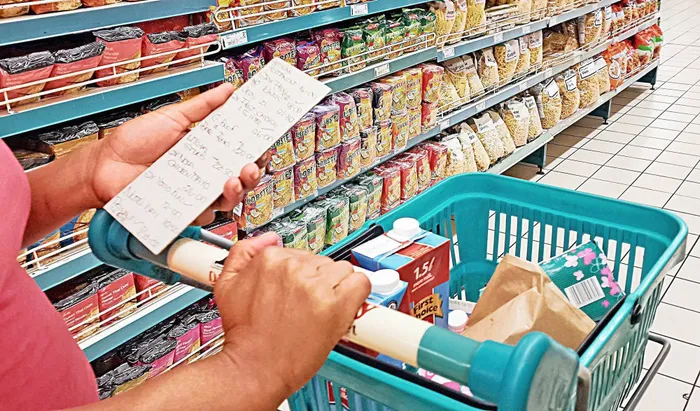
The Pietermaritzburg Justice and Dignity Group (PMBEJD) household affordability Index released on Monday indicated that in February 2026, the average cost of the Household Food Basket was R5 383,81.
Image: File
The latest Household Affordability Index released on Monday by the Pietermaritzburg Justice and Dignity Group (PMBEJD) brings good news for consumers. In February 2026, the average cost of the Household Food Basket decreased to R5 383,81, reflecting a month-on-month drop of R17,63 (-0,3%) compared to January 2026. While prices are still slightly higher year-on-year — up R70,59 (1,3%) — the monthly decrease offers welcome relief for households managing tight budgets.
Mervyn Abrahams, Director at PMBEJD, said that the Household Food Basket shows that on average; food prices have come down marginally over the past month, and a little up from a year ago. “In February 2026, the Basic Nutritional Food Basket, using the same household size as tracked by the Household Food Basket, is R6 459,83. This shows that the difference in cost between the foods which families living on low incomes try and buy each month (a household food basket) and the foods which families would like to buy and should buy to meet basic nutrition (a basic nutritional food basket) was R1 076,02 (R5 383,81 vs. R6 459,83).”
Abrahams added that in February, of the 44 foods tracked in the basket: 19 foods increased in price, 24 foods decreased in price, and 1 food remained unchanged. “Foods in the basket which increased in price in February 2026 by 5% or more, include: onions (9%), carrots (5%), and cabbage (7%). Foods in the basket which increased in price in February 2026 by 2% or more, include: maize meal (2%), rice (2%), beef liver (3%), wors (4%), tinned pilchards (3%), canned beans (4%), and white bread (2%).”
Abrahams said foods in the basket which decreased in price in February 2026, by 5% or more, include: soup (-8%), tomatoes (-6%), butternut (-12%), and green pepper (-7%). “Foods in the basket which decreased in price in February 2026, by 2% or more, include: sugar beans (-3%), tea (-3%), Maas (-3%), eggs (-3%), chicken gizzards (-2%), beef (-4%), beef tripe (-2%), spinach (-3%), cremora (-4%), margarine (-2%), and peanut butter (-3%).”
Abrahams added that Statistics South Africa’s latest Consumer Price Index for January 2026 shows that Headline inflation was 3,5%, and for the lowest expenditure quintiles 1-3 it is 2,6%, 2,7%, and 2,9% respectively. “CPI Food & non-alcoholic beverages inflation was 4,4%. STATS SA’s Producer Price Index for December 2025 shows Agriculture was -6,6%, of which, Products of crops and horticulture was -23,5%, and Live animals and animal products was 23,7%.”
Abrahams concluded that the National Minimum Wage is R28,79 per hour, R230,32 for an 8-hour day, and R4 836,72 for an average 21-day working month. “In February 2026, with 20 working days, the maximum National Minimum Wage for a General Worker is R4 606,40. Workers work to support their families. The maximum wage of R4 606,40 when disbursed in a family of four persons is R1 151,60. This is below the National Upper-Bound Poverty Line of R2 846 per capita per month, and below the National Lower-Bound Poverty Line of R1 415 per capita per month.”
Evashnee Naidu, KwaZulu-Natal regional manager of Black Sash, said that while there might have been a slight reduction in the food basket month-on-month, the nutritional value of what food is actually purchased leaves much to be desired. “Poorer households have to use their income sparingly and after settling their most pressing debts, can they use what is left on food. This means that the nutritional value of food can scarcely be a concern and this puts these households at greater risk of ill health and forcing them to use what little is left of monthly budgets to now also look at possible health risks that may arise.”
Naidu added that all of these factors place further strain on households and will eventually impact government spending.
Aliya Chikte, an Economic Justice Project Officer at the Alternative Information and Development Centre (AIDC), said that the recent slowdown in inflation is not enough to reduce food prices to where they were a year ago.
“Although food price increases have moderated and are rising more slowly than wages and social grants, this offers little relief to those who are unemployed or unfairly excluded from social assistance,” Chikte said.
Chikte added that the latest Stats SA report on poverty trends reveals that two-thirds of South Africans are living in poverty.
“Meanwhile, the Child Support Grant and the Social Relief of Distress (SRD) grant remain far too low to enable households to meet even their most basic needs. As the Minister of Finance tables the budget on Wednesday, it is imperative that the government introduces the long-awaited Basic Income Guarantee,” Chikte said.
BUSINESS REPORT