

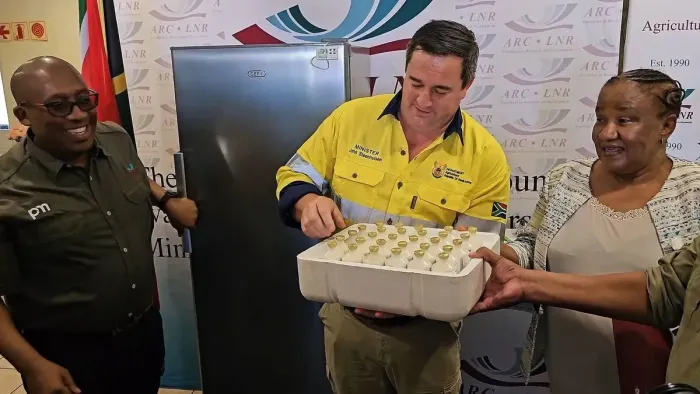
Minister of Agriculture John Steenhuisen announced on Tuesday that the first batch of one million high-potency vaccine doses against Foot and Mouth Disease from Biogénesis Bagó in Argentina is scheduled to arrive this weekend in South Africa
Image: File Supplied
Minister of Agriculture John Steenhuisen announced on Tuesday that the first batch of one million high-potency vaccine doses against Foot and Mouth Disease from Biogénesis Bagó in Argentina is scheduled to arrive this weekend in South Africa. Steenhuisen said that the vaccines are part of the government's comprehensive plan to vaccinate the entire national herd. Agricultural associations have welcomed the news.
Steenhuisen said that this shipment is the first phase of a broader agreement, with a further five million doses set to follow in March. “These vaccines are a critical component of the Department of Agriculture’s new strategy against FMD, where the national herd of over 14 million cattle will be proactively vaccinated, to ensure South Africa transitions to “FMD-Free Status with Vaccination.”
Steenhuisen added that in addition to the Argentine supply, the Botswana Vaccine Institute (BVI) remains a vital partner; it has delivered two million doses to date since the recent outbreak and is scheduled to provide doses of FMD vaccine on a monthly basis. “In addition to the Argentine supply, the Botswana Vaccine Institute (BVI) remains a vital partner; it has delivered two million doses to date since the recent outbreak and is scheduled to provide doses of FMD vaccine on a monthly basis.”
The Department said that Minister Steenhuisen called on the Agricultural Research Council (ARC) to fast-track its production of the locally produced FMD vaccine that can protect livestock for up to 12 months. “On 6 February 2026, the ARC handed Minister Steenhuisen the first batch of 12,900 locally produced FMD vaccines in over 20 years. These vaccines have subsequently been distributed to the provinces for vaccination. The ARC has committed to producing 20,000 vaccines per week and scaling up to 200,000 per week in 2027. By the end of March, a total of over five million vaccines will have entered the country from three international suppliers.”
Francois Rossouw, the CEO of the Southern African Agri Initiative (Saai), said that the arrival of one million vaccine doses is, in principle, an important development. “Any additional vaccine supply is welcome in the context of a crisis of this magnitude. However, the real issue is not the announcement of doses arriving, but how, where and to whom those vaccines will be distributed. To date, there has been no clear indication of which regions or producers will receive this first batch. The Minister’s rollout strategy prioritises highly infected regions. Yet over the weekend, senior political figures were publicly vaccinating cattle in the Western Cape, which is one of the least infected provinces.
Rossouw added that this creates understandable confusion about whether the strategy being implemented aligns with what has been communicated. “There is also a concerning lack of clarity around the objective. In a recent media statement, the Minister referred to vaccinating the national herd. In earlier statements and interviews, the focus was on vaccinating targeted herds in specific control areas. These are two very different strategies with vastly different logistical, financial and epidemiological implications. The industry needs a consistent and transparent plan. More fundamentally, centralising the entire vaccine value chain within the government is the wrong approach. Procurement and distribution bottlenecks have already cost us critical time. Unless private sector capacity is urgently unlocked for procurement, storage and distribution, we will not reach herd immunity within the required timeframe.”
Dawie Maree, head of information and marketing at FNB Agriculture, said this is at least a start for the process.
“Given the size of the outbreak and the required numbers, this will be great if the vaccines can be used in the most urgent and intense outbreaks e.g. in the dairy industry in KZN etc. Follow-up imports are now crucial to maintain momentu,” Maree said.
Dewald Olivier, the CEO of Red Meat Industry Services, said that the Minister’s announcement of the arrival of one million vaccine doses, together with updates on further shipments, renews his hope that this outbreak can finally be brought under control.
“However, getting vaccines into the country is only the first step. The urgency and focus must now be on practical execution — distributing vaccines without delay, expanding veterinary capacity, and ensuring that all cattle owners in South Africa have access. This will require clear, practical coordination on the ground, and the industry stands ready to support this execution. The plan is in motion; it now needs to deliver the results,” Olivier said.
BUSINESS REPORT