

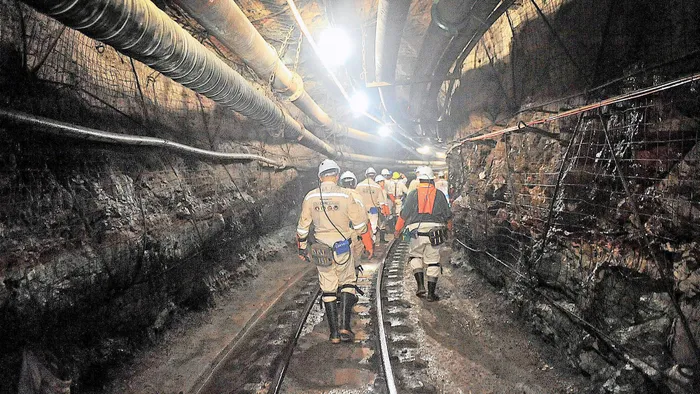
A new Bureau for Economic Research (BER) document indicated that South Africa’s mining sector has been in decline in recent years but still has potential to be a force globally.
Image: Itumeleng English/ Independent Newspapers
A new Bureau for Economic Research (BER) document indicated that South Africa’s mining sector has been in decline in recent years but still has potential to be a force globally.
Robert Botha from BER said that the economic history of South Africa is intimately bound to the extraction of its mineral wealth.
“Despite this geological lottery, the sector faces various constraints that have prevented it from taking full advantage of successive commodity booms. Once the primary engine of the economy, the sector’s economic contribution has stagnated, allowing the notion to take hold that South African mining is a sunset sector,” Botha said.
Botha added that despite successive commodity price booms, in real terms the sector has declined since 1994. “Over this period, the sector contracted by 0.29% on average. By 2024, the sector was nearly 12% smaller than it was in 1994. The long-term performance of the South African mining sector is defined by a significant structural decline that began in the 1970s. A collapsing gold sector, once the backbone of the economy, reduced aggregate mining production volumes.”
Botha said the most profound evidence of structural failure occurred during the global "Missed Super-Cycle" (2001–2008). “While peer resource-rich nations like Australia saw mining investment and GDP surge due to Chinese industrialisation, South Africa’s mining contribution actually shrank by 1%. Research indicates that this divergence was largely driven by domestic policy transitions rather than geology.”
Botha added that the trajectory of investor confidence, as tracked by the Fraser Institute, reveals a steady descent. “South Africa transitioned from a premier investment destination in the early 2000s to a bottom-tier jurisdiction by 2024. This decline was accelerated by the policy shock era (2004–2010), followed by a crisis of confidence era (2011–2017) which was marked by labour unrest and state-led corruption.”
Botha said despite a long-term decline in real terms, the South African mining sector remains a cornerstone of the national economy. “In 2024, the industry directly contributed R442 billion, representing 6% of the nominal GDP. Beyond its direct output, the sector functions as a vital economic engine through significant multiplier effects. The Minerals Council estimates an employment multiplier of ten, meaning every direct mining job supports ten additional opportunities in other sectors.”
Botha added that the sector is the primary anchor for South Africa’s external trade balance, accounting for over 50% of all merchandise export earnings. “This trade surplus provides a critical cushion for the current account, helping to offset structural deficits caused by the importation of machinery and refined fuels.”
Botha said that between 2018 and 2024, the sector accounted for between 6.5% and 10.9% of total national revenue through corporate income tax, mining royalties, and personal income tax. “In real terms, the industry has shrunk by 11.5% since 1994, exerting a persistent drag on national GDP growth. This decline is primarily driven by the collapse of the gold sector, which saw an 84% reduction in output over this period. However, if gold production is excluded, the rest of the sector actually grew by 41%, revealing a stark divergence in sub-sector performance.”
Botha added that mining employment has steadily contracted from its 1987 peak of over 760,000 jobs to approximately 465,000 today, reflecting a disconnect between rising wages and stagnating labour productivity. “Furthermore, the sector faces a capital productivity paradox where increased fixed capital formation, which reached R159 billion in 2024, fails to translate into higher volumes due to external constraints.”
Botha said South Africa possesses one of the world's most significant mineral endowments. “The country holds the world’s largest reserves of Platinum Group Metals (PGMs) and manganese, as well as the second largest deposits of chromium, positioning it as an indispensable anchor in global industrial value chains. Despite this wealth, the sector's full potential remains largely latent: with only 9% to 14% of the country geo-mapped at a detailed 1:50,000 scale, significant discoveries likely remain untapped.”
Botha added that structurally, the industry is split between large-cap multinational majors and a vital but struggling junior mining sector. “The majors—such as Anglo American and Glencore—operate at a massive scale, focusing on brownfields exploration to extend the life of existing assets. Junior miners serve as the industry’s research-and-development arm, focusing on high-risk greenfields exploration. The long-term health of the industry depends on a functional relationship where juniors discover new deposits and majors bring them into production.”
BUSINESS REPORT