

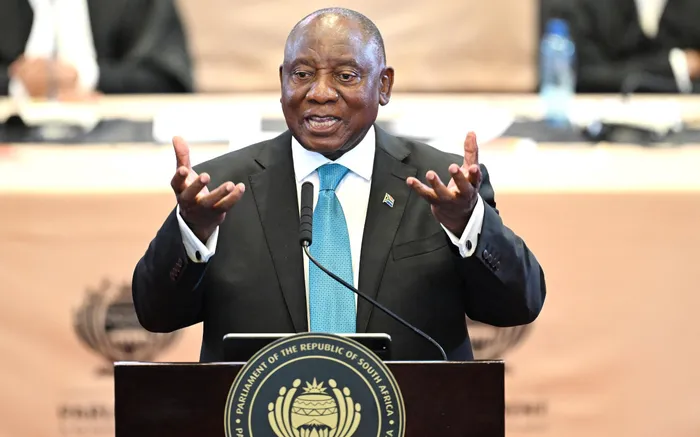
President Cyril Ramaphosa.
Image: GCIS/Phando Jikelo
Business Unity South Africa (Busa) expressed its support for President Cyril Ramaphosa’s recent State of the Nation Address (Sona), labelling it a significant confidence signal poised to enhance the investment climate and stimulate economic growth.
However, Busa cautioned that public trust and investor optimism hinge critically on the actual execution of the proposed reforms.
“A positive narrative, backed by clear plans, boosts confidence, which in turn attracts investment that drives growth,” stated Busa Chief Executive Officer Khulekani Mathe.
“This speech has, in large measure, achieved a positive narrative. The next test is implementation.”
The President's mention of various constraints impacting daily life and business operations, including public safety, poor municipal performance, and unreliable infrastructure, was well-received by Busa.
However, the organisation emphasised that the focus must now shift toward effective execution, with clear accountability and measurable outcomes.
Busa particularly hailed the emphasis placed on tackling crime, corruption, and the illicit economy, asserting that business cannot flourish in a lawless environment.
These pervasive issues inflate operational costs, erode competitiveness, and diminish overall economic confidence.
The organisation welcomed the call for timely implementation of the Madlanga Commission's recommendations, advocating for enhanced investigations, prosecutions, and a robust system of consequence management.
Furthermore, the integration of technology into law enforcement initiatives was viewed as a timely advancement, provided it is thoughtfully governed and legally applied.
“Fighting crime through the use of technology is long overdue, and the private sector stands ready to support these initiatives,” Mathe affirmed.
Busa applauded the President's commitment to prioritising water management, urging that a results-driven approach to delivery should overshadow the introduction of new bureaucratic processes.
Although the acknowledgment of water as a crucial issue was welcomed, Mathe stressed, “Recognition of water as the pressing challenge is commendable but does not go far enough. We should not have reached this point in the first place.”
The establishment of the National Water Crisis Committee, led by the President, is expected to influence prompt repairs and disciplined maintenance at the municipal level.
Busa also supported the move to incentivise municipalities in safeguarding revenues from essential services like water and electricity for service operations and infrastructure upkeep.
While agreeing with the ambitious goals of growth and inclusion, Busa raised concerns regarding the lack of specificity in the strategies outlined in the President's address. Mathe indicated that a clearer programme detailing policy choices and responsibilities is urgently required to facilitate a constructive evaluation of proposals.
“The Growth and Inclusion strategy lacks detail to allow for its assessment,” he noted, urging for a more actionable framework that reduces barriers for investment and expansion.
Busa endorsed proposals aimed at bolstering infrastructure delivery, including the establishment of specialised courts for commercial infrastructure, which could significantly expedite legal processes if adequately resourced. On energy reform, they welcomed the explicit direction concerning Eskom’s restructuring, particularly the establishment of an independent Transmission System Operator (TSO), a move seen as essential for restoring order and clarity in the energy sector.
“We are looking forward to hearing more about the new task team but are pleased to see that National Treasury and the Minister of Finance will be part of it,” stated Mathe, stressing the urgency behind the three-month deadline for reporting back on these reforms.
Busa also commended initiatives aimed at propelling tourism, such as the rollout of an electronic travel authorisation system for visa-required nations, a crucial element in enhancing tourism's contribution to job creation.
Furthermore, increasing the skills development levy repayment to employers by 40% is seen as a pivotal incentive, encouraging ongoing investment in skill building necessary for sustainable economic growth. Mathe remarked that the commitment to reform the National Skills Fund represents a significant victory, with progress expected to be measured through improved training quality and governance.
Additionally, the hints of housing policy reforms, which could invigorate the housing market, along with the intention to solicit input on the business licensing bill, are viewed as potential catalysts for invigorating the small business sector.
In conclusion, while the overall tone of the Sona has been positively received, Busa maintains that the real measure of success will depend on the government’s commitment to turn these plans into action. Mathe stated, “The speech recognised the positive role business plays in our economy, and we stand ready to support the ambitious plan announced by the President.”
BUSINESS REPORT