

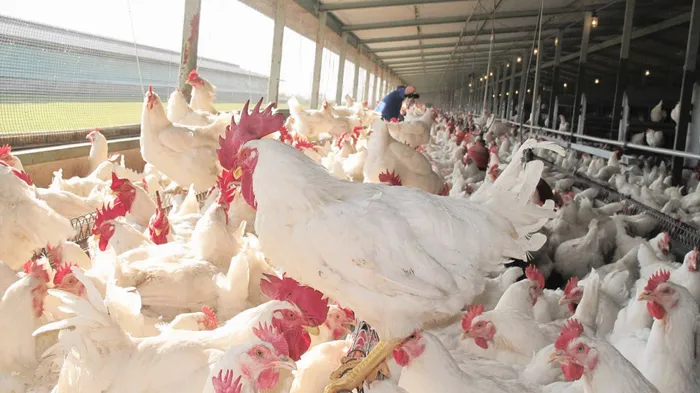
Historically ranked behind Brazil and the US, South Africa is now the second most competitive poultry producer globally.
Image: Supplied
South Africa’s poultry production sector has once again demonstrated its global competitiveness, outperforming European producers and now surpassing the United States in technical efficiency.
Historically ranked behind Brazil and the US, South Africa is now the second most competitive poultry producer globally, using less feed to produce a kilogram of chicken than most of its international counterparts.
This is according to the latest Bureau for Food and Agricultural Policy (BFAP) 2025 Competitiveness Benchmark Report, compiled in collaboration with Wageningen University in the Netherlands. The report found that South Africa’s average production cycle of 31.5 days is the shortest among all countries studied, while carcass weights have increased by 4.5% over the past decade.
The cost differential between South Africa and Brazil narrowed steadily until 2023. Although it widened again in 2024 due to drought-related feed price increases, the long-term trend indicates a strengthening competitive position.
Feed costs remain the largest variable in the comparison. However, improvements in local soybean processing are expected to support further gains in the near future. Feed conversion efficiency has improved by 14.1% over the past decade, underscoring ongoing advancements in genetics, management practices and production technology.
“Input costs account for approximately 70% of the cost of rearing a bird. As such, feed costs remain the dominant driver of overall production costs, but the report highlights that efficiency gains have mitigated much of the impact of price volatility,” said Izaak Breitenbach, the CEO of South African Poultry Association (SAPA).
The study noted that although the nominal price of feed rations in 2024 was 26% higher than in 2015, the feed-related cost per kilogram of chicken produced increased by only 8% due to improved conversion efficiency.
This outcome reflects the sector’s investment in improved production systems and its ability to maintain technical competence and competitiveness despite adverse cost conditions.
While the cost of producing chicken in South Africa remains higher than in Brazil, the world’s leading exporter, it is now lower than in the United States and substantially below that of all three European benchmark countries, despite the government subsidies available in those markets.
The report attributes South Africa’s relative cost improvements to gains in feed efficiency and lower slaughter and labour costs, which have offset higher input and housing expenses.
BFAP noted that the period under review was marked by significant headwinds. Load shedding in 2023 increased the cost of feed milling and hatchery operations, while the 2024 drought curtailed maize and soybean production, pushing feed prices above export parity levels at a time when global prices were declining.
The report also recorded the significant impact of the 2023 outbreak of highly pathogenic avian influenza (bird flu), which led to the culling of 3.5 million broiler breeder birds — approximately 45% of the national flock — and temporarily raised day-old chick prices. Imports of fertile eggs were permitted to ensure continuity of supply.
Housing and capital costs rose sharply due to higher interest rates, while the depreciation of the rand increased the cost of imported inputs.
“Despite these pressures, the broiler industry maintained production growth and preserved its competitiveness,” Breitenbach said.
The report concludes that the South African poultry industry’s progress over the past decade is the result of sustained investment and structural reform, even amid constrained consumer spending, high input costs and recurring external shocks.
Production increased by 11.8% over the past ten years, outpacing consumption growth of 8.8%. As domestic demand stabilises and opportunities for import replacement narrow, future growth will increasingly depend on the industry’s ability to compete in export markets.
With feed prices beginning to moderate, improvements in macroeconomic conditions, and the sector’s demonstrated capacity for technical and economic adaptation, the industry appears well positioned for continued recovery and growth.
“South Africans can be proud that their poultry industry is the second most competitive poultry producer in the world. All it needs now is Minister Steenhuisen’s assistance with the facilitation of exports and bird flu vaccinations — that is the only way the local industry will improve its competitiveness,” Breitenbach said.
BUSINESS REPORT