

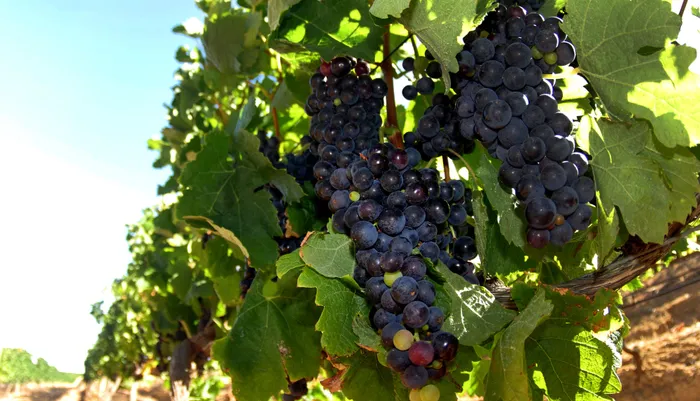
Agricultural Business Chamber of South Africa (Agbiz) believes that the South African agricultural export front is gaining momentum
Image: Ian Landsberg/Independent Newspapers
South Africa’s agricultural export prospects are gaining momentum following the signing of new trade agreements with China and South Korea, a development that could help the sector diversify markets and unlock new growth opportunities, according to the Agricultural Business Chamber of South Africa (Agbiz).
The positive outlook follows the Department of Trade, Industry and Competition’s (the dtic) conclusion of the China–Africa Economic Partnership Agreement (CAEPA), alongside a separate agreement by the Department of Agriculture granting South Africa market access to export fresh table grapes to the Republic of Korea.
The dtic said last week that Trade, Industry and Competition Minister Parks Tau and China’s Minister of Commerce, Wang Wentao, signed a Framework Agreement on Economic Partnership for Shared Prosperity.
Negotiations on an Early Harvest Agreement are expected to be concluded by the end of March 2026, paving the way for duty-free access for South African exports to China and increased Chinese investment into the local economy.
Meanwhile, Agriculture Minister John Steenhuisen confirmed that South Africa secured access to the South Korean market for fresh table grapes, effective from 23 January 2026, allowing producers to begin exports immediately.
Agbiz chief economist Wandile Sihlobo on Monday said the CAEPA has the potential to significantly enhance South Africa’s agricultural exports, particularly given China’s scale as a global importer.
“We don’t yet know what the tariff lines and levels will look like, but this certainly bodes well for agriculture, as China has long been, in our view, a place for export expansion," Sihlobo said.
"As I noted, China is the world's second-largest agricultural importer, spending approximately $200 billion (R3.1 trillion) annually. We have a small 0.4% share in this, and hopefully, with lower tariffs, we can increase it.”
Sihlobo also pointed to the one-year extension of the African Growth and Opportunity Act (Agoa) as a positive development, largely from a sentiment perspective.
“In the absence of Agoa, some South African export products to the US would have likely faced around 33% tariffs, including Most Favoured Nation (MFN) tariffs, in addition to Liberation Day Tariffs. This is not far from the current 30% tariffs; thus, I say the benefits are largely sentiment-driven rather than fundamentally on the cost side.”
He added that the South Korea table grape agreement, achieved after more than two decades of technical negotiations, is likely to deliver tangible benefits to producers in the next export season.
“This is the result of more than 20 years of negotiations among the technical teams of both countries. What is key is that, in the next season, we are likely to see the benefits of this market access success for the industry. Of course, much of this, particularly the Chinese Framework Agreement, has yet to provide us with more detail on the tariff lines and their implementation.”
Dawie Maree, head of information and marketing at FNB Agriculture, welcomed the agreements but cautioned that implementation would be critical.
“For our exports, it creates opportunities to diversify our markets and not be reliant on only a few traditional trading partners," Maree said.
"We've seen stagnant growth in these traditional markets, e.g., the EU and UK. Opportunities in China, South Korea, India, etc., we need these growing markets to grow our exports and keep our agricultural growth.”
The Citrus Growers’ Association of Southern Africa (CGA) also welcomed the reauthorisation of Agoa, although it noted that the extension does not materially change tariff conditions for citrus exports to the United States.
The CGA said this extension does not materially impact the tariff regime for South African citrus exports to the US as the tariffs imposed by the White House take precedence over Agoa benefits. As a result, the CGA said Agoa’s renewal does not, at present, alter market access conditions for local citrus exporters.
CGA CEO Dr Boitshoko Ntshabele warned that imposing tariffs on mandarins could create price spikes and inflationary pressure in the US market.
“SA supplies mandarins counter-seasonally to America, so we do not threaten US production or jobs," she said.
"In fact, we help keep consumers in the category year-round with our high-quality and healthy citrus, handing the consumers over to fellow growers in states like California and Florida at the end of our season.”
BUSINESS REPORT