

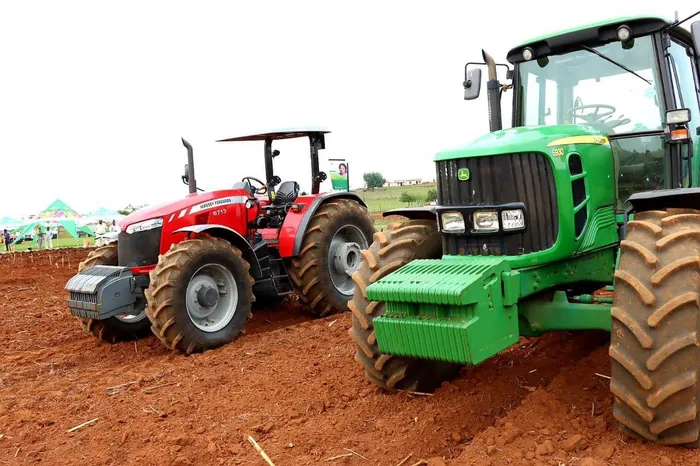
Agricultural Machinery Sales indicate an increase in January sales released on Friday the date indicated an increase compared to the same period in 2026.
Image: File KwaZulu-Natal Department of Agriculture and Rural Development
South Africa’s agricultural machinery sales got off to a positive start in January 2026, with tractor sales rising sharply year-on-year, reflecting cautious optimism among farmers despite mixed rainfall patterns and softer commodity prices.
Figures released on Friday by the South African Agricultural Machinery Association (SAAMA) show that 517 tractors were sold in January, a 13% increase compared with the 457 units sold in January 2025, according to SAAMA chairperson Willie Human.
Sales of combine harvesters remained unchanged, with five units sold, the same as in the corresponding month last year.
Human said the current summer cropping season has been a “mixed bag”, with uneven rainfall distribution and varying planting times across regions.
“Overall, the summer crops are looking good, but farmers will only know their production once these crops have been harvested,” he said.
Human said that commodity prices have retreated from their recent higher levels.
“Nevertheless, the general mood in the industry is one of positivity. At the moment, it looks as though sales this year will be in two halves; sales in the latter half of the year being largely dependent on summer crop production and commodity prices.”
Human said that tractor sales for the 2026 calendar year are expected to be similar to, or marginally lower than, those recorded in 2025.
Wandile Sihlobo, chief economist at the Agricultural Business Chamber of South Africa, said the strong start to 2026 follows a robust performance in 2025.
“Remember, South Africa’s 2025 tractor sales totalled 7 668 units, up 19% from 2024; combine harvester sales totalled 207 units, up 3% from the previous year.”
Sihlobo noted that January 2026 sales data confirm this momentum, supported by an expansion in summer grain and oilseed plantings for the 2025–26 season, as well as improved farmer finances following solid production in the previous agricultural year.
He said that South Africa’s 2025-26 preliminary area plantings for summer grains and oilseeds are 4.54 million hectares, up 2% from the previous season.
“This comprises maize, sunflower, soybeans, groundnuts, sorghum, and dry beans. There is a broad expansion in the area under major crops, with sorghum, groundnuts, and dry beans being the only crops showing a decline in the area farmers tilled.”
Although the season is still in its early stages, Sihlobo said favourable rainfall across major crop-producing regions points to another potentially strong year.
“Given such a promising season, agricultural machinery sales are likely to remain strong this year. Moreover, the cost of capital remains reasonably affordable, strengthening some farmers’ financial positions and again underscoring our optimism about this year,” he said.
Shlobo also welcomed the extension of the African Growth and Opportunity Act (Agoa) through December 31, 2026, saying it provides important support for South Africa’s agricultural exports, despite some distortion caused by recent US tariff measures.
He said while the 30% Liberation Day tariffs have distorted the benefits of Agoa to some extent, Agoa remains crucial.
“In the absence of Agoa, some South African export products to the U.S. would have likely faced around 33% tariffs, including Most Favoured Nation (MFN) tariffs, in addition to Liberation Day Tariffs,” he said.
BUSINESS REPORT