

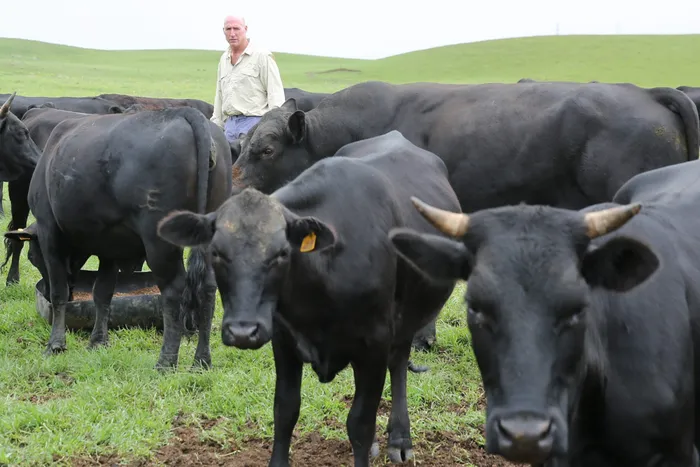
The Bureau for Food and Agricultural Policy (BFAP) has raised concern about the economic impact of Foot and Mouth Disease (FMD).
Image: Motshwari Mofokeng/Independent Newspapers
The economic fallout from South Africa’s ongoing Foot-and-Mouth Disease (FMD) outbreaks is deepening, with export losses and production declines threatening the sustainability of the beef and dairy sectors, according to the Bureau for Food and Agricultural Policy (BFAP).
BFAP said a recently released initial assessment of the economic impact of FMD shows that more than R821 million in export revenue was lost during three major waves of the disease between 2019 and 2025.
The organisation warned that, at the current trajectory, cumulative export losses could rise to as much as R2.6 billion by the end of 2026.
The scale of the outbreak has intensified significantly. BFAP noted that the previous 20-year high of 7 700 reported FMD cases in 2022 was far exceeded in 2025, when cases surged to 24 400. The estimates, it added, exclude the impact of other diseases affecting the beef sector, including tick-borne diseases, brucellosis and Rift Valley fever.
According to BFAP’s June 2025 Gross Production Value (GPV) baseline estimates, losses to agricultural output could accumulate to R25.6bn over the next decade.
Under a medium-burden scenario, lost GPV is estimated at R3.2bn between 2025 and 2030, driven by reduced production volumes, weaner supply constraints and calf mortality linked to ongoing outbreaks.
Under a high-burden scenario, GPV losses could reach R11.3bn over the same period, exacerbated by export disruptions and price pressures.
BFAP said the rapid escalation of FMD outbreaks in the dairy sector since November 2025 points to particularly severe economic consequences. Based on case studies in the Eastern Cape, losses have reached close to R5 000 per cow, largely due to reduced milk production, increased veterinary expenses and higher animal husbandry costs.
With more than 90 dairy farms affected by mid-January 2026, involving over 210 000 dairy animals, BFAP estimates that economic losses in the dairy sector have already exceeded R1bn.
The organisation warned that continued pressure could force some dairy farms to shut down, resulting in significant job losses in rural areas.
Wandile Sihlobo, chief economist at the Agricultural Business Chamber of South Africa, said the BFAP report provides critical insight into the true cost of FMD on the cattle and dairy industries.
“The FMD remains a major challenge in the SA cattle industry. Various export markets, which we have cultivated over the years, have temporarily banned SA beef,” Sihlobo said.
“This will weigh on the industry, along with the losses that some farmers are experiencing. We must also not forget the losses in the dairy industry, which has been hardest hit, especially in KZN.”
Francois Rossouw, CEO of the Southern African Agri Initiative (Saai), said the BFAP figures are likely conservative, as they account only for direct export losses.
“The R821 million export loss linked to the three major FMD waves since 2019 reflects only direct, measurable export revenue losses. It does not fully capture secondary impacts such as long-term loss of market share, cancelled supply contracts, price discounts imposed on South African products, or the knock-on effects across feedlots, abattoirs and logistics,” Rossouw said.
“Once an export market is disrupted by disease risk, it is exceptionally difficult and costly to regain trust, even after disease events subside.”
Rossouw added that the projected escalation in losses is driven not only by the virus itself, but by systemic failures in disease management.
“South Africa’s inability to secure consistent vaccine supply, implement a credible national vaccination strategy, and unlock private-sector capacity has turned FMD into a recurring structural risk rather than a containable outbreak,” he said.
“If these institutional weaknesses are not urgently addressed, export losses will continue to compound year after year - not because FMD is unmanageable, but because it is being mismanaged.”
National Red Meat Producers’ Organisation chief executive Dr Frikkie Maré said BFAP’s attempt to quantify the economic impact is valuable, even if the exact figures remain open to debate.
“However, I appreciate their attempt to at least quantify it. Whether the actual amount is more or less, it does not matter as the impact will stay enormous,” he said.
“I think the fact that we got here is the fault of many, but the final plans for how we are going to get out of here should be put in place very quickly. Industry and government are working extremely hard to find solutions to get us out of FMD’s grip, and we can only hope that these solutions are implemented sooner rather than later.”
BUSINESS REPORT