

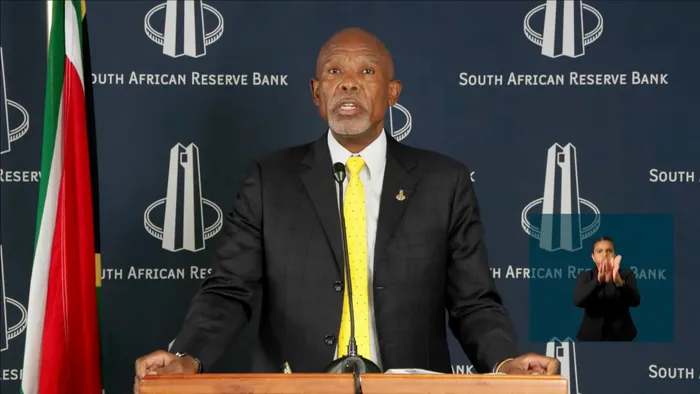
South African borrowers face ongoing financial strain as the Reserve Bank held the repo rate steady at 6.75%. Experts weigh in on the implications for consumer spending and the property market amid rising living costs.
Image: File.
South Africans paying back interest on loans were given no reprieve this past week after the South African Reserve Bank (Sarb) opted to keep the repurchase rate (repo rate) unchanged.
This means the repo rate will remain at 6.75%, translating to the prime lending rate also staying the same at 10.50%.
The repo rate, which acts as a key determinant of interest rates across the economy, plays a critical role in shaping the financial landscape for borrowers.
Experts have expressed mixed reactions to the Sarb’s decision.
While some believe that stability in borrowing costs is essential for encouraging consumer spending and stimulating growth, others caution that prolonged high-interest repayments could exacerbate financial strain for many South Africans.
Toni Anderson, Head of Home Services at Standard Bank said that the Sarb's decision provided stability and confidence for the country's property market.
Anderson said, "The South African Reserve Bank’s decision to hold the repo rate steady provides welcome certainty for homeowners and prospective buyers, reinforcing a period of stability in the residential property market."
"While interest rates remain unchanged, the cumulative effect of earlier rate cuts has already begun to improve affordability and buyer sentiment. Since the easing cycle started towards the end of 2024, Standard Bank has observed increased engagement from prospective homeowners, with steady home loan application activity reflecting renewed confidence in the market," Anderson added.
He added that a stable rate environment gives buyers the opportunity to plan with greater certainty and supports more balanced decision-making.
"For sellers, this stability encourages realistic pricing, which remains a key driver of successful transactions in the current market. Holding rates at current levels allows households time to adjust to earlier relief, while providing a supportive backdrop for sustained recovery in housing demand across select regions," Anderson said.
Meanwhile, Neil Roets, CEO of Debt Rescue told Business report that South Africans are entering deeper into 2026 under severe financial strain, driven by persistently high living costs, limited income growth, and borrowing costs that remain elevated.
Roets said that while it’s understandable that the Sarb would ultimately weigh both domestic inflation conditions and global risks before taking the next step in the rate-cutting cycle, the state of the consumer should be the utmost priority for government right now.
He said South Africa’s consumer credit crisis isn’t a matter of balance sheets and interest rates, it’s a story of households pushed to the brink, of parents borrowing to feed their children, and of ordinary citizens trapped in a cycle of debt just to survive through each month.
"The country’s economic stress factors, from high borrowing costs to rising prices for essential goods and services like food, fuel, electricity, and water, are forcing millions of consumers to lean heavily on credit and personal loans to make it through the month, Roets said.
“Households have entered the year already weighed down by accumulated debt, back-to-school costs, and essential living expenses that continue to rise faster than incomes can stretch, The only light at the end of this dark tunnel is the prediction by experts like FNB chief economist Annabel Bishop, that the high interest rate, currently at 6.75% - which is 325bps above the inflation rate - supports interest rate cuts in the months to come," Roets added.
"Meanwhile, food and utility costs continue to climb, outpacing wage growth and rendering everyday necessities increasingly unaffordable, especially for low-income households who are battling to afford to buy enough food each month, according to the latest Household Affordability Index, conducted by the Pietermaritzburg Economic Justice and Dignity Group," Roets stated.
KPMG lead economist, Frank Blackmore said that the rate was left unchanged despite a number of promising signs in the economy.
Blackmore said, "Growth is forecast to be slightly faster this year than last year, and well above the 1% level, which is a vast improvement on the average of 0.7% experienced over the previous decade. On the inflation front, inflation for last year averaged 3.2%, very close to the new target of 3%."
"The December figure came in at 3.6%, which, although higher, was due to temporary factors and is expected to be the peak in the Sarb’s forecast as we enter 2026. As a result, we can expect further reductions in the inflation rate. The reasons cited for keeping interest rates on hold were the number of risks that remain. Although these risks are viewed by Sarb as broadly balanced, they still pose upside risks to inflation," Blackmore said.
The KPMG economist said that most notably, these included external risks such as geopolitical and trade-related pressures facing South Africa, as well as internal risks, including potential increases in administered prices, particularly electricity tariffs.
Roets said, "Right now, life is grim for South Africans from all walks of life who are buckling under the physical and mental repercussions of debilitating financial pressure. A recent Debt Rescue survey found that 87% of consumers polled currently feel worried, extremely stressed and anxious, or completely overwhelmed by their financial situation."
"My advice to those who cannot break free from their financial constraints is to seek help from a registered debt counsellor who can assist them to manage their financial predicament. This has been a very successful solution for thousands of consumers who are plagued by over-indebtedness," Roets further said.
BUSINESS REPORT