

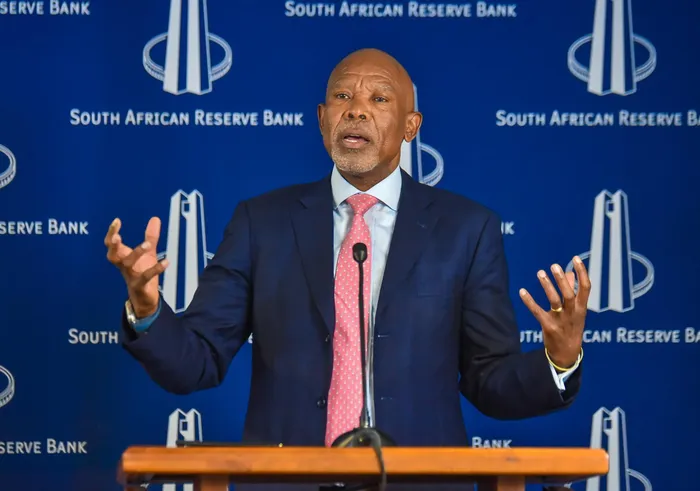
Consumers can expect no reprieve from interest rate cuts this January, as the South African Reserve Bank (Sarb) maintains a cautious approach amid fluctuating inflation rates and economic uncertainty.
Image: SARB | Facebook
As Janu-worry comes to an end, consumers will not be given any reprieve in the form of an interest rate cut this month.
The South African Reserve Bank (Sarb) Monetary Policy Committee (MPC) will be announcing their first decision on the repurchase rate (repo rate) this Thursday.
Economists and analysts have predicted that the central bank will be moving with caution and keep the rate unchanged at 6.75%, translating to the prime lending rate also staying the same at 10.50%.
Investec's lead economist, Annabel Bishop, said that the MPC meeting is not expected to see a change in interest rates, coming so soon after November’s -25 basis points cut.
"With the repo rate currently at 6.75%, 325bp above the inflation rate, and with CPI inflation expected to fall below 3.0% y/y in Q2.26, the high real interest rate in South Africa supports further interest rate cuts. Indeed, without an additional -50bp cut this year (expected to be spread over two meetings), the real interest rate will rise further, nearing 4.00% mid-year," Bishop said.
The Sarb has been very cautious on easing monetary policy, preferring a tight stance.
"The MPC seeks to suppress the inflation environment and over the medium-term embed the inflation rate at the new target of 3.0% y/y, noting, “we are in a very uncertain environment and it’s important we move with caution”. Adding that its QPM (quarterly projection model) “says you will get to 5.75% in the outer years of the forecast horizon” for the repo rate – by the end of 2028," Bishop added.
The steady state however for the repo rate is seen at 5.50%.
"From the current 6.75% rate for the repo this implies another -125bp cut in interest rates, and we currently expect this to be reached in 2029, that is when the repo rate reaches 5.50% in South Africa. Much depends on the inflation outlook, and environment, which currently is expected to become embedded at the 3.0% y/y target over the medium term, allowing for a sustained lower interest rate environment," Bishop added.
"We expect the next move in the repo rate will be in March this year, a -25bps drop as CPI inflation falls to 3.0% y/y in February, lower on a rise in inflation a year ago and the modest inflation environment. Quicker than expected growth is a risk to the inflation outlook, reducing the chance of interest rate cuts," she further said.
"With consumer spending and not fixed investment driving growth last year, the inflation and interest rate outlook would be at risk if this persists," Bishop added.
Lead economist at KPMG, Frank Blackmore, said that inflation is calculated on a month-to-month basis.
"We compare January 2026 to January 2025 and if there has been a small change in terms of inflation last year it may result with the same month and month change to a slightly higher level of inflation. We therefore expect inflation to come in around 3.7% in 2026. This will not deter the Reserve Bank from reducing interest rates further throughout 2026 because the expectations for inflation are converging on the new target of 3% and in our prediction, we can therefore expect an additional 50 basis points of cuts through 2026," he said.
Eugene Botha, Head: Research Hive at Momentum Investments told Business Report that South Africa’s inflation-targeting regime, introduced in 2000, has been a cornerstone of monetary policy for 25 years.
"Moving away from an eclectic approach, the Sarb adopted a 3–6% target range for inflation, aiming to stabilise prices and anchor expectations. Over the past 25 years, this framework has delivered notable success, with inflation volatility falling sharply and credibility improving. Yet, the midpoint of 4.5% remained high compared to global norms," Botha said.
He said that moving South Africa’s target to 3% aligns it with major trading partners, reduce inflation risk, and reshape the investment landscape.
"Lower inflation reduces uncertainty, allowing for longer investment horizons and more effective capital allocation. It also narrows exchange rate volatility. Sarb simulations suggest economic growth could rise by 0.25% within five years and 0.4% after a decade, driven by higher investment and fiscal savings from reduced debt-service costs," Botha added.
"Inflation is not just a macroeconomic statistic, it influences every asset class. It affects discount rates, borrowing costs, and valuation multiples. Lower inflation may potentially compress country risk premia, reduce nominal yields, and alter the relative attractiveness of bonds, equities, cash, and real assets. For investors, understanding these dynamics is critical for both tactical positioning during the transition and strategic allocation in the new regime," Botha said.
BUSINESS REPORT