

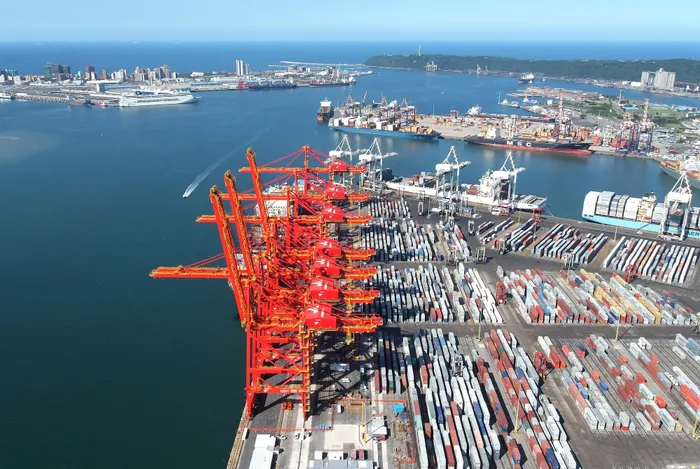
Industry experts have responded positively to Transnet SOC Ltd (Transnet) and the world’s largest independent terminal operator, International Container Terminal Services, Inc (ICTSI).
Image: File
Industry experts have broadly welcomed the landmark 25-year partnership between Transnet SOC Ltd and International Container Terminal Services, Inc (ICTSI), saying the deal could mark a turning point for South Africa’s struggling port and logistics system.
The agreement, officially signed in December, came into effect on 1 January 2026 and paves the way for the strategic redevelopment of Durban Container Terminal (DCT) Pier 2.
Under the arrangement, Transnet Port Terminals (TPT) and ICTSI will jointly manage the upgrade and long-term development of the country’s largest container handling facility.
Peter Besnard, CEO of the South African Association of Ship Operators and Agents (Saasoa), last week said DCT Pier 2 is a critical national asset, handling more than 70% of the Port of Durban’s container throughput and about 46% of South Africa’s total container traffic.
He said the planned upgrades are expected to increase capacity from about 2.0 million to 2.8 million twenty-foot equivalent units (TEUs).
Operational targets include lifting gross crane moves per hour from around 18 to about 28 and doubling ship working hours from roughly 60 to 120, significantly improving vessel turnaround times.
Besnard noted that ICTSI, one of the world’s largest independent terminal operators, brings international best practice, technology and capital investment to a strategic South African port.
He said the deal is central to Transnet’s strategy to modernise ports through private-sector participation.
“Gauteng is South Africa’s economic heartland and a major consumer/producer region that heavily relies on Durban for imports/exports: Faster cargo movement,” Besnard said.
“Better performance at Durban reduces dwell times for cargo moving inland by road and rail — critical for Gauteng’s manufacturing, retail, and industrial sectors.”
He added that investment in port equipment and operations is also expected to create jobs at the port and stimulate growth across the broader logistics value chain, including transport, warehousing and related services.
Dr Jacob van Rensburg, head of research and development at the Southern African Association of Freight Forwarders (SAAFF), said private-sector participation at DCT Pier 2 is a necessary structural reform for South Africa’s ports and logistics system.
He said sustained capital and operational investment is essential if the port system is to stabilise and improve, adding that appropriate governance, regulatory oversight and legal processes are in place to manage risks and ensure accountability.
Van Rensburg said the biggest benefit of the Pier 2 development lies in its potential to stimulate economic growth.
“Trade, transport, and logistics are foundational enablers of economic growth and competitiveness. Historically, close to half of South Africa’s container traffic has moved through DCT Pier 2, making it a critical national asset,” he said.
“Given that containerised trade accounts for over 40% of the tradeable economy and more than 20% of GDP, improvements in reliability, capacity, and efficiency at Pier 2 should have meaningful positive spillovers for Gauteng and the wider economy.”
Malcolm Hartwell, a director at Norton Rose Fulbright and a master mariner, said the finalisation of the deal was welcomed by the industry after initial uncertainty.
The original award of the tender to ICTSI had been interdicted by Maersk following a High Court application, raising concerns about potential delays if the decision was appealed.
Hartwell added that Transnet has suffered numerous challenges over the last several years in improving container handling at the port of Durban.
“This has been due not only to challenges in the port but also in the delivery of containers to and from the port via South Africa’s overloaded road network and via Transnet’s collapsing rail network,“ Hartwell said.
“We have seen several initiatives in the last few years to improve other aspects of container handling between the critical industrial heartland of Gauteng and South Africa’s busiest port and container port. This agreement marks yet another improvement, and hopefully, we will see continued improvement in ship turnaround time and container handling generally."
BUSINESS REPORT