

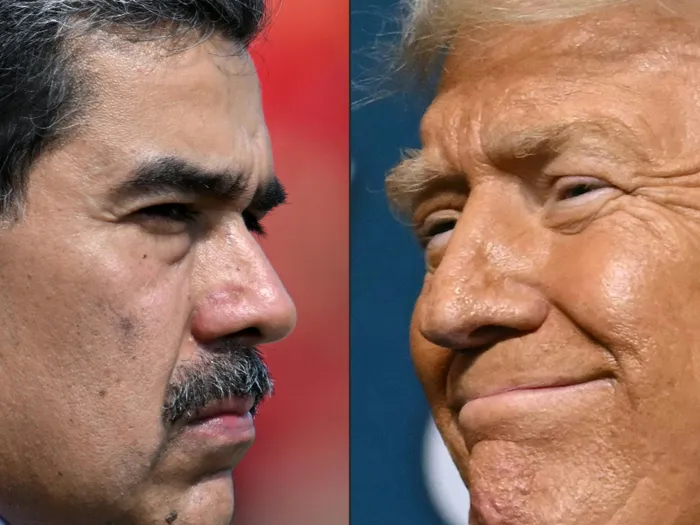
Experts have raised concern about the global impact on economies and oil prices following the United States attack on Venezuela and capture of President Nicolás Maduro over the last weekend.
Image: JUAN BARRETO / AFP
Experts have raised alarm over the potential global economic and energy market consequences following reports that the United States launched a military operation in Venezuela over the weekend, resulting in the capture of President Nicolás Maduro.
Dr Sakhile Hadebe, a lecturer in Political Science and International Relations at the University of KwaZulu-Natal (UKZN), on Tuesday said the reported US action represents a dangerous turning point in the global political economy, with implications far beyond Venezuela.
“While framed in Washington as a targeted intervention, the ripple effects extend far beyond Caracas, particularly for an already fragile global economy,” Hadebe said.
“The most immediate impact would be felt in energy markets. Venezuela holds some of the world’s largest proven oil reserves, yet years of sanctions and underinvestment have already constrained its output.”
Hadebe added that any military disruption, whether to infrastructure, ports, or export routes, would inject fresh volatility into global oil prices.
“Even if Venezuelan supply is marginal in current volumes, markets trade on expectations and risk perception. A sharp spike in prices would therefore be less about barrels lost and more about geopolitical uncertainty priced in by traders,” he said.
He added that higher oil prices would hit inflation-sensitive economies in the Global South particularly hard, driving up transport, food and production costs at a time when many countries are already struggling with post-pandemic debt and tight financial conditions.
“The intervention risks externalising US strategic choices onto economies least able to absorb the shock,” Hadebe said.
Hadebe also cautioned that trade flows could be disrupted, as heightened tensions in the Western Hemisphere may affect shipping insurance, reroute cargo and further fragment global trade amid existing supply-chain pressures.
Professor Andre Thomashausen, professor emeritus of international law at Unisa, said the arrest of Maduro mirrors the 1990 US arrest of Panamanian leader Manuel Noriega.
“The International Court of Justice (ICJ) declared it a violation of international law many years after that intervention by the USA in Panama, but entirely without effect,” Thomashausen said.
“In the Maduro trial, the USA will argue that their forceful removal of Maduro was a well justified intervention, maybe even a humanitarian intervention.”
He said the lack of strong opposition from major global powers such as China, India, Russia and Saudi Arabia amounted to tacit support.
“They find themselves in charge of a new multipolar world order, together with the USA. Small and failed states like South Africa will have to tread carefully not to let nationalist sentiments get ahead of what is in their best interests.”
Not all analysts, however, expect a major global economic shock.
Political analyst Zakhele Ndlovu, also from UKZN, said the impact on the global economy and oil prices is likely to be limited in the short term.
“Venezuela accounts for less than 2% of oil exports even though its oil reserves are the largest. The US' attacks have instilled fear in enemies such as Iran, Colombia, Cuba, etc., and could have a destabilising effect in the South American region. I don't see the oil prices getting affected in the short term,” Ndlovu said.
The African Energy Chamber (AEC) said Venezuela enters 2026 amid heightened uncertainty following Maduro’s detention and the announcement by the country’s supreme court that Delcy Rodríguez has assumed the role of Acting President.
“These developments place renewed focus on the importance of institutional continuity and stability at a moment when Venezuela’s economic and energy future hangs in the balance,” the AEC said.
The chamber stressed that stability remains the most critical requirement for development, noting that Venezuela’s vast oil reserves could transform its economy if paired with predictable governance, responsible resource management and investment-friendly frameworks. The AEC called on the international community and energy industry to support Acting President Rodríguez and promote unity and continuity.
Political analyst Siyabonga Ntombela from UKZN warned that the consequences could be particularly severe for South Africa.
"We currently considered the enemy of the West. Now that the US controls the largest oil reservoir in the world, it will use that against us. America will probably use oil as an incentive to countries that been loyal. It will sell oil to South Africa at a premium," Ntombela said.
BUSINESS REPORT