

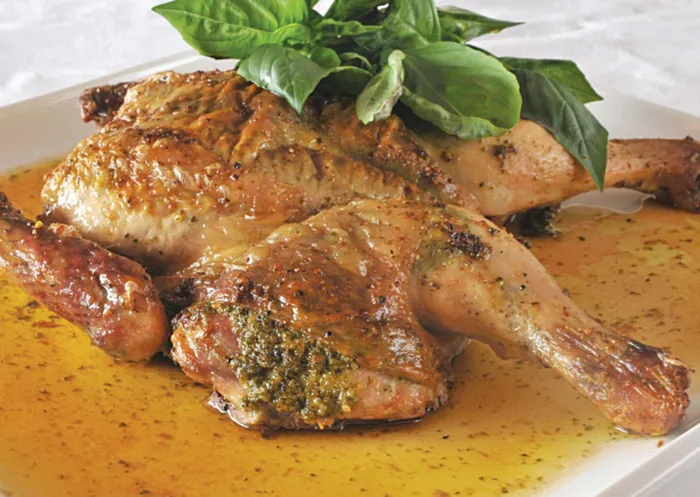
Pesto stuffed spatchcocked chicken Pesto stuffed spatchcocked chicken
Cape Town - As South Africans grapple with price hikes across the board, some relief is promised with news that big increases in chicken prices - the most popular meat of choice in the country - are unlikely.
In addition, more relief for the poor is on the cards, with the recent announcements that the state is to increase the monthly value of some social grants.
Fears of major hikes in chicken prices came after Monday’s announcement of import tariff hikes by the Department of Trade and Industry.
But the SA Poultry Association, which represents major producers, said late this week that while poultry prices could increase “in the medium term”, as retailers passed on higher tariffs to consumers, more specific figures would “just be mostly guesswork”. These were, however, unlikely to be dramatic.
The department said the increases for five “classes” of chicken products, imported from all countries except those in the EU and Southern African Development Community, would help the country’s “distressed” poultry industry, which directly employs 48 700 people.
The department said the hikes, which range from 5 percent to 12 percent for “boneless cuts”, and 27 percent to 82 percent for whole birds, “struck an appropriate balance” between the interests of poor families – which spend relatively more of their income on chicken – and the poultry industry.
The Food and Agriculture Workers Union (Fawu), which had also called on the government to raise tariffs, said it was expecting prices to rise by roughly 12 percent
in the next nine to 12 months.
The union’s general secretary, Katishi Masemola, said anything more would set off alarm bells.
“Beyond 15 percent, that will become a problem for consumer welfare,” he said, adding that the union would look at the tariffs again if increases went beyond this.
Based on Fawu projections, the price of a 1.5kg whole fresh chicken, which cost R52.50 in July according to the National Agriculture Marketing Council, would cost roughly R60 in a year.
Following Monday’s announcement, retailers sought to calm fears of dramatic price increases for South Africa’s most popular meat.
Pick n Pay merchandise director Peter Arnold said the supermarket chain only imported a “very small” percentage of chicken products from overseas – and only from the EU, which has not been affected by the tariff change.
“We believe the full impact of any tariff change in South Africa would only probably be felt closer to the first quarter of next year,” he added.
Shoprite Checkers spokeswoman Sarita van Wyk said all whole birds, and the “vast majority” of chicken portions, were bought locally.
“The supermarket group’s current chicken prices will therefore not be influenced by the increased import tariffs,” she said.
But prices might still go up, according to Van Wyk.
“The price of any future chicken imports will be dependent on possible increases in locally produced chicken now that the industry will enjoy price protection.
“Shoprite Checkers will negotiate for higher local prices if it means that more jobs will be created in the industry to boost the country’s economic growth,” she said.
Economist Johann van Tonder, from Unisa’s Bureau of Market Research, said that while chicken price increases would be “spread around all consumers”, those in the lowest income group would be hardest hit, as they spend a greater proportion of their income on chicken.
He said the lowest-earning 20 percent of consumers spent R5.72 of every R100 on poultry, compared to 79c per R100 by the top 20 percent.
The fact that tariffs had risen by 82 percent for imported “whole” chickens – generally bought by richer consumers, but by only 12 percent on “boneless cuts” and by 37 percent for “bone-in portions” – more popular with poorer consumers, showed “careful planning by government”.
“So the government made the decision: ‘We are going to need higher prices in order to protect our jobs’, that is basically what it boils down to,” said Van Tonder.
“Each and every one of us will pay a little more for chicken,” he said.
In choosing between saving jobs by raising tariffs, or keeping prices low by not increasing them, Van Tonder said the government’s priority was to create, or at least not lose jobs.
But, to reduce the impact on the poor, the state has increased some social grants by R10 a month effective from the beginning of this month.
Van Tonder said it was difficult to predict how the chicken price increase would affect the standard of living of South Africans, but said price increases would be “tough”.
Masemola said the union’s members were “feeling the pinch”.
“There is a feeling that prices have risen, not just of food, but especially of electricity, beyond acceptable levels.”
Weekend Argus