

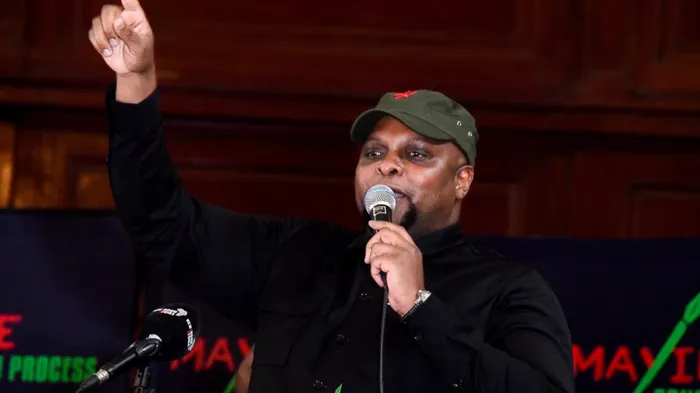
Floyd Shivambu of Afrika Mayibuye refutes claims of institutionalised tribalism against Tsonga and Shangane people in KwaZulu-Natal while addressing the socio-economic impacts of undocumented immigration.
Image: X
Afrika Mayibuye president Floyd Shivambu has strongly rejected claims that people in KwaZulu-Natal have displayed institutionalised tribalism against Tsonga and Shangane communities.
In outlining his position, Shivambu drew on his extensive experience as a political organiser and leader within organisations such as SASCO, the ANC Youth League, the EFF and the MK Party.
Shivambu said that while derogatory phrases or sentiments such as “maShangane ahambe” (Shangane people must leave) have occasionally surfaced, including in Parliament, these incidents stemmed from historical linguistic misunderstandings and isolated individual attitudes rather than any organised or systemic campaign.
To support his argument, he pointed to the strong backing he and others received in KwaZulu-Natal during political leadership contests, despite their linguistic backgrounds.
The Afrika Mayibuye leader also reflected on his extensive travels across the province, from Umhlabuyalingana to Msinga and Kokstad, noting that traditional and royal leaders, including Misuzulu kaZwelithini and the late Goodwill Zwelithini, consistently engaged with and respected their leadership.
“There’s a deep historical and linguistic connection between the Tembe and Tsonga people. Historical records of the iSimangaliso Wetland Park area show that these communities share deep cultural roots.
“There are specific instances of tribal prejudice and negative stereotypes that still exist and must be decisively challenged,” Shivambu said.
He maintained that there was no collective or institutional effort to target Shangane people.
Shivambu also addressed the socio-economic and security implications of illegal and undocumented immigration in South Africa, arguing that the issue was pressing and could not be ignored by government.
He associated undocumented migration with certain categories of crime, including localised drug distribution networks, and said it had a significant impact on the informal economy.
Referring to data from Statistics South Africa, Shivambu said a large proportion of immigrants in South Africa worked in informal sectors such as domestic work and gardening. He argued that this displaced local workers and fuelled concerns within communities.
Shivambu further questioned what he described as the national government's failure to appreciate the grassroots economic insights of traditional leaders and royal councils across regions, including the Zulu, amaBhaca, Bapedi and Vhavenda kingdoms.
He contrasted what he viewed as ineffective municipal development plans with the more comprehensive proposals advanced by traditional leaders.
“These local initiatives range from structural policy frameworks such as ‘Invest Rural’ and localised mineral resource development to ambitious infrastructure projects, including an international airport near the Kruger National Park and an economic integration viaduct linking South Africa and Mozambique,” he said.
Meanwhile, with tensions building ahead of the June 30 deadline set by anti-illegal immigration activists, Acting Police Minister Firoz Cachalia said authorities were prepared to manage any potential disruptions.
Cachalia addressed SAPS leadership on the matter in Pretoria on Saturday.
He said he had received detailed briefings on national and provincial operational plans aimed at ensuring that any protests take place in a safe, secure and peaceful manner.
SAPS spokesperson Kamogelo Mogotsi said the acting minister was satisfied with the measures that had been put in place.
She added that Cachalia would meet with the Minister of Defence and provincial premiers this week to strengthen coordination and monitoring efforts.
“The Ministry of Police will further conduct visits to identified areas that have experienced heightened levels of instability to assess operational readiness and reinforce policing efforts.
“The Acting Minister has, however, expressed confidence that the SAPS is operationally prepared to uphold and enforce the law.
“While the constitutional right to peaceful protest will be respected, no acts of lawlessness, violence, intimidation or criminality will be tolerated.”
March and March movement leader Jacinta Ngobese-Zuma has also urged supporters not to engage in violence or criminal activity during planned demonstrations at the end of the month.
Ngobese-Zuma said the protest would be peaceful and aimed at raising concerns around undocumented migration and community safety.
“I know a lot of people see individuals walking around with sticks and think they are going to harm people because it looks intimidating, and that is not the case.
“Even in our culture, when we are celebrating, that is how we look. So, it is not a sign of violence. It is really just a show of strength and unity.”
Cultural and linguistic expert Sompisi Mphemba said there was a need to discuss the complex social dynamics, identity, and discrimination within South Africa, noting that various theories exist regarding specific derogatory expressions or names used between different groups, such as the Tsonga and Zulu communities.
He argued against isolating a single factor or treating it as the core national issue, and said that the current tensions cannot be solely blamed on recent developments like illegal immigration, as these divisive names and underlying prejudices have existed for a long time.
“These internal tensions and distinct identity divisions are present across all cultural groups, there are friction even within the Xhosa community between those identifying as Mpondo or Xhosa,”Mphemba said.
He asked the media and the public to move past superficial, heated public exchanges on social and traditional platforms, urging for a much deeper, reflective national conversation that traced the true historical origins of the divisions to properly understand the country's current state.
DAILY NEWS