

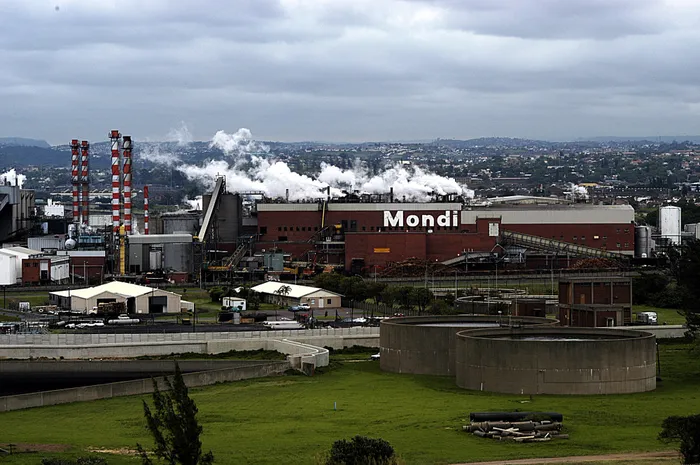
Mondi’s Merebank plant in Durban is a paper mill that produces office paper, including the premium South African brand Mondi Rotatrim.
Image: supplied
Mondi’s interim dividend fell substantially to 9.42 euro cents per share from 23.33 euro cents at the same time last year after its sustainable packaging and paper operations experienced margin pressure from higher input costs and lower selling prices.
The UK-based, JSE- and London-listed group, which operates in about 30 countries, said Thursday first half earnings before interest, tax, depreciation, and amortisation (EBITDA) fell to €379 million, including a forestry fair value loss of €35m, compared with €564m at the same time last year, including a fair value gain of €18m.
“We made good progress in delivering actions to strengthen Mondi’s performance, cash generation, and competitiveness. We took strong pricing actions, maintained cost discipline, progressed our plant network optimisation programme, and continued to drive operational excellence across the business,” the CEO Andrew King said.
The pressure on margin was partially offset by higher sales volumes and pricing actions.
Paper sales prices declined in the second half of 2025 and into early 2026. This resulted in the group entering 2026 with selling prices below average levels in the first half of last year.
“Although price increases were implemented, with some initial benefits realised, average prices remained below the comparative prior year. The full benefit of these price increases is expected to be achieved in the third quarter of 2026,” said King.
Cash generated from operations of €347m (€416m) was supported by a strong focus on working capital management. Full year 2026 expected capital expenditure was expected to fall to around €500m from €550m previously.
Good progress was made on converting plant network optimisation, with six plants closed or in the process of closure. There was a pre-tax charge of €320m for impairments and restructuring, of which the expected cash effect was €24m.
King said heightened geopolitical tensions in the Middle East caused supply chain disruptions and contributed to higher input costs. Group teams had acted to protect operational continuity, support customers, and implement price increases across packaging and paper products.
“Trading momentum improved and we entered the second half with higher packaging paper prices, supported by good order books. We expect higher wood costs across Central and Eastern Europe, and we continue to manage volatile energy-related input costs,” he said.
Major expansion investments were now largely complete, and the focus was on disciplined growth while executing opportunities to strengthen cost competitiveness.
“We remain confident in the structural growth drivers that underpin our sustainable packaging businesses. Combined with our innovative packaging and paper solutions, our cost-advantaged, integrated assets, and our commitment to continuous improvement, Mondi is well positioned to deliver long-term value for shareholders,” King said.
Progress on actions to strengthen performance, cash generation, and competitiveness included plant network optimisation, workforce reductions, productivity improvements, working capital management, extended debt maturities, and disciplined capital allocation.
Plant network optimisation, following the three converting plant closures announced with the 2025 results, included a further three closures in April, bringing the total number of recently announced closures to six across corrugated and flexible packaging.
“While these were profitable, alternative plants within our network offer greater scale, stronger growth opportunities, and the ability to serve customers more effectively,” said King.
Of the six, four converting plant closures: one corrugated solutions plant in each of Germany, Poland, and Türkiye, and the consumer flexibles plant in Hungary, were expected to be completed by year-end. The six converting plant closures are expected to reduce headcount by some 580 roles by year-end.
Group organisation structures were also streamlined through the combination of Corrugated Packaging and Uncoated Fine Paper, while the Group Services' headcount fell by about 70 staff.
The Schumacher assets had been integrated into the Corrugated Solutions network, and the group was on track to deliver €32m of cost synergies over the three years from completion.
BUSINESS REPORT