

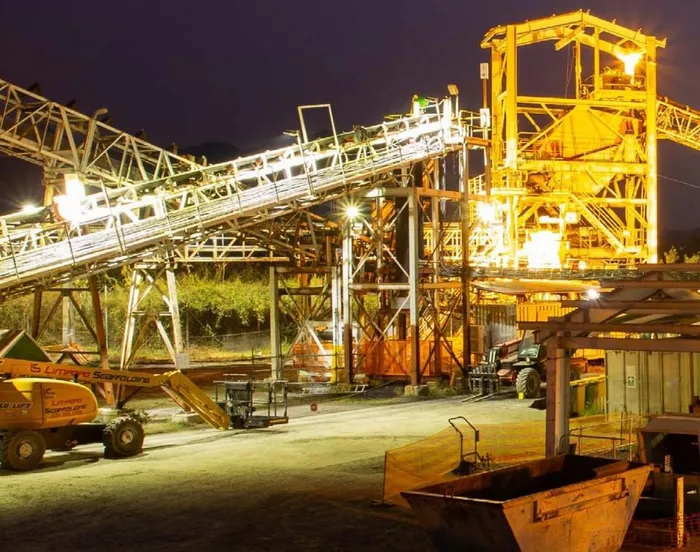
ARM, through its wholly owned subsidiary, African Rainbow Minerals Platinum, acquired Bokoni Platinum Mines in September 2022. Bokoni is a large, high-grade, long-life UG2-led asset with a brownfield foundation located on the north-eastern limb of the Bushveld Complex in Limpopo, South Africa.
Image: Supplied
African Rainbow Minerals’ (ARM) board has approved the massive R15,2 billion development of Bokoni Mine over 7 years to increase capacity to 180,000 tons per month (KTPM).
ARM's directors said Thursday their long-term platinum group metals (PGM) market outlook remains constructive, notwithstanding the anticipated impact of battery electric vehicles on the market.
ARM’s share price, however, did not appear constructive, with the price falling 6,63% to R159,73 on Thursday morning on the JSE. A year before, the price was R201,35.
This view is supported by anticipated resilience in PGM industrial demand and the enduring role of PGMs across automotive applications.
Sustained underinvestment, accelerating shaft depletion in South Africa, and structural decline across other producing regions are collectively expected to progressively reduce primary supply.
“These dynamics are expected to move the platinum market into deficit, providing support for the PGM basket price and incentivising new production,” they said in a statement.
ARM, through its wholly owned subsidiary, African Rainbow Minerals Platinum, acquired Bokoni Platinum Mines in September 2022. Bokoni is a large, high-grade, long-life UG2-led asset with a brownfield foundation located on the north-eastern limb of the Bushveld Complex in Limpopo, South Africa.
The approval of the project, which has a capital expenditure estimate of R15,2bn, follows the completion of a feasibility study in June 2026. The capital expenditure is expected to be deployed over a seven-year period from the 2027 financial year to the 2033 year.
The capacity increase will comprise the existing 60,000 tons per month concentrator and a new 120,000 tons per month concentrator. First production from the refurbished 60,000 tons per month concentrator is scheduled for the first half of the 2028 financial year.
Commissioning of the new 120,000 tons per month concentrator is scheduled for the second half of 2030. The anticipated annual steady-state production is about 350,000 - 400,000 6E ounces per year.
The expected payback period for the expansion is 6,3 years, and the internal rate of return was projected at 28%.
“Bokoni is a strategic, long-term growth asset underpinned by a large, high-grade UG2 mineral resource, the second-largest PGM mineral resource base in South Africa, with the higher-grade UG2 reef accounting for approximately two-thirds of the orebody.”
The directors said the project presents a clear, long-term value-creation opportunity to scale the PGM portfolio, enhance its global competitiveness, and pursue further growth.
They said Bokoni has a world-class mineral resource of 329,4 million tons with an average milled grade of 6,1 grams per ton (6E).
"The significant resource base combined with the high-grade characteristic of the orebody reaffirms ARM's strategic rationale of securing a long-life UG2 asset that enhances the scale, quality, and competitiveness of ARM's PGM portfolio while growing the company's total copper equivalent production,” they said.
At the end of the 2025 financial year, ARM suspended ore mining and milling operations while advancing ore reserve development and re-evaluating the optimal mining method, transitioning from an initial single-phase, fully mechanised concept to a more phased and flexible strategy.
This culminated in the completion of a revised feasibility study, which forms the basis for the 180,000 tons per month project.
“In light of the steep dipping orebody, the mining method has been revised to adopt a hybrid approach, integrating mechanised off-reef development with conventional stoping in order to optimise ore grade and revenue per tonne whilst preserving capital efficiency,” they said.
As only approximately 13% of Bokoni's mineral resources are expected to be depleted, there was significant potential to extend the life of mine beyond the initial 19-year plan, they said.
ARM’s board also approved the restart of open-pit mining operations and nickel concentrate production at Nkomati Nickel Mine. This approval fulfils one of the conditions precedent to the nickel concentrate off-take agreement concluded with Boliden Commercial AB (Boliden).
The restart was expected to cost about R753 million, and the life-of-mine is 13 years. The expected payback period was 5.3 years, with the estimated internal rate of return at 28%.
“The board's approval follows the completion of a feasibility study to restart open-pit operations at Nkomati and consideration of the alternative of continuing to maintain Nkomati on care and maintenance,” ARM directors said. The restart represents a low-risk, immediately actionable development opportunity, they said.
BUSINESS REPORT