

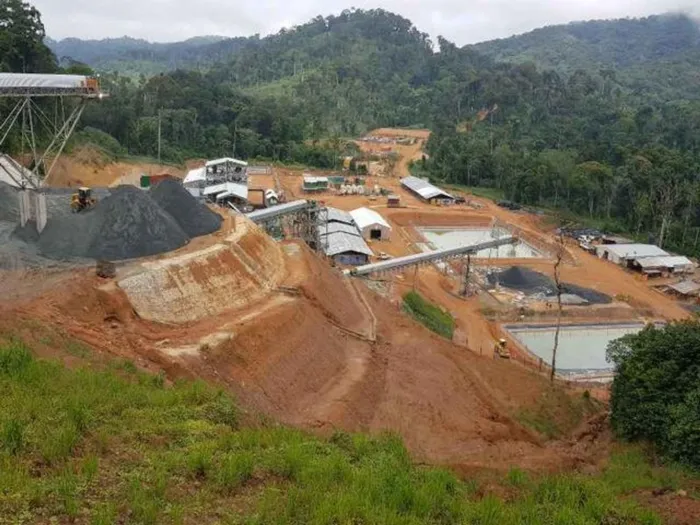
Alphamin’s Mpama South extension of the Bisie tin mine, in Democratic of Congo
Image: LinkedIn
Canada and JSE-listed Alphamin Resources Corporation said it would likely achieve record earnings before interest, tax, depreciation, and amortisation (EBITDA) of $167 million in the second quarter to June 30, up 6% from the prior quarter.
Tin production came to 5,013 tons, and 5,014 tons of tin was sold through the three-month period. All-in sustained costs (AISC) were expected to increase 6% to $19,043 per ton. Net cash fell by 35% to $90,67m.
The average tin price achieved increased 5% to $51,957 per ton.
Alphamin indirectly owns 84.14% of its operating subsidiary, to which the information pertains. Mpama North and Mpama South in the Democratic Republic of Congo are claimed to be the world’s highest-grade tin mines.
Contained tin production of 5,013 tons for the quarter was in line with the target guidance of 20,000 tons per annum and that of the previous period.
Tin sales of 5,014 tons resulted in the first four-quarter rolling period of 20,000 tons achieved. Processing recoveries dipped 2% from 74,2% in the first quarter to 72,8% in the second quarter.
The metal sulphides in the current mining area were above average levels, and this resulted in excessive near-gravity material interfering with the efficiency of the gravity circuit.
The growth in EBITDA compared to the prior quarter was attributed to a 5% increase in the tin price. The higher guidance for AISC per ton was due to a combination of off-mine costs in the form of increased royalties, export duties, marketing commissions, and net smelter returns, which increase as the tin price increases, and timing on capital expenditure.
On-mine operating costs increased largely as a result of higher fuel prices impacting diesel and transport costs.
Fuel stocks have been and remain at full capacity, with higher prices expected to continue into the third quarter due to ongoing orders at elevated prices.
Drilling continued at Mpama North and South mines with mixed results.
A total of 1,893 metres was drilled at Mpama North in the second quarter, with three holes completed and a further drill hole abandoned due to difficult ground conditions.
At Mpama South, a total of 3,653.7 metres was drilled, with five holes completed and a further two abandoned due to difficult ground conditions. Drilling targeted extensions of the defined resource at depth, with three of the five completed holes intersecting visible cassiterite mineralisation.
Visit:www.businessreport.co.za