

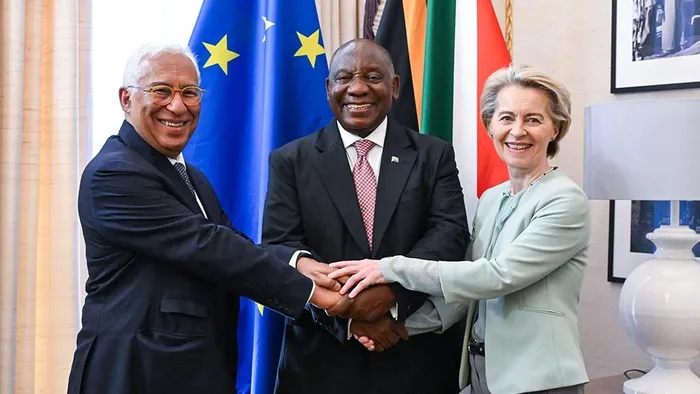
President Cyril Ramaphosa and President of the European Council, António Costa, and the President of the European Commission, Ursula von der Leyen, in Cape Town where EU leaders announced the first Clean Trade and Investment Partnership in November 2025, as part of the Global Gateway Investment Package.
Image: Supplied
South Africa and the EU on Friday kicked off the first government-to-government dialogue at the senior-official level, to advance the implementation of their new Clean Trade and Investment Partnership (CTIP).
The aim of the talks is to reinforce clean and resilient supply chains, support local strategic industries, and accelerate investments in green hydrogen and critical raw materials. South Africa is the EU’s first CTIP partner and the region's largest investment partner in Sub-Saharan Africa. Trade flows stood at €45 billion (R839.7bn) in 2022, and the EU is the number one investor in South Africa, representing over 40% of foreign direct investment.
The government-to-government dialogue will focus on specific CTIP business cases and flagship projects, aimed at materialising mutual trade and investment opportunities, including South Africa’s expansion of the electricity grid, renewable energy, sustainable aviation fuels, critical raw materials, and green hydrogen, a statement said.
Also being discussed are trade and investment facilitation measures aimed to make the business environment more transparent and predictable, by sharing specific information on recent regulatory processes and providing clarifications to industry.
Regulatory cooperation on climate and energy will also be discussed, which is aimed at deepening cooperation on regulatory approaches, standards, and implementation frameworks to advance the green transition.
“This new form of trade engagement brings together competitiveness and climate action by stepping up mutually beneficial cooperation in the clean economy and on critical raw materials,” the EU said. Governments play a crucial role in creating a conducive regulatory business environment for these investments to scale and reach their full potential.
The ambition for future developments in the clean transition is big – for instance South Africa aims to reform its electricity sector and build approximately 14,500 km of new transmission lines in the next ten years. The CTIP will promote investment opportunities in clean supply chains and create mutual benefits for the EU and South Africa.
The CTIP complements the Economic Partnership Agreement between the EU and the Southern Africa Development Community, which provides a solid legal framework on trade in goods for the CTIP by liberalising trade in environmental goods and granting favourable market access for South African agricultural and manufactured goods.
The EU and South Africa signed their first CTIP in November 2025, designed to drive mutually beneficial trade, investment, and job creation while supporting decarbonisation and clean supply chains.
In March, South Africa and the EU organised the first business-to-government dialogue under the CTIP. Over 150 business representatives attended.
CTIPs are a new policy tool announced by European Commission President Ursula von der Leyen in 2024, aimed at supporting the EU’s decarbonisation and competitiveness objectives as an external instrument of the Clean Industrial Deal.
The CTIP cooperation tools includes investment measures to improve the business environment for EU companies; mobilisation of sustainable finance and green investment via EU development banks and export credit agencies; exchange of information on CTIP-related investments and EU Global Gateway projects; promotion of public procurement opportunities in clean sectors; promotion of clean technologies and environmental social governance standards; and regulatory cooperation on trade, investment, energy, and climate issues.
Deputy Minister of Trade, Industry and Competition of South Africa, Alexandra Abrahams, said at the opening of the business-to-government dialogue that the EU remains one of South Africa’s largest trading partners, with total trade growing by 56% since 2016, and the mutually beneficial partnership would continue to be deepened.
“The CTIP will expand trade volumes while reshaping value chains. It will align decarbonisation with industrialisation and investment with local economic development, ensuring that South Africa participates as an industrial partner in clean supply chains rather than as a supplier of raw materials,” she said at the time.
Visit:www.businessreport.co.za