

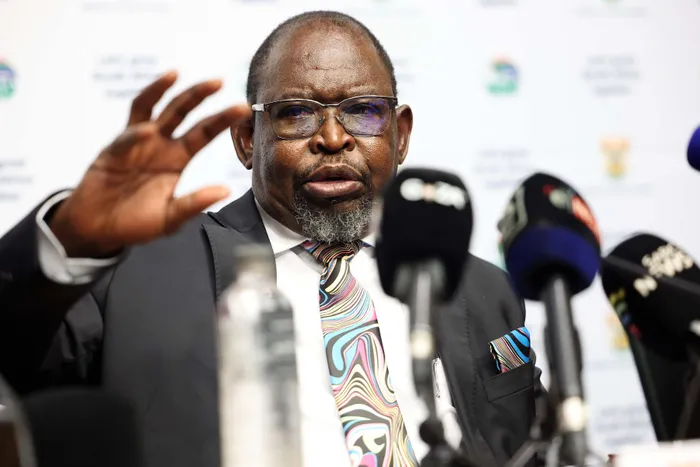
Finance MInister Enoch Godongwana recently warned the City of Johannesburg that it is facing a deepening financial crisis. National Treasury has since withheld July 2026 municipal transfers temporarily to over 60 local government structures, including Johannesburg, for failing to timeously remedy its financial problems.
Image: GCIS
National Treasury’s announcement to temporarily withhold July 2026 equitable share transfers to 69 municipalities has also again exposed the massive financial mismanagement taking place at many of South Africa’s municipalities.
On Tuesday, National Treasury said its decision to withhold the fund transfers followed "persistent and serious non-compliance" with the Municipal Finance Management Act (MFMA) and its supporting regulations, despite support provided by the National Treasury through guidance, engagement and communication.
Six municipal governments in the Eastern Cape are affected, including Buffalo City, Nelson Mandela Bay, and Makana; 16 in the Free State, including Mangaung; 6 in Gauteng, including the City of Johannesburg; 7 in KwaZulu-Natal; 8 in Limpopo; 11 in the Northern Cape; 13 in North West; and 3 in the Western Cape.
National Treasury said that since 2021-22, municipalities have incurred R24.12 billion in fruitless and wasteful expenditure; irregular expenditure amounted to R145.21bn, with R40.14bn incurred by municipalities in the 2024-25 financial year alone.
Since 2021-22, municipalities had disclosed R118.13bn in unauthorised expenditure, R63.43bn of which was on non-cash budget items; while in 2024-25, 116 municipalities (45 per cent) adopted unfunded budgets (a spending plan without the revenue to fund it) – up from 113 (44 per cent) in the previous year’s adjusted budget.
By the 2024-25 year-end, municipalities owed R3.40bn in interest to Eskom and R1.21bn interest to water boards; and a total of 48 municipalities (20 per cent) had third-party deductions that were overdue for more than one month.
“National Treasury has found that many municipalities have not processed unidentified, irregular, fruitless, and wasteful expenditure (UIFWE) cases through their municipal public accounts committees (MPACs), which are responsible for overseeing accountability in some municipalities.”
“Some of the affected municipalities have also failed to show that consequence management is being implemented, including on a timely basis. This includes referrals to disciplinary boards, investigations, disciplinary actions, recovery steps, and criminal referrals where required,” National Treasury said.
National Treasury said non-compliance with the financial legislation is not only a dereliction of fiduciary duties by the political and administrative leadership of municipalities, but it is also threatening the financial sustainability of bulk suppliers such as water boards and Eskom. In addition, failure to pay third parties negatively impacts the ability of statutory bodies to continue operating optimally.
It said consistently incurring UIFWE is also indicative of weak governance and, in instances where it is accompanied by financial losses, negatively impacts service delivery. Non-payment of service providers results in fruitless and wasteful expenditure due to interest and penalties charged and service delivery disruptions.
National Treasury said transfers will resume once the affected municipalities meet the required conditions and submit proper proof of the conditions being met. It anticipates that the transfers will be withheld for a short period so that service delivery will not be impacted.
“The municipalities have been given sufficient notice in writing and urged to take measures to change their financial management positions ahead of the withholding of funds,” National Treasury said.
Professor Joseph Sekhampu, chief director of the NWU Business School, said the challenge in South Africa is that many municipalities have very limited revenue from their own sources and remain heavily dependent on transfers from the national fiscus.
"Where local economic activity has declined, the municipality's capacity to raise revenue, attract skilled officials, and maintain institutional capability also weakens. In such circumstances, financial mismanagement is often both a governance problem and a symptom of deeper structural constraints<," said Prof Sekhampu.
The National Treasury and the provincial governments already provide significant technical and financial support to municipalities, and that assistance can improve financial reporting, compliance, and governance.
"However, it cannot create a local economy or broaden the tax base. Better financial management is essential, but it cannot by itself make a structurally weak municipality financially sustainable," he said.
The Auditor-General's 2024-25 consolidated report on local government found that not a single metropolitan municipality achieved a clean audit. Five metros carry qualified audit opinions, up from only two at the start of the sixth administration.
Water losses across the eight metropolitan municipalities totalled nearly R10bn, electricity losses exceeded R17bn, and the average creditor payment period reached 121 days.
Prof Sekhampu said the dominant explanation for the failure of local government in South Africa—there are 257 municipalities—has long been that many municipalities are too small, too poor, and too administratively fragile to function effectively.
“However, the metro findings point to a different governance challenge. Metropolitan municipalities are constrained not primarily by a lack of resources. Together, they manage R336bn, some 54% of local government expenditure, and serve nearly 25 million people. They possess the institutional and financial capacity expected of large urban governments, yet continue to experience serious governance failures,” said Prof Sekhampu.
Visit:www.businessreport.co.za