

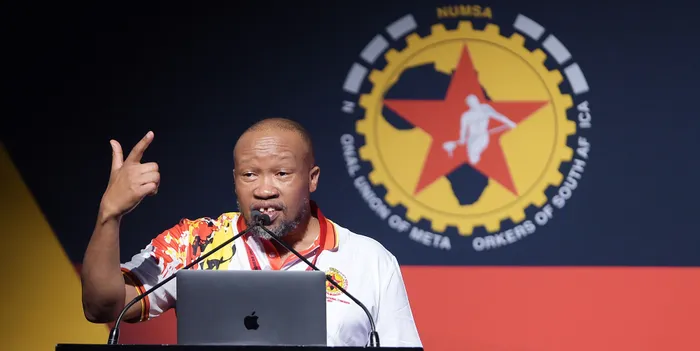
NUMSA general secretary Irvin Jim claims the 165 planned retrenchments at Metair subsidiary First Battery is due to poor management decisions and could have been avoided.
Image: Phando Jikelo/African News Agency (ANA)
Metair subsidiary First Battery’s plans to retrench 165 workers are due to its management failing to position the company to meet the evolving specifications of the automotive industry, the National Union of Metalworkers of South Africa (Numsa) claimed on Monday.
First Battery said it has received notice from Numsa of its intention to commence protected strike action, due to proposed retrenchments currently being implemented following an extensive consultation process.
:The decision to proceed with workforce reductions was not taken lightly and followed an extensive consultation process lasting several months. Throughout this process, the company engaged with employee representatives in an effort to identify viable alternatives and minimise the impact on employees," the company said in response to Business Report questions.
The retrenchments are being implemented to ensure the long-term sustainability of the operation. "The company has contingency plans in place to manage the operations during the strike," the company said.
Numsa general secretary Irwin Jim alleged that First Battery had adopted strategies that were contrary to Masterplan Vision 2035, which encourages companies to drive localisation with a target of 60% localisation by 2035, by dumping imported batteries in South Africa and supplying imported batteries to BMW.
“These job losses could have been avoided. They are the direct consequence of poor decisions by a management team that completely lacks the vision required to position its business strategy within the automotive industry,” said Jim.
During the Section 189 consultation process, Numsa put forward alternatives. As required by the Labour Relations Act, an employer must disclose relevant information to enable the union to advance informed alternatives. “Instead, senior management rejected Numsa’s alternatives without even considering them,” said Jim.
“Consequently, after First Battery management issued termination letters, Numsa was left with no choice but to issue a 48-hour notice for a legally protected, indefinite strike, which will commence on July 6, 2026,” he said.
For instance, Numsa demanded and placed for consideration to the company the following alternatives to avoid forced retrenchments: dealing with the dumping of batteries that are eroding the market share of First Battery, by way of import tariff protection measures, cost-cutting measures, reducing scrap costs that were bleeding the company’s balance sheets, and improving process management and maintenance.
He said a company whose cash flow had consistently improved refused to give workers, who will likely never have a job again, a decent Voluntary Severance Package (VSP) of R200,000.
“Settling at these higher thresholds is standard practice across various stable companies we negotiate with. Yet they have the audacity to tell us that these workers deserve R10,000. We rejected the lie that the company is bankrupt, as the figures do not correspond,” said Jim.
“Management must return to the negotiating table instead of showing the union the middle finger,” said Jim.
“Every single South African must understand that every imported battery represents production stolen from a South African factory—production that could have supported local jobs, put food on the table for local families, developed our industrial capabilities, and driven economic growth,” said Jim.
Visit:www.businessreport.co.za