

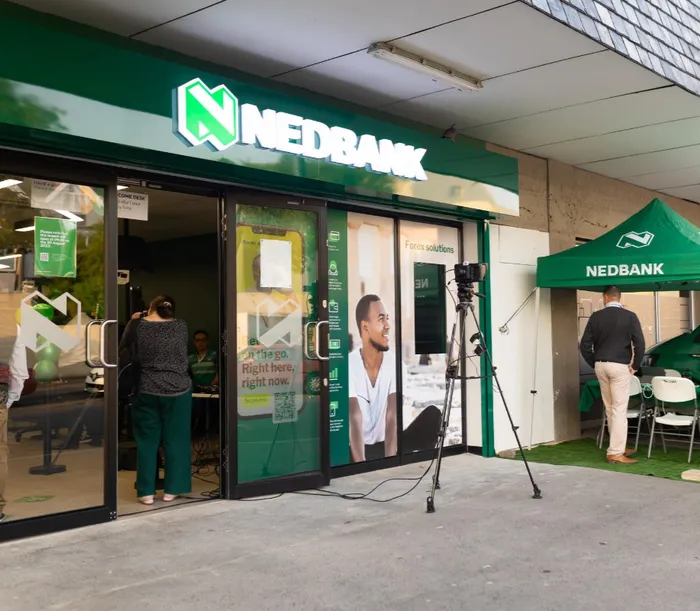
Nedbank Group says domestic demand contracted through the 5 months to the end of May 2026, hurt by inventory rundowns, a relapse in fixed investment and a “marked” slowdown in consumer spending.
Image: Nedbank/Facebook
Nedbank Group earnings guidance for 2026 remains on track even though geopolitical tensions and trade disruptions have weighed on confidence and investment through the first five months of the year.
The bank said in an update Wednesday that the operating environment in South Africa was mixed in the 5 months - GDP growth surprised on the upside in the first quarter, expanding 0.5% quarter on quarter, but domestic demand contracted through the period due to inventory rundowns, a relapse in fixed investment and a “marked” slowdown in consumer spending.
The bank now expects 2026 GDP to grow by 1.3%, revised down from the 1.5% forecasted by the bank in February. Inflation would likely rise to around 4.6% in June, before easing to about 3.2% by year-end, as global oil prices have reduced in recent weeks after the US and Iran reached an agreement to end hostilities and reopen the Strait of Hormuz.
Industry-wide credit extension strengthened modestly, with private sector credit growth rising to around 9% year-on-year in April 2026. Corporate credit growth accelerated into double digits, driven by increased activity in general loans, although demand was sensitive to weak business confidence and subdued fixed investment.
Household credit growth has improved gradually but remains relatively weak below 5%, reflecting ongoing affordability constraints. Credit growth across both corporates and households is expected to remain positive in the second half, albeit at more moderate levels, as heightened uncertainty and cautious borrowing behaviour persists.
The bank said headline earnings (HE) for the 5 months was broadly in line with management expectations at the beginning of the year. Diluted headline earnings per share (DIPS) growth for 2026 was expected to remain slightly ahead of HE growth given the impact of the share buybacks concluded in 2025.
The 5-month performance reflected improving net interest income (NII) growth, strong non-interest revenue (NIR) growth and expenses that were well managed, resulting in pre-provisioning operating profit (PPOP) growth.
Excluding associate income, PPOP growth was in the upper single digits. This growth was offset by a higher impairment charge and no further recognition of associate income from Ecobank Transnational Incorporated (ETI) post the sale of the bank’s investment in 2025. Excluding ETI, headline earnings growth was upper single digits.
Corporate and Investment Banking (CIB) had a good performance, supported by healthy balance-sheet growth as strong growth in Investment Banking was partially offset by slow growth in Property Finance, a low impairment charge, strong fee and commission growth, and a solid trading performance.
Business and Commercial Banking's (BCB) performance was negatively impacted by a once-off single client impairment which masked good underlying core business fundamentals, evidenced in better loan growth and double-digit NIR growth, supported by increased transactional client activity.
Earnings in Personal and Private Banking (PPB) were impacted by lower endowment income and higher impairments, offsetting strong momentum in insurance, fee and commission income, and secured lending, while expenses were tightly controlled.
NII (net interest income) growth of low to mid-single digits was driven by average interest-earning banking asset growth of mid-to-upper single digits, offset by a lower net interest margin (NIM), driven primarily by the impact of interest rate cuts in 2025 on endowment income.
At the end of May 2026, the group's impairment charge and annualised credit loss ratio (CLR), which is cyclically higher at the start of the year, increased period on period, with the CLR moving into the upper half of the bank's through-the-cycle (TTC) target range of 60 bps to 100 bps.
NIR (non-interest revenue) growth was at upper-single digits, driven by double-digit growth in insurance income, a solid trading performance, and good growth in commission and fees that was underpinned by strong growth in CIB and BCB, as well as continued growth in maintenance fees, driven by client gains, and fees from value-added services in PPB.
NIR growth was expected to remain around upper-single digits for the year. Expense growth was well managed at below mid-single digits in the 5 months, benefiting from below mid-single digit growth across salaries and wages, computer processing, communication and travel, and accommodation costs.
BUSINESS REPORT