

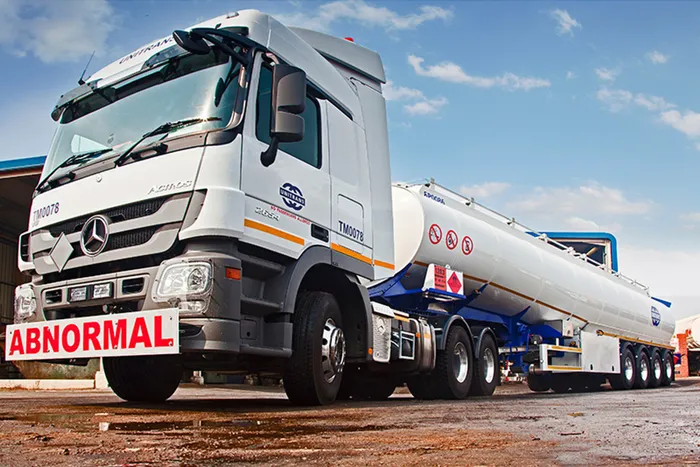
A truck frm KAP's transport business Unitrans. Unitrans' operating profit increased meaningfully in the 11 months toe end May 2026, primarily due to cost savings, improved operational efficiencies and higher fleet utilisation, which offset a lower contribution from the passenger operations.
Image: Supplied
KAP, the diversified industrial group, expects to increase headline earnings by more than 50% to at least 36,2 cents a share for the year ending June 2026, in spite of the challenging trading environment.
Headwinds facing the group include subdued consumer demand, global oversupply in certain product categories, competitive pressures, rising trade barriers and geopolitical uncertainty
More recently, the conflict in the Middle East, including the closure of the Strait of Hormuz, has heightened uncertainty, contributed to global supply chain disruptions, increased operational complexity, and led to additional inflationary pressures.
In this context, revenue was stable, and earnings before interest, tax, depreciation, and amortisation (EBITDA), operating profit, and earnings increased during the period.
At subsidiary PG Bison, panel production and sales volumes ramped up, including full utilisation of PG Bison's new medium-density fibreboard (MDF) line, which was commissioned during the year ending June 30, 2024.
There were increased domestic new vehicle assembly volumes, which supported an improved performance by automotive component manufacturer Feltex. Additionally, there was an improvement in underperforming businesses, primarily Unitrans. The group also benefited from lower net finance costs.
The prior period's performance was negatively affected by increased operating costs related to the ramp-up of PG Bison's new MDF line, as well as lower domestic new vehicle assembly volumes.
“The outlook for the operating environment is uncertain, with limited near-term visibility due to recent geopolitical developments,” the group directors said.
Safripol, strategically positioned as a local manufacturer, benefited from increased sales volumes and higher global polymer prices arising from the conflict in the Middle East. However, the sustainability of these gains was unclear, considering the uncertainty around the duration of the conflict, the timeframe over which supply chains will normalise, and the potential for second-order effects, such as softer demand.
“Management remains focused on factors within their control, including operational efficiencies, cost savings, and increased value-added sales volumes, while continuing to execute on the group's three key strategic objectives: realising value from the major capital projects, improving underperforming businesses, and reducing net debt.”
PG Bison’s higher sales volumes were primarily driven by demand creation and customer-enablement activities, the development of new markets specifically for MDF, and underlying demand growth enabled by increased production volumes.
The division also made progress in redirecting sales from marginal deep-sea export markets to higher-margin markets. The division's prior-period performance was constrained by the ramp-up of the new MDF line.
Revenue and operating profit for the 11 months were “meaningfully higher” compared with the prior period.
At Safripol, supply disruptions arising from the conflict in the Middle East resulted in reduced import competition and significantly higher raw material and polymer prices towards the end of the period.
Although reported revenue and operating profit for the first half of the year were lower than in the year before, these factors limited the revenue decline to moderate levels and operating profit rose marginally for the 11-month period.
Unitrans' revenue was moderately lower, mostly owing to the passenger operations, which closed commuter operations in Mozambique and disposed of a local commuter contract in the 2025 year. Operating profit increased meaningfully, primarily due to cost savings, improved operational efficiencies, and higher fleet utilisation, offsetting a lower contribution from passenger operations.
Feltex benefited from increased domestic new vehicle assembly volumes, as well as improved sports utility vehicle and light commercial vehicle sales, predominantly in the first half.
In the prior period, sales volumes were affected by temporary operational constraints at two original equipment manufacturers, while the division also incurred costs related to a major model changeover. These factors had been resolved. Revenue and operating profit were meaningfully higher, despite a softening in the second half.
Sleep Group operated in challenging trading conditions, primarily due to subdued consumer demand. Revenue increased marginally. Operating profit declined moderately as a stronger performance in the division's raw material operations, particularly the turnaround in its foam operations, was offset by a weaker result from the bedding operations.
BUSINESS REPORT