

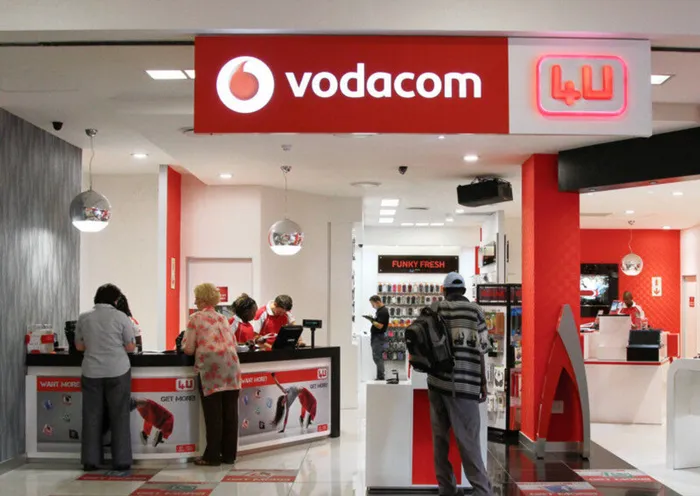
Vodacom upgraded its 2030 ambition for financial services customers to 130 million, from 120 million at the end of its 2026 financial year. The transaction value processed reached $525.6bn through the year, up 16.6%.
Image: Supplied
Vodacom Group invested a massive R23.6 billion across the group in its 2026 financial year, an increase of 16.5% over the previous year, to increase its mobile network resilience, maximise spectrum value, broaden its services and modernise its IT platforms.
CEO Shameel Joosub said in the annual report released Friday that investing in innovation is crucial to its strategy of diversifying revenue streams and expanding beyond mobile services.
In Egypt, spectrum was acquired, “augmenting Egypt’s leading spectrum position, which will support us in capturing the significant latent data demand in the country.”
This added to spectrum acquisitions in Mozambique, DRC and Tanzania over recent years, while substantially improving the group’s customer experience through network modernisation in Tanzania.
The operation in Ethiopia - the group first entered the market in 2022 - had grown by 54.2% to 13.6 million customers in the past year, and the business continued to see progress towards EBITDA (earnings before interest tax depreciation and amortisation) break-even in the 2027 financial year, while targeting a medium-term customer base of 15 to 20 million.
“These examples demonstrate that purpose-driven expansion delivers both social impact and commercial returns,” said Joosub.
He said the acquisition of a strategic stake in fibre business Maziv was transformative for South Africa.
“Following final Independent Communications Authority of South Africa approval in November 2025, we can now leverage our combined strengths to accelerate fibre-to-home and fibre-to-site across the country, providing high-speed connectivity to millions who have long awaited reliable fixed access,” he said.
In Kenya, fibre was being extended to low-cost government housing developments, ensuring that affordable housing includes digital connectivity from the outset.
“These two milestone transactions materially enhance the group beyond mobile positioning. The group fibre footprint now extends to 3.6 million homes passed, strengthening our connectivity leadership and long-term growth potential,” he said.
Partnerships with satellite providers complement Vodacom’s existing network. “Satellite fills gaps in mobile and fixed networks, providing coverage in sparsely populated areas where traditional infrastructure is not economically viable,” he said.
“Satellite also enables us to build more rural mobile sites by providing backhaul connectivity where fibre does not exist. This combination of technologies – mobile, fixed and satellite – ensures we can connect people everywhere, fulfilling our purpose while expanding our addressable market,” said Joosub.
Another core pillar of growth in the group is financial services, with financial services customers increasing by 17.4% to 103 million, including Safaricom, contributing 23.1% to service revenue on a normalised basis.
Group mobile money platforms processed $525.6bn in transaction value in the 2026 financial year.
“Our upgraded target of 130 million financial services customers reflects our confidence in achieving growth while advancing financial inclusion. Key to our ecosystem are our super-apps – VodaPay, Vodafone Cash and M-Pesa – which provide a unified platform that integrates our products and partner offerings and processes $16.438bn in daily mobile money transactions.
M-Pesa revenue grew 16%, driven by double-digit growth across all markets, while the customer base increased 9% to 73 million.
“From consumers to businesses, payments, savings, e-Commerce, microloans to enterprise financing, these solutions enable economic activity across all segments of society. Reflecting the strength of its impact and the scale of opportunity, we have upgraded our Vision 2030 ambition for financial services customers to 130 million, from 120 million previously.”
“Advancements in technology improve operational effectiveness and output, while broadening the availability of high-quality resources across sectors,” said Joosub.
For example, the group health platforms were digitizing healthcare delivery at scale. Government clinics in South Africa run on Vodacom’s technology, as does the national blood bank. The group manages the National Health Insurance platforms in Egypt and Kenya, and its systems enable vaccine distribution for malaria and other diseases across multiple countries.
“M-mama, a government-led emergency transport system for maternal and neonatal emergencies, has saved more than 9,000 lives in Tanzania and Lesotho,” he said.
The group also delivers digital agriculture solutions to enhance input distribution, improve access to insurance and financing, create new market opportunities and facilitate payments and subsidies for farmers. “We serve 9.9 million beneficiaries in the agricultural sector through our platforms, including eVuna, MYFARMWEB, e-Vouchering solutions, M-Kulima and Moloni,” said Joosub.
“Our investments in emerging technologies are transforming network performance and planning and optimising network build, site selection and customer experience outcomes,” said Joosub.
BUSINESS REPORT