

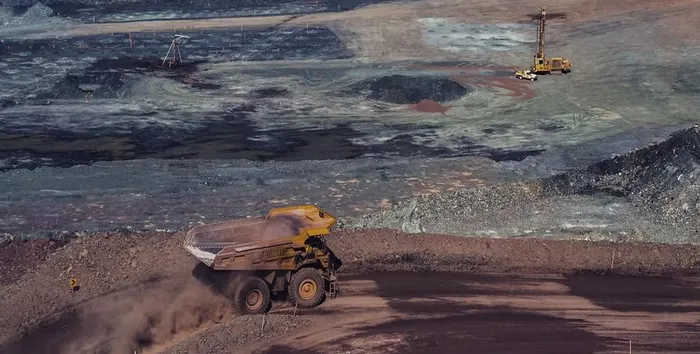
Located in central Zambia, the historic Kabwe Mine was among the world’s richest zinc and lead producers, operating from 1904 to 1994.
Image: Supplied
Shuka Minerals, the London, JSE and AltX-listed Africa-focused mining company, said Wednesday it has completed a third drill hole at the No. 2 ore body at the Kabwe Zinc Mine project in Zambia, which had shown good results.
"The follow-up holes of our campaign continue to deliver excellent (Zinc) grades, with every hole and intersection we are learning more and more about the orebody," Shuka’s CEO Richard Lloyd said in a notice to the JSE.
"It is also encouraging to continue to see much higher grades and over significant widths versus the previously reported NI 43-101 resource. The upcoming drill holes will look to prove the ore body extending laterally and at depth."
He said the third diamond drill hole (KBDD03) was planned at 65 degrees at a bearing of 125 degrees and was designed to intersect the ore body 30 metres to the east of the KBDD01 intersection at a depth of approximately 250m.
The company has also started a fourth hole to intersect the orebody in the western area of the extended ore body.
Readings from a downhole gyroscope survey revealed the hole was 240m deep, with a final azimuth of 123,66 degrees and a dip of 65,49 degrees. All of these survey readings are vital to accurately map the trajectory of the hole and therefore the mineralised zones in a 3D model.
KBDD03 returned 29.58% zinc over 19m from 221,10m to 240,10m (downhole), based on an arithmetic average of 62 individual portable XRF readings at 3 readings per metre of whole core.
Individual readings over the entire interval ranged from 1% – 53% zinc, with better point grades averaging 40,09% zinc in the uppermost 9m of the orebody.
As previously announced, the Behre Dolbear 2023 NI 43-101 report indicates the No. 2 ore body has 3,1MT of ore remaining at grades of 11.4% zinc and 1.7% lead plus silver and vanadium oxide.
Mineralisation is typically associated with a weakly brecciated to semi-massive haematitic ironstone mixed with mostly zinc silicate (probably willemite) and lesser zinc carbonate minerals.
The footwall comprises moderately jointed and fractured massive dolomite with hematite stringers and fracture coatings that are believed to be the main hosts to zinc mineralisation.
The assays were taken with a calibrated XRF machine and would be verified in due course with JORC/NI 43-101 laboratory analysis and testing.
Lloyd said this intersection aligns with the company's objectives for its 2026 exploration program aiming to increase the existing resource by 50%, subject to the results of the drilling program.
Lloyd is overseeing the initial (2,000m) phase of drilling. Drilling is being undertaken by Ox Drilling, a contractor with 21 years of established operating experience in Zambia.
BUSINESS REPORT