

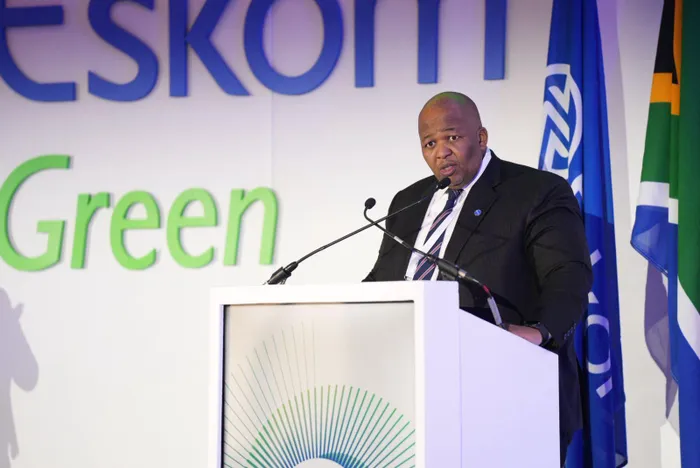
Eskom Group CEO Dan Marokane said the announcement is not simply about carbon content compliance but delivering leading-edge solutions at scale to enable Eskom customers in implementing their decarbonisation strategies.
Image: Supplied
Eskom has launched a dedicated renewable energy business, Eskom Green, in a major strategic shift aimed at accelerating utility-scale renewable energy development, supporting industrial decarbonisation and expanding South Africa’s clean energy supply.
Announced on Tuesday, Eskom Green will initially operate within Eskom Holdings before being separated into a wholly owned subsidiary with its own board, subject to regulatory, governance and shareholder approvals.
The new business is designed to fast-track renewable energy projects and provide large electricity users, particularly in the mining and manufacturing sectors, with tailored solutions to reduce carbon emissions while maintaining competitiveness in export markets.
“Eskom Green is a utility-scale renewable energy business that rapidly accelerates the options available to South Africa’s industries to decarbonise and transition industrial and productive capacity to maintain export competitiveness,” said Eskom Renewables Group Executive, Rivoningo Mnisi.
“The business is set to increase the supply of renewable energy to enable customers to lower their carbon footprint in their energy consumption.”
The launch marks Eskom’s formal entry into the utility-scale renewable energy market at a time when industries face mounting pressure to meet environmental, social and governance requirements and carbon border regulations in international markets.
Eskom Group CEO Dan Marokane said the initiative goes beyond regulatory compliance and is focused on providing large-scale energy solutions for customers pursuing their own energy transition goals.
Marokane said the announcement is not simply about carbon content compliance but delivering leading-edge solutions at scale to enable Eskom customers in implementing their decarbonisation strategies.
“This new entity is built on decades of power generation skills and expertise the nation has invested in, and Eskom Green reflects successful adaptation to new technologies within Eskom,” Marokane said.
“We have been playing in this space for some time, and we are now putting a stake in the ground – this is a development that South Africa can be proud of.”
Eskom Green has been developed following benchmarking research involving more than 20 international utilities.
Eskom said the findings highlighted the need for more agile decision-making, diversified funding models and partnership-based project delivery structures than those traditionally used in the utility’s vertically integrated generation business.
The company plans to offer renewable energy supply agreements directly to large customers through power purchase agreements and projects supported by Section 34 allocations under South Africa’s energy framework.
Under the model, Eskom Green will act as the customer’s primary renewable energy supplier, combining its own generation assets with storage and firming technologies to provide round-the-clock electricity where required.
Pricing will be structured transparently, with customers paying separately for energy generation and regulated network charges such as wheeling and transmission fees.
The utility said the first phase of the business will focus on large industrial customers, while a second phase will expand services to municipalities, the Eskom Distribution market, the developing South African Wholesale Electricity Market and regional customers through the Southern African Power Pool.
A central component of the strategy is Eskom’s renewable energy pipeline. The utility expects Eskom Green to have approximately 6GW of carbon-free electricity available by 2030 through projects already under development.
Eskom said that a total of 17 priority projects have been identified across its coal-fired power station sites, leveraging existing infrastructure to accelerate deployment and reduce costs. Among the first projects is the 75MW Lethabo Solar PV facility in the Free State, with additional developments planned at Komati Power Station.
The utility expects at least 2GW of renewable energy and pumped-storage projects to move into implementation from 2026.
Looking further ahead, Eskom Green plans to develop up to 32GW of renewable energy and storage capacity by 2040. These projects will largely be funded through dedicated special-purpose vehicles and public-private partnerships, limiting pressure on Eskom’s balance sheet while attracting private and concessional capital.
Eskom said the initiative aligns with the Integrated Resource Plan (IRP) 2025, which targets 5.6GW of renewable energy capacity by 2030, 21GW by 2035 and 32GW by 2040.
The utility believes Eskom Green will play a critical role in helping South Africa close its renewable energy gap, improve energy security and meet emissions-reduction commitments while supporting economic growth and industrial competitiveness.
BUSINESS REPORT